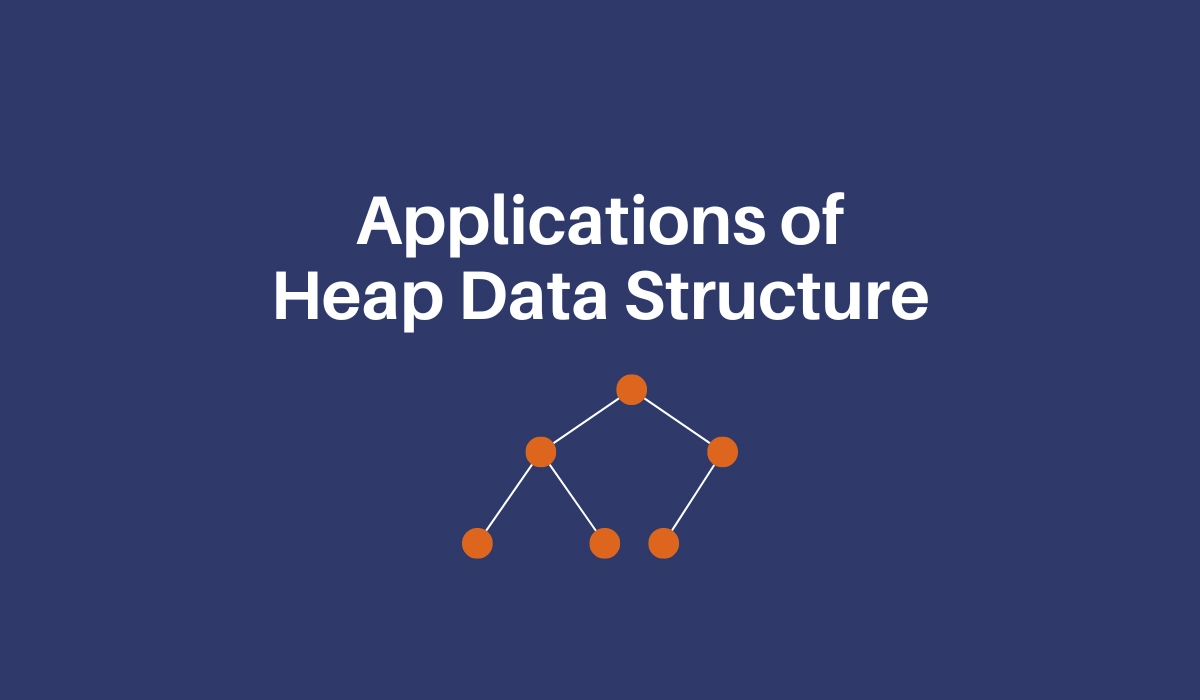
What is a Heap Data Structure?
At its core, a heap is a special type of binary tree that satisfies the heap property. But what does that mean?
Imagine a tree-like structure where each node has at most two children — that’s a binary tree. Now, in a heap, every parent node follows a rule:
- In a max heap, each parent node is greater than or equal to its children.
- In a min heap, each parent node is less than or equal to its children.
This makes heaps perfect for efficiently accessing the largest or smallest element — depending on the type.
To make it even more practical, heaps are usually implemented as arrays, not linked structures. That’s because there's a simple formula to locate parents and children:
- For a node at index i:
- Left child: 2*i + 1
- Right child: 2*i + 2
- Parent: (i - 1)/2
This array-based approach makes heap operations fast and memory-efficient.
Types of Heap
Let’s break down the two primary types of heaps.
1. Max Heap
In a max heap, the largest element is always at the root. This property ensures that you can quickly access the maximum value in constant time — O(1).
Structure Example:
markdown
Copy Code
CopyEdit

       90

       /  \

     15    10

    / \   /

   7  12  2
Here, 90 is the maximum and sits at the top.
2. Min Heap
In a min heap, the smallest element is at the root. Just like the max heap, it supports quick access — but this time, to the minimum value.
Structure Example:
markdown
Copy Code
CopyEdit

       2

       /  \

     10    15

    / \    /

   12  90  20
Notice how 2 is the smallest and holds the root position.
There are other heap variations like Fibonacci Heaps, Binomial Heaps, and Pairing Heaps, but for most practical applications, min and max heaps are more than enough.
Core Heap Operations
Heaps revolve around a few key operations, and understanding them is crucial:
1. Insertion
When a new element is added:
- It is placed at the end (in the array representation).
- Then, it is "heapified" — moved up until the heap property is restored.
Time Complexity: O(log n)
2. Deletion
Typically, we delete the root (maximum or minimum).
- The last element replaces the root.
- Then we "heapify down" — pushing the element down to its correct position.
Time Complexity: O(log n)
3. Heapify
This is the process of turning a binary tree into a valid heap. It's called recursively to adjust the tree when inserting or deleting elements.
Time Complexity: O(log n)
4. Build Heap
When creating a heap from an unsorted array, we use the buildHeap() function.
Time Complexity: O(n)
Applications of Heap Data Structure
Heaps may seem abstract, but they have real-world applications in everything from everyday tech to complex systems. Here are some places where heaps shine:
1. Priority Queues
Heaps form the backbone of priority queues, where tasks are processed based on importance (not arrival time). Imagine an operating system managing multiple background processes. Some tasks, like battery monitoring, might need higher priority. A min or max heap helps maintain and update this order efficiently.
2. Heap Sort
Heap sort is a comparison-based sorting technique based on a binary heap. It:
- Builds a heap from the array
- Repeatedly removes the root
- Reconstructs the heap until it's sorted
Though not as commonly used as quicksort, it's in-place and has a time complexity of O(n log n).
3. Finding K Largest or Smallest Elements
Need to find the k largest numbers in a huge dataset? A min heap of size k can help:
- Traverse the array
- Maintain the heap with top k elements
- The root of the heap will give you the kth largest
It’s especially useful in competitive programming and data processing tasks.
4. Graph Algorithms
Heaps are a critical part of algorithms like:
- Dijkstra’s Algorithm (for shortest paths)
- Prim’s Algorithm (for minimum spanning trees)
In these, a priority queue (heap) helps pick the next best node or edge to explore.
5. Median in Streaming Data
Imagine a system like Google Analytics that receives traffic data every second. To calculate the median dynamically, heaps can be used:
- A max heap for the lower half
- A min heap for the upper half
Balancing these lets you fetch the median in real-time.
6. Load Balancing and Scheduling
In web servers or cloud computing environments, heaps help distribute workloads. By organizing servers in a min heap based on current load, the lightest-loaded server can be selected quickly.
7. AI and Machine Learning
Some decision-making algorithms, especially those involving best-first search or *A (A-star)**, use heaps to prioritize paths based on their potential cost.
Advantages of Heap
- Fast access to min or max: You always know the root is the value you're looking for.
- Efficient insertion and deletion: O(log n) time for updating structure.
- Memory efficiency: Simple array-based storage without needing extra pointers.
Limitations of Heap
- No direct access to elements: Unlike arrays or hash maps, you can't access elements in the middle efficiently.
- Not suitable for complete sorting needs: While heaps are great for some sorting tasks, quicksort and mergesort generally perform better in practice.
- Balancing required: You have to ensure the heap property is maintained after every insert or delete.
Real-World Analogy
Think of a heap like a to-do list where you always want to deal with the most urgent or important task first. The highest-priority item always rises to the top, and new tasks are added in a way that doesn't disrupt the flow.
That’s exactly how a heap data structure behaves — ensuring priorities are always respected.
Implementing Heap in Code (C++ Example)
Here's a basic illustration of a min heap using C++'s STL:
This example uses std::priority_queue as a min heap and processes the smallest element first.
Copy Code
cpp

CopyEdit

#include <iostream>

#include <queue>

int main() {

    std::priority_queue<int, std::vector<int>, std::greater<int>> minHeap;

    minHeap.push(10);

    minHeap.push(4);

    minHeap.push(15);

    minHeap.push(7);

    while (!minHeap.empty()) {

        std::cout << minHeap.top() << " ";

        minHeap.pop();

    }

    return 0;

}

Output: 4 7 10 15
Why Should You Learn Heap?
Whether you're a developer, data scientist, or student, heaps give you an edge in:
- Solving complex problems efficiently
- Writing optimal code for large data sets
- Cracking competitive coding or technical interviews
Many questions in coding tests or interviews revolve around heaps, especially in companies like Google, Amazon, and Microsoft.
Want to Master Heap and Other Data Structures?
To dive deeper into heaps, tree-based structures, and real-world algorithmic challenges, check out the Data Structures and Algorithms Course by Uncodemy. It’s designed to help students and professionals master concepts with practical examples, coding assignments, and real-world projects.
🔗 Explore Uncodemy’s DSA Course
Whether you're preparing for your next big tech interview or building your own product, Uncodemy’s expert-curated content will help you learn not just how heaps work — but why they matter.
Final Thoughts
The heap data structure is more than just another item on the data structure syllabus. It's a smart, powerful, and practical tool used in everything from search engines and operating systems to AI and analytics. Whether you’re implementing efficient sorting, managing priorities, or optimizing memory usage — heaps are there, quietly doing the heavy lifting.
So the next time you’re coding or prepping for an interview, don’t overlook the humble heap. Master it, and you’ll be one step closer to writing faster, smarter, and cleaner code.
Heap Data Structure: Definition and Applications
When it comes to organizing data efficiently, especially for operations like sorting or managing priority tasks, the heap data structure steps in as a true champion. Known for its elegant design and performance benefits, heaps have quietly powered many systems you rely on daily — from search engines to real-time task scheduling.
In this article, we’ll walk you through what a heap is, how it works, and where it’s used in the real world. If you’re a computer science student, preparing for coding interviews, or just exploring data structures, this deep dive is for you.