It is not only technological but rather a more fundamental shift in the state of human affairs, where the prospect of saving lives is palpable, alleviating human suffering, and enabling people to receive healthcare and dealing with the disease more quickly. With every electronic medical records, every wearable fitness tracker, the incredible world of information about health, there is a once-in-a-lifetime opportunity to learn about patient needs in a way that would have been impossible in prior decades. Data science as a field closes that gap between numeric data and practical decisions that can improve the quality and scope of healthcare delivery by being able to make sense of the information at hand.
The message of the complexity of the human body, with its own genetic makeup and lifestyle considerations, as well as environmental factors, is at the core of healthcare. Historically, physicians placed greater emphasis on their training, following gut intuitions and their experience, as only a small amount of test results were available. Although this was effective, it usually had risks of misdiagnosis, delays, or a one-size-fits-all treatment plan. Precision medicine would have been impossible without data science, which has revolutionised this space. Complex algorithms are capable of assessing the genetic makeup of a given patient, their medical history, and additional background variables in order to provide treatment solutions that address individual needs. To illustrate, the procedures of treating cancer can now be optimised based on the analysis of genetic mutations, because of which, oncologists will now know which drug is most likely to work on a particular patient. This degree of individualisation greatly increases effectiveness with a lesser side effect. It also enables healthcare systems to distribute resources more effectively without having to resort to trial and error in terms of care.
Predictive analytics is another significant way in which data science is improving healthcare outcomes. Healthcare is not just a reaction to sicknesses but the prediction of illnesses as well. The predictive models are based on past information and trends to predict health risks in the future before they escalate. To give an example, patients with chronic conditions such as diabetes, hypertension, or heart disease can be monitored more closely by the models that can reveal early warning symptoms of a decline. Predictive analytics allow hospitals to estimate probabilities of readmission, plan proactive care and follow-ups, decreasing the burden to the patient and the healthcare infrastructure. The importance of using predictive models became evident with the COVID-19 pandemic, as it allowed the forecasting of infection waves and motivated governments and hospitals to pre-stock ventilators, ICU beds, and protective equipment. Such foreknowledge and readiness are a game-changer in enhancing healthcare outcomes since they will save time and lives.
Medical imaging has also undergone an evolution with data science. The words radiology, pathology and the like almost always have the implication of looking at pictures, e.g., X-rays, CT scans, and MRIs. This in the past took a lot of time and would require so much expertise and human error was never an exception. Machine learning algorithms today can be taught thousands of medical images and have become remarkably accurate at detecting anomalies such as tumours, fractures, or infections. Along with providing radiologists with a second pair of eyes, these tools can considerably minimise the time that is involved in the diagnostic process. To the patients, this means faster results, prevention of pain and predications and increased chances of recovery. Machines powered by AI increase the delivery of lifesaving knowledge in areas where it would otherwise not be present, in some rural or less-resourced areas where specialists are not available. Data science can be used to address the issue of healthcare inequality in that it can make the use of correct diagnostics a democratic process, thus alleviating the suffering areas due to overall proximity to healthcare.
Another sector where data science has made a significant impact on healthcare outcomes relates to drug discovery and development. Conventionally, it would take many years of trials, experiments, and billions of investment before a new drug could be developed with no certainty of success. Machine learning and big data analytics are enabling researchers today to virtually screen potential drug compounds and predict whether they are likely to be effective before needing to take them into costly clinical trials. It not only speeds up the process but also makes the investment of resources a wiser one. Data-driven research and simulations have also led to an all-time breakthrough in developing COVID-19 vaccines, especially with rapidity. This is because data science helps to drive life-saving drugs to the market sooner, ultimately helping patients across the world by reducing timelines and costs.
Healthcare is more than a treatment; it is disease prevention, and data science has significantly changed this field, too. Health wearables such as smartwatches and fitness trackers generate ongoing health data on measures including heart rate, sleep, and activity. With such data, one can follow early signs of upcoming complications and suggest a healthier life to medical professionals. To give an example, a wearable can recognise unusual heartbeat rhythms and thereby heart fibrillation that might ultimately lead to a stroke if one seeks medical assistance in time. At a community level, PHM systems monitor trends and risk factors by pooling health data to find ways of addressing the community health issues; governments and other organisations can then arrange targeted preventive health initiatives based on these data.
Data-driven decision-making on patient care management has also been enhanced. Thousands of patients are handled by hospitals every day, and they have various needs. It is not easy to manage this efficiently. Data science can also be used to streamline the hospital processes, such as bed assignment, surgery scheduling, and resource utilisation, that would optimise resource usage without overworking the staff. Data analytics-driven real-time dashboard helps administrators regulate patient flow and adjust operations. To the patients, this implies a shortened waiting period, enhanced coordination of their care, and an enhanced experience at large. At the Intensive Care Unit, high-tech monitoring technology, supplied with data science, constantly monitors vital signs and gives an alarm to medical professionals at the first sign of trouble. Such a real-time support system enhances survival and patients get care at the right time and the right care.
Naturally, there are no challenges in the integration of data science into healthcare. Patient data security and privacy stand at the forefront. As volumes of sensitive information are being gathered and distributed, it is of crucial importance that such information is not exposed to snooping. There are also ethical concerns concerning the ownership of data and the use to which it must be put. Otherwise, data-driven healthcare may only increase inequalities instead of decreasing them. As an example, algorithms primarily trained on datasets with racial implicit biases might not be equally effective in every human population. The key to actually making a positive contribution to healthcare and improving outcomes is to ensure that data science is used in a transparent, fair, and patient-centred manner. This involves engagement of data scientists, health practitioners, regulators and policymakers to develop systems that are credible and embracive.
It is evident that data science has the potential to transform healthcare, but it remains challenging. Healthcare is being improved by every new achievement connected with predictive analytics, medical imaging, drug discovery, patient monitoring, and personalised medicine, putting another veil of precision and efficiency on the medical system. What this means to patients is earlier diagnosis and more effective treatment, sooner recovery and improved quality of life.
Essentially, the field of data science is not a replacement for a doctor or medical knowledge but actually an augmentation of a doctor or medical knowledge. The best use is when there is a combination of human opinion and empathy with the machine's accuracy and speed. Data science gives the doctor a broader lens to look through, a better perspective of risks, and more decisions about treatment. It is this human-machine interdependence that ultimately leads to improved healthcare. It serves to remind us that technology in healthcare is not an end to itself but a set of means toward healthier lives and more resilient communities.
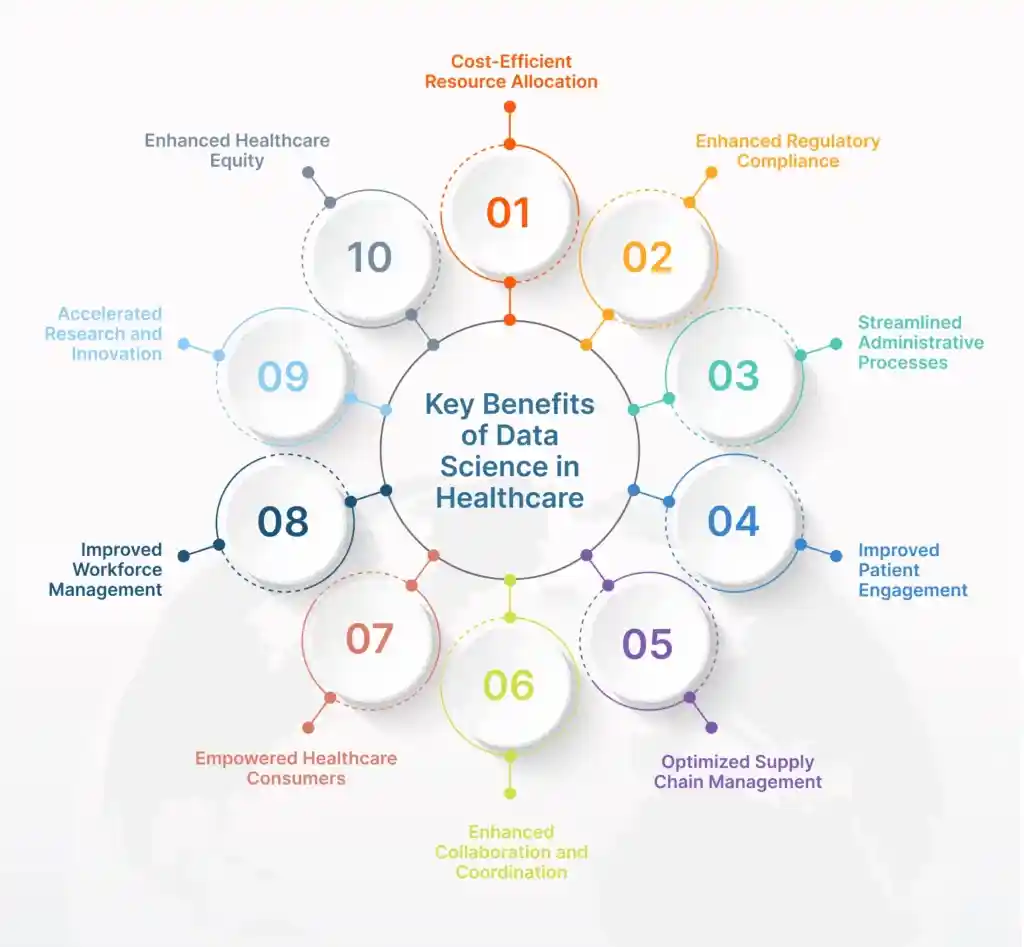
In conclusion, it can be said that data science is a tool that transforms healthcare by presenting insights that could have never been fathomed. Its effects stretch across the spectrum of personalised care and predictive analytics, better diagnostics, accelerated drug discovery, preventive medicine, and equity of access. Although there is still the challenge of privacy and ethics alongside other issues of inclusivity, the impact it has on patients and providers is tremendous. With technological progress, the application of data science to all levels of healthcare will only progress further and become part of the framework of modern medicine. Finally, its only real success is not a technological advancement but its capacity to make healthcare more humane, accessible, and effective.