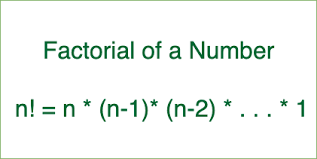
Understanding Factorials
An n! factorial is read as n factorial. To a non-negative integer n is the product of all the positive integers between 1 and n. By way of example 3! is 3 x 2 x 1 = 6.
The values of factors are developed extremely quickly as the number of the input increases; with 6! equaling 720 and 9! equal to 362,880. The factorial itself by definition is 0! = 1 that ends up being a base case of a lot of factorial computations. It is vital that one defines this term before implementing the factorial calculations in programming.
Ways of Computing Factorials
These are some of the methods to compute factorials each having its advantages and shortcomings. Iterative and recursive as well as built-in functions are the most common.
Iterative Method
The loop based iterative method computes factorial by multiplying the numbers in the decreasing sequence till 1. This technique is usually not deemed to be inefficient in terms of memory as it just involves one loop and nothing extra is added to the system with respect to extra calling functions. As an example, in order to find n!, you will initialize the result (answer) variable with 1, and multiply it repeatedly by the successive integers in the range [1, n], using the loop. This shows that it is an economic and simple option when it comes to moderate to high inputs. Time complexity-iterative method is O(n).
The following is an iterative implementation of Java factorial in which the result variable is initialized to 1, and the range is 1 to n where each i is multiplied to the result. As an illustration factorialIterative(5) would compute 5! as 120. The general iterative problem in Python would work in a similar manner by setting the value of fact to 1 and copying the value of fact x n as long as n is larger than 1 decreasing by 1 in each iteration.
Recursive Method
The recursive version literally corresponds to the standard mathematical definition of a factorial, in which!=n×(n−1)!. This style is an implementation of a recursive function in which the function is called by itself recursively until it reaches a base case which is usually through n being zero or one, that is, output is 1. Although being elegant and concise in terms of writing code (and doing the same job in as few lines of code as possible), recursion may be more greedy in terms of memory consumption since additional calls to the function add stack frames. This may cause delays in execution and may result in the error of stack overflow with large numbers. Time Complexity in the recursive method is also O(n).
In Java, a classical example of recursion is demonstrated: factorialRecursive(n) recursively calls itself a variable n decreasing until the value of n equals to 1. In the case of factorialRecursive(7) the result would be 5040. Equally, Python makes use of recursion as a form in which a function invokes itself to derive the factorial.
Built-in Functions
The computation of factorials is often provided built into many programming languages; these are usually the most optimized and efficient way to compute it, particularly on large numbers. As an example, the functionality of the same method within Python is optimized down to the bottom on performance and memory requirements (more than recursion is avoided, and large numbers are handled without a hitch). The approach has minimal code and the faster performance over any custom, iterative or recursive solutions. It however offers less control on the internal implementation and does not lean well to learning the concepts of algorithms.
Dealing with Edge Cases, Performances
Programming factorial Factorial programs Factorial programs The concept of edge cases must be applied when writing factorial programs, and performance must be considered. Factorials are not defined outside the non-negative integers. Hence, when validation is done on programs, the programs must know what to accept and what to reject like negative numbers, decimals or values that are not numeric; error messages must be delivered when the program receives an error input.
Performance tests are very important even more so when dealing with large figures because factorials increase exponentially. Large calculation can be done with arbitrary-precision integers in Python, but it can be slightly slower. Deep recursion may result in stack overflow errors when a large input is provided and therefore one must also consider the choice of implementation methodology relative to the size of input and speed requirements.
Organising a Blog Post on Mathematical Concepts
In preparing an article in a blog regarding a mathematical concept such as factorials, there should be a format and method of structure to make it readable with ease and be interesting. This is whether it is an academic or a casual audience.
Blog On Radio
It is important to develop an effective blog outline, which will help to provide a correct structure of a post and make it interesting. The blog outline generators that exist in artificial intelligence are capable of producing the SEO-friendly outlines in a brief moment as they integrate the main keywords and secondary ones. This will assist in simplifying the method of creating contents and makes certain that the post handles the search interest of the reader.
Development of a good blog outline usually goes through a few steps:
What Will Your Topic and Goal Be: Take the time to define what you will be writing on and what you want your readers to do after reading the post.
Original Research: Start by applying your own original ideas and reasoning about the subject and then turn to outside sources.
Google Research on People Also Ask Questions: Search on Google your central subject and find some of the frequently asked questions in the section of People Also Ask to be included in your post. Repeated opening of these questions may lead to emergence of more related questions.
Keyword Research: Consider the tools such as Keywords Everywhere and ChatGPT to come up with keywords and associated topics. Search and find commercial intent keywords in case you are going to use affiliate links.
Combine Long-Tail Keywords and People Also Ask Questions into a draft outline and divide them into major and minor categories.
Compare your AI outline with another one: Provide your own main keyword and generate the other outline in AI tools to compare and vice versa, you will see what gaps or areas you might have ignored in the current strategy.
Edit outline and add call to action: Fine Tune your outline, fill in blank spaces and add a clear call to action at the end, which can be a video, to join an email list or to buy a product.
Find sources of support: Find any sources of support you may need to add to your content and internal links.
Finalisation of Headings Complete: Put the main keyword in your hook and the intro and then main points under H2 and sub topics under sections in H3 or made bold.
The blog Structure we recommend Recommended Blog Structure
A blog post can be designed in the model of an Internal Assessment (IA) using mathematics, encouraging autonomous work and individual involvement.
Introduction: The introduction should indicate the context of the exploration of the aim of the exploration. It is a possibility to present the personal involvement by declaring your interest in the topic, its importance, previous familiarity, and goals.
Body of Exploration: The focus should be made on the selected mathematical topic and other pertinent content that answers the purpose. Clearness and the quality of mathematical language is highly rewarded.
Conclusion: draw on the research and findings and link conclusions to the original objectives. Explain problems and possible future investigation. Speculate what the learning has meant to you or your life.
Formatting: There are no particular font requirements, but it is normally advised to use Arial or Times New Roman font with the line spacing of two and font size 12. The text should include relevant graphs, tables and diagrams, properly labeled and in a diagrammatic representation, but this cannot be just in the appendix. Direct quotation has to be cited at the bottom of the page and a complete bibliography has to be given.
Uncodemy Courses
Uncodemy is a Noida and Delhi-based educational organization that supplies training in many IT skills and industry knowledge. The papers do not exactly state that there are courses on "factorial calculation," however, Uncodemy goes on to talk about programming and mathematics-related courses.
Uncodemy places great emphasis on practical, industry-relevant training with hands-on case studies and at the same time, they try to provide job-oriented professional courses. They have mentor-led 1:1 sessions, mock interviews, career advice, and resume reviews from senior industry experts. The institution also gives life-long placement assistance and is proud of their successful placements in companies such as CISCO, Adobe, McKinsey & Company, and IBM. To students who are not near, online and live sessions offer the same experience as regular classroom training.