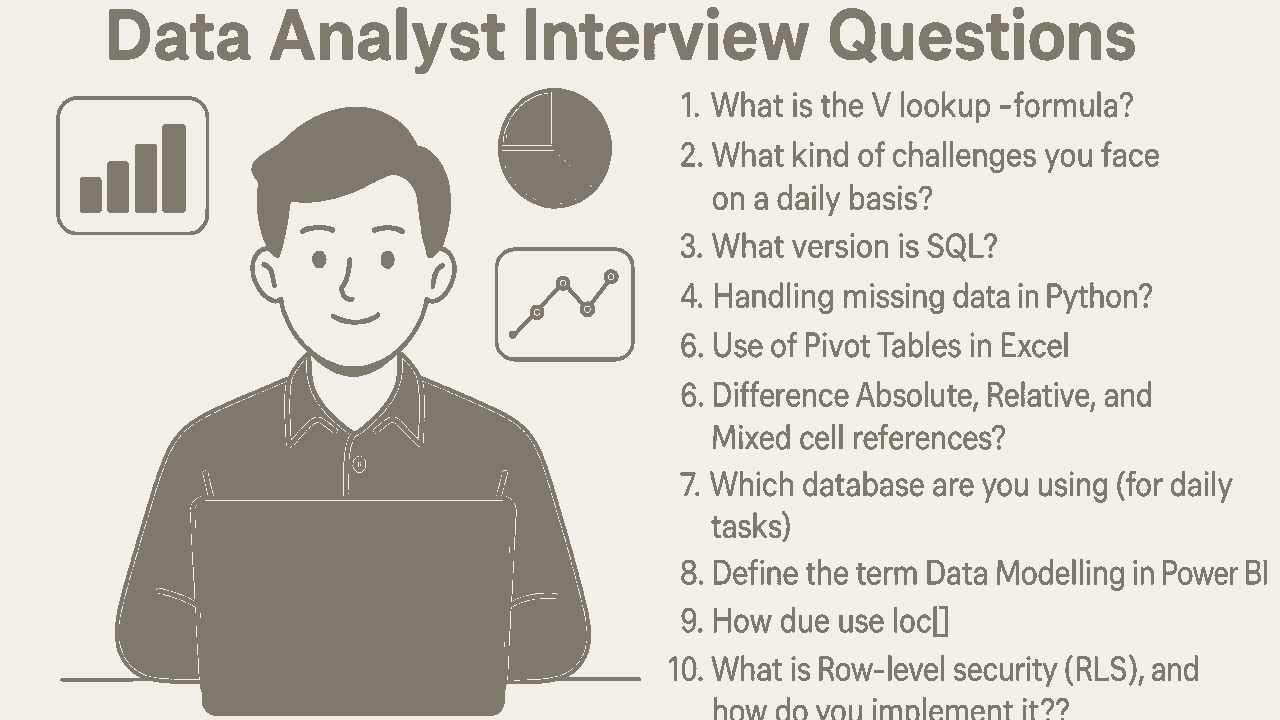
Compared to some other job interviews, where personality and general aptitude can be much greater factors, a data analyst interview is a blend of technical analysis, business understanding and soft skills. This process is multi-layered and can be illustrated as coding tests, case studies, technical discussions, and HR rounds, each of which needs a different kind of preparation.
The most important thing in preparation for such an interview is the establishment of a strong base in the fundamentals of data analysis. In India, employers frequently screen skills in SQL, Excel, and one or more programming languages like Python or R. Knowledge of SQL is particularly valued, as a large majority of companies work with large amounts of data stored in tables using SQL. You are expected to compose queries capable of utilising filtering, table joins, data aggregation, and data grouping. Python and R are common in more serious analysis, and recruiters prefer candidates to be familiar with libraries like Pandas, NumPy, or ggplot to clean and visualise data. It is not necessarily obsolete, especially in Indian businesses that do not necessarily resort to sophisticated tools to accomplish any given task, which is why you can gain an advantage by becoming efficient in using pivot tables, VLOOKUP, and formatting data. For learners looking to develop these practical skills in a structured environment, Uncodemy's Data Analytics course can provide a focused learning path covering essential tools, concepts, and hands-on data analysis practices that are relevant to today's job market.
One more important aspect can be the preparation of statistics and probability. Several interviewers would wish to see whether you would be able to solve statistical concepts of data problems in real life. These are topics such as hypothesis testing, regression analysis, correlation, and variation, as well as distribution, which are common in technical rounds, as well as, in the case studies. A candidate capable of not only knowing how to execute these techniques, but also knowing when to execute them proves depth in analytical thinking. Statistical modelling is instrumental in decision-making in Indian companies, especially in the field of finance, e-commerce, healthcare, and consulting and therefore, it is important to refresh the concepts in these fields. Equally, it is beneficial or even essential to know some of the fundamental machine learning algorithms, unless the title includes overlapping work with that of data scientists, whose roles often involve applications.
One thing that is immensely vital to interview preparation would be practice. Solving LeetCode, HackerRank, or Kaggle problems can also assist you in becoming acquainted with the nature of code-based, as well as SQL tasks, which you can encounter. The procedure in India is that interviewers frequently provide you with a set of data and expect you to perform an analysis of the data within a time limit and not only does it check your technical ability but also your problem-solving skills and time management capability. You can also differentiate yourself by working on sample projects and posting those on GitHub or Kaggle as recruiters like seeing practical, real-world uses of your knowledge. These projects show initiative and provide you with examples to discuss when interviewed with behavioural questions such as, what happened when you solved a difficult problem with the help of data.
Although technical preparation is key, the other essential thing is the comprehension of the business context. Being a successful data analyst does not only mean that you are able to clean and visualise data, but it means that you are able to explain how these numbers translate into the purpose of the company. Prior to an interview, there should be research on the industry in which the company is operating, its competitors, emerging trends, and the type of challenges that it may be experiencing. As an example, during an interview with an e-commerce company, consider how data might help serve customers better, to achieve the best prices, or supply chain. In case it is a bank, think about how the data could be used in risk analysis or customer segmentation. Confirming the awareness of the industry-specific apps, you demonstrate the position of the candidate who may fill the gap between raw data and sound strategies.
The last underrated skill is communication, and it is what can make an excellent candidate out of a good one. There is a case study round in many of these interviews in India where they ask you to describe in detail your line of thought as you examine a set of data. When interviewing, the interviewers will not just consider your correctness of your answer but also how well you explain it. The ability to explain complex results using language that can be understood in business terms is an art that is learnt through practice. It would help you to practice the description of your projects to the non-technical audience with the emphasis on what problem was solved, what actions have been taken, and what outcomes you have achieved. Certain data-driven storytelling is what makes you stand out in the mind of an interviewer.
The mock interviews are another great idea that helps you to gain confidence and see what you have not yet prepared. In India, the competition is also stiff and therefore, practising with colleagues or mentors will allow you to experience real conditions during an interview. There are websites that will provide you with mock technical rounds or a behavioural interview so it can be done online, or another way is to simply record yourself answering common questions using a camera and assess yourself. Think of the manner you organise your answers, your gestures, and how you handle last-minute queries. It is not uncommon to be caught by a curveball during an interview, as interviewers may test your ability to manage solutions to a problem on the spot, to the point that being relaxed and methodical in your strategy may impress.
Besides preparation in technical and communication skills, it is also worth setting up HR and behavioural preparation for the interview. Questions such as why do you want the opportunity in the company, how do you overcome difficult situations, and your career goals are common among Indian recruiters. You are supposed to make authentic responses that effectively portray your character and values and ones that are synchronised with the business mission. Examples include: Where do you see yourself in five years? or How do you prioritise when managing more than one project? And you are expected to answer such questions exhibiting an ability to be adaptable, work in a team and problem-solving. It is always important to remember that companies are seeking an individual who will fit into their culture besides being a results-driven one.
One more factor to consider is to prepare your resume and your portfolio. A jammed resume may end up working against you, particularly in India where recruiters have to sift through hundreds of resumes. Do not write a lot of information in your resume. Keep it short and relevant in terms of skills, internship, projects and certifications. Only feature accomplishments that demonstrate quantifiable outcomes, e.g. “streamlined processing time by 20 per cent using streamlined SQL queries.” Even projects done independently can be used to prove your abilities and provide the interviewers with something to speak about. Tool certifications such as Tableau, Power BI, or Google Data Analytics could be valuable to certify, but in a complementary role, with regard to practical skills.
Lastly, you cannot overestimate the importance of being mentally prepared and confident. The interview itself may take a lot of time and may consist of several rounds, and it is not strange that one gets nervous. Living well in advance, practising frequently, and having a positive frame of mind to help you calm down during the actual interview. You also need to accept that you will not always give an interview well and that it is a learning process. You learn with each interview, and it is frequently the persistence that pays off in securing a good job.
In conclusion, a successful data analyst interview in India demands a well-rounded field that incorporates both technical competence, statistical preparedness, work-experienced projects, scope of business, interpersonal ability, and self-esteem. Dedicating time to practice, learning and realising company needs, and creating a polished method of presenting your skills will give you a strong advantage of success. The point is that data is not just a matter of proving that you are capable of working with data; it is also a matter of demonstrating the ability to transform data into something tangible by turning it into insights that can be used to drive business results. Most of the interviews in the data analyst setting should be prepared like any other proper job interview with the right attitude, and you will be proud to move into any interview room.