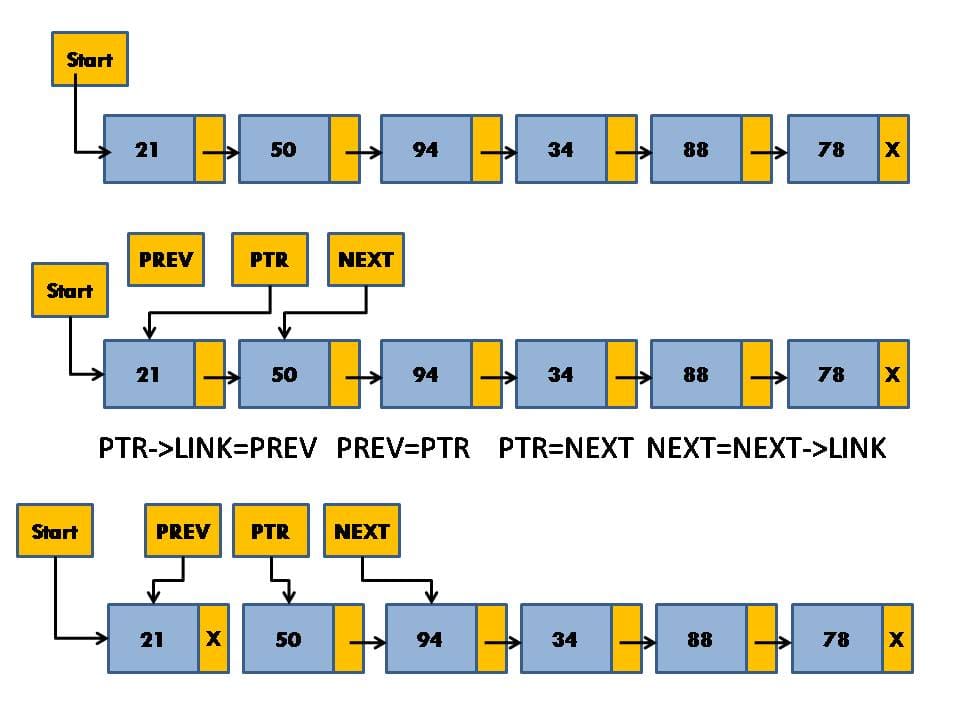
In the world of computer science, few topics are as fundamental—and as frequently tested—as linked lists. Whether preparing for technical interviews, university exams, or software development projects, students quickly realize that understanding how to manipulate linked lists is critical. One of the most commonly asked questions in this area is how to reverse a linked list. For students enrolled in a Data Structures Course in Noida, mastering this operation is not just a learning milestone—it is a practical skill that will repeatedly appear in both academic and professional settings.
This article offers a detailed, step-by-step guide to reversing a linked list, including explanations of the core logic, visual walkthroughs, code examples, common mistakes, and real-world relevance. The goal is to provide readers with a clear and comprehensive understanding of this operation, presented in a student-friendly, humanized tone.
Before diving into how to reverse a linked list, it is essential to understand what a linked list is. A linked list is a linear data structure made up of nodes, where each node contains two parts: the data and a pointer (or reference) to the next node in the sequence. Unlike arrays, linked lists do not require contiguous memory, making them flexible and dynamic in size.
There are several types of linked lists:
Singly linked lists, where each node points to the next node.
Doubly linked lists, where each node has pointers to both the next and the previous nodes.
Circular linked lists, where the last node points back to the first node.
For this article, the focus will be on singly linked lists, as they are the most common and form the basis for learning more advanced linked list operations.
Students in a Data Structures Course in Noida often start by building basic linked lists before moving on to more advanced operations like reversal, merging, and detecting cycles.
Why Reverse a Linked List?
Reversing a linked list is a classic problem that teaches several key programming concepts:
Pointer manipulation: Changing the direction of the next pointers.
In-place modification:Reversing the list without using extra space.
Algorithmic thinking:Planning and executing iterative or recursive solutions.
Beyond theory, reversing a linked list has real-world applications, such as reversing a playlist order, undoing recent operations in a software application, or processing data in reverse chronological order.
Understanding how to reverse a linked list helps students develop confidence in working with pointers and memory, which are central topics in any Data Structures Course in Noida.
The Core Idea: Reversing Pointers
At its core, reversing a linked list involves changing the direction of the next pointers so that they point to the previous node instead of the next one. For example, if the original list is:
1 → 2 → 3 → 4 → NULL
After reversing, it should become:
4 → 3 → 2 → 1 → NULL
To achieve this, the algorithm must:
Keep track of the current node.
Save the next node before changing pointers.
Update the current node’s next pointer to point backward.
Move forward using the saved reference.
This pointer juggling might feel tricky at first, but with a careful step-by-step approach, it becomes manageable and intuitive.
Step-by-Step Guide to Reversing a Linked List
Here’s a detailed explanation of the iterative approach, which is the most commonly taught method in data structures courses.
Step 1: Initialize Pointers
Three pointers are typically used:
prev:Points to the previous node (initially NULL because the first node will become the last).
current: Points to the current node being processed.
next:Temporarily stores the next node so the list can keep moving forward even after reversing the current link.
Step 2: Iterate Through the List
While traversing the linked list:
Store current.next in next.
Update current.next to point to prev.
Move prev forward to current.
Move current forward to next.
This process is repeated until current becomes NULL, meaning the end of the list has been reached.
Step 3: Update the Head
After the loop finishes, the last processed node (prev) becomes the new head of the reversed list.
Visual Walkthrough
Let’s break this down with an example:
Original List:
1 → 2 → 3 → 4 → NULL
Iteration 1:prev = NULL, current = 1, next = 2 → 1.next = NULL → move prev to 1, current to 2
Iteration 2:prev = 1, current = 2, next = 3 → 2.next = 1 → move prev to 2, current to 3
Iteration 3:prev = 2, current = 3, next = 4 → 3.next = 2 → move prev to 3, current to 4
Iteration 4:prev = 3, current = 4, next = NULL → 4.next = 3 → move prev to 4, current to NULL
Final List:
4 → 3 → 2 → 1 → NULL
Code Implementation
Here’s a clean implementation in C, which is often taught in data structures classes.
                                #include
                                #include

                                struct Node {
                                    int data;
                                    struct Node* next;
                                };

                                void reverse(struct Node** head_ref) {
                                    struct Node* prev = NULL;
                                    struct Node* current = *head_ref;
                                    struct Node* next = NULL;

                                    while (current != NULL) {
                                        next = current->next;   // Store next
                                        current->next = prev;   // Reverse current node's pointer
                                        prev = current;         // Move pointers one position ahead
                                        current = next;
                                    }
                                    *head_ref = prev;
                                }
This function takes a pointer to the head of the linked list and updates it after the reversal. Students in a Data Structures Course in Noida are encouraged to test this code with various inputs and understand each line.
Recursive Approach
While the iterative approach is most common, the recursive method is an elegant alternative.
In this version, the function calls itself until it reaches the end of the list and then flips the pointers on the way back up.
Common Mistakes
Students often make a few mistakes when learning to reverse a linked list:
Losing the next node: Not saving the next pointer before changing current.next can break the list.
Forgetting to update the head: After reversal, the head pointer must point to the new front of the list.
Misusing recursion:Recursive solutions require a clear base case; missing this can cause infinite recursion.
Instructors in a Data Structures Course in Noidaemphasize careful pointer handling and thorough testing to avoid these pitfalls.
Real-World Applications
Reversing a linked list might sound academic, but it has practical uses:
Undo functionality:Many applications use linked lists to track user actions, and reversing the list helps implement undo features.
Data structure manipulation:Reversing nodes is often part of more complex data processing tasks.
Network packet reordering:In some low-level programming contexts, linked lists are used to reorder or reverse data packets.
Learning Tips for Students
Mastering how to reverse a linked listrequires practice. Here are some tips for students:
Draw diagrams:Visualizing each pointer movement on paper helps build intuition.
Code by hand: Typing code into an editor is good, but writing it out without looking at references strengthens memory.
Experiment:Modify the code to handle doubly linked lists or circular lists to deepen understanding.
Pair programming:Working with classmates can reveal new insights and spot mistakes.
Students in a Data Structures Course in Noidaare often given exercises, assignments, and projects centered on linked list operations, making this an indispensable part of the curriculum.
Conclusion
Reversing a linked list is a fundamental operation that teaches crucial programming concepts such as pointer manipulation, recursion, and in-place data modification. For students enrolled in a Data Structures Course in Noida, mastering this skill is not just about passing exams or clearing interviews; it is about building a strong foundation for working with complex data structures in real-world systems.
By following the step-by-step approach outlined here, practicing with code, and learning from common mistakes, students can confidently tackle this classic problem and apply the same logic to even more advanced challenges in the future.