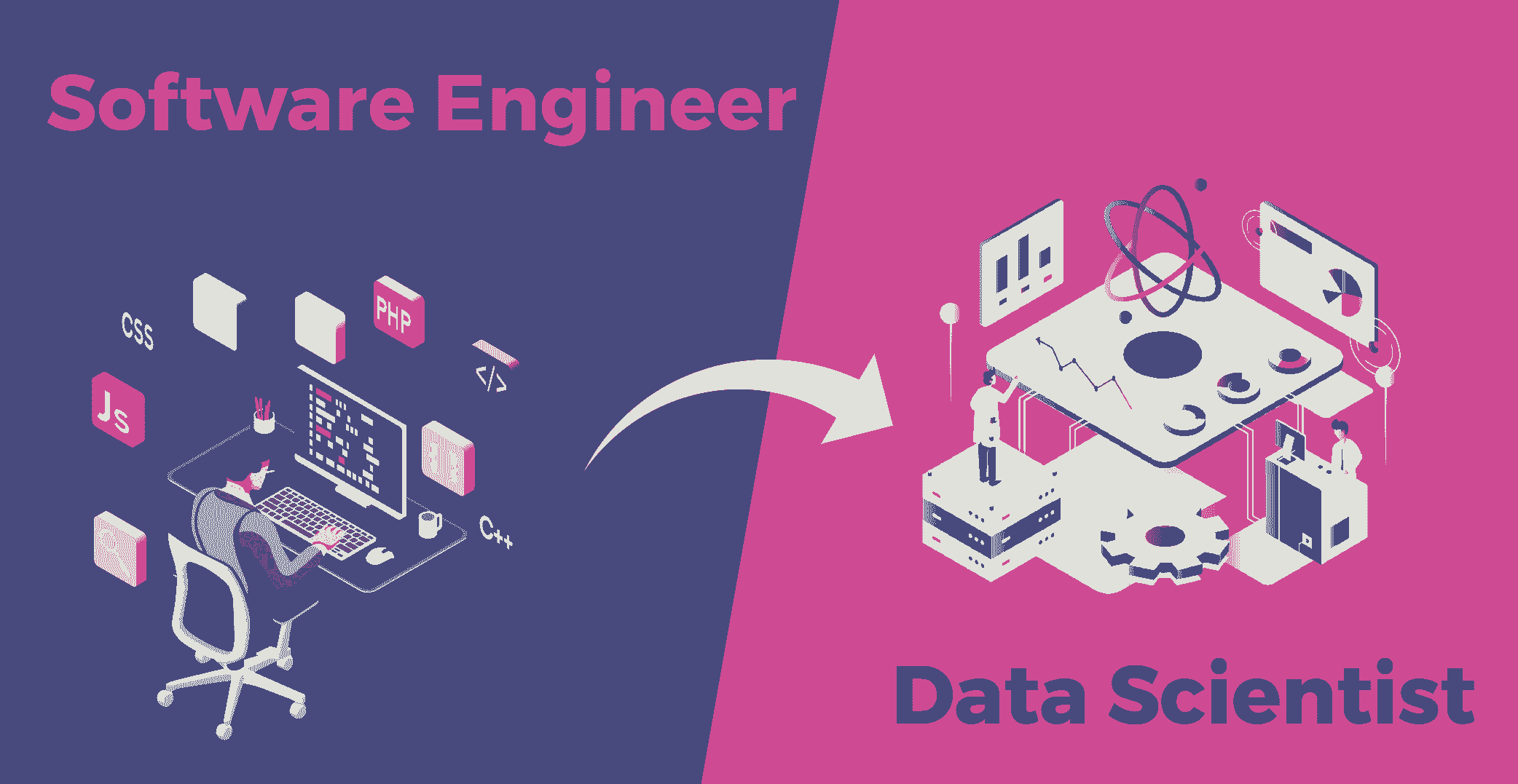
These days, the idea of a career change from web development to data science is not just a matter of just jumping on to another trend but a strategic move for future-proofing their skill sets. Though the change can appear intimidating, it is not at all impossible. Actually, many web developers have the technical skills required and with some targeted effort, they can turn into data scientists. The article will take you through the difficult journey of shifting from web development to data science, uncovering the necessary skills, common problems, and the possible future you are to discover.
Why Web Developers Look Toward Data Science
The aspect of data science is thought of by web developers as one possible next step on the basis of various reasons, that is not only professional but also personal.
Primarily, the lack of data scientists in the labor market is at its peak advertising the need for the job. Data science is consistently ranked amongst the rapidly expanding sectors worldwide where they require staff exceeding the number that can be trained. For those who desire career security, the transition will be statically wise to move in this direction.
Also, web developers are willing to keep on learning as an intellectual pursuit. Indeed, the job of a web developer is creative and challenging but can become boring as a result of repetition of the same tasks after several years of experience. With data science, we are talking about being on the forefront of innovations like machine learning, AI, and predictive modeling. The work is often about uncovering the hidden parts of the problem and using creative solutions that include deep analytics. Also, the fact that data science is multisciplinarily is the third argument in favor of data science. The field of data science employs many concepts from mathematics, statistics, and computer science as well as domain knowledge. This is very attractive to the people who love learning new things in different areas.
Also, web developers use many of the software and skills that are part and parcel of data science, thus, the transition is easier compared to a total shift from a completely different field.
Skills Overlap Between Web Development and Data Science
Web development and data science are just two different things. While one concentrates on digital interfaces, the other, data, is to get insights. But there is a considerable overlap in terms of skills:
Programming Knowledge
Web developers can code in languages like Python, JavaScript, and PHP. And out of all these, Python is the one that is also the most preferred in data science.
Database Skills
SQL, MySQL, and MongoDB are the main web development tools for data storage and retrieval. These technologies are equally necessary in data science when dealing with structured and unstructured datasets.
Debugging and Logical Thinking
Debugging of tough issues and solving technical problems is a routine activity for web developers. The same logical mindset is essential in data science when the solutions are not very apparent.
API Integration
Developers usually work with APIs to connect a service to a website or an application. As far as data science is concerned, APIs are used to get hold of datasets, to load models, and also to make ML tools applications-connected.
Version Control and Collaboration
The background with GitHub or GitLab is just as; very good for data science projects especially those involving teamwork and version control.
The presence of skills in both career paths means that web developers are not starting at zero when they decide to switch their careers. They have transferable skills that will help them smoothly transit into data science.
Skills You Need to Add
Without the overlapping part, there is a set of skills that web developers should acquire if they want to work in data science.
Statistics and Probability
Grasping data distributions, hypothesis testing, probability, and correlation should be the basics. The practice of data science is deeply rooted in the statistics field, and without it, making sound inferences becomes a tall order.
Mathematics for Algorithms
The works of machine learning models become clearer when individuals have an understanding of linear algebra, calculus, and optimization. Even if most of the processes are automated through libraries, the basic understanding is still significant.
Data Wrangling and Cleaning
Real-world datasets are usually messy, missing things, or not consistent. Learning and being able to do it efficiently with Pandas or NumPy is an important skill to have.
Machine Learning
The main directions of data science are regression, clustering, classification, and neural nets. Learners can use Scikit-learn, TensorFlow, and PyTorch to create their own models.
Data Visualization
One point that is almost as important as the analysis is the communication part. One can easily visualize the data with the help of Matplotlib, Seaborn, and Tableau that streamline the process.
Big Data Tools
In big companies, architects and data scientists who deal with very large datasets need to be comfortable using Hadoop, Spark, or cloud services like AWS and Google BigQuery.
These skills won’t develop overnight, but with organized learning and persistency, one can get better at them gradually.
Steps to Transition Into Data Science
Moving from one career to another demands a step-by-step approach rather than an instant switch. Here is a map for web developers to follow:
1. Deepen Mathematical and Statistical Knowledge
Normally, web development does not require advanced statistics or mathematics. In order to shift, start with probability, algebra, and statistical reasoning. Just a few hours of regular study per week can become a sturdy base.
2. Data Science with Python
The majority of web developers are most likely familiar with Python, however, the emphasis of data science is different. One must be proficient with such libraries as Pandas, NumPy, Matplotlib, and Scikit-learn which are very common data science tools.
3. Discover Machine Learning Models
Initially, you can use the simplest models like linear regression and decision trees. Then enhance to advanced models like random forests, support vector machines, and deep learning networks.
4. Be Involved in Real Projects
Doing is always different from knowing. Working with public data-sets, predicting results, or even making dashboards is just some of what you can do practically. Just to mention a few beginner projects: you can work on "customer churn analysis" or on "house price prediction".
5. Get Trained and Certified
Learning in a conventional way is the best way to keep concentration. Taking courses on online platforms like Coursera, edX, or through specialized instructors in the industry are just some of the ways to get into data science with a certification, which is like a seal of authenticity on your resume.
6. Join the Community
Being active in forums, going to the data science meetups, and doing your part in open-source projects are ways to get to know the people in the industry and to give you some real-world skills.
7. Create a Portfolio
What you have done with your knowledge is what matters to a great extent. Showing your projects on GitHub is usually more impressive than a resume. Employers want to see you apply your skills practically.
8. Make the Change Slowly
If you can, do data science as a side discipline in your current web developer job. Tech companies like that you have expertise in two areas because you can do things like create data dashboards or web-apps that have AI built into it.
Common Challenges in the Transition
The path that leads from web development to data science is fruitful but not without obstacles.
- Learning Curve in Math: Developers commonly feel statistics and linear algebra very scary. To solve this, you need to be persistent.
- Time Management: Combining current work with various upskilling activities is a tough task. Having a study habit can make things easier.
- The Overflow of Resources: There are a lot of online tutorials for beginners and they may feel lost. To avoid this, just pick one clear path and stick to it.
- Showing Skills: Due to the level of competition in the job market, web developers should back up their knowledge in data science with projects and certifications.
By perceiving these problems, the workers become able to organize their journey more effectively.
Possible Positions after the Change
Once the web developers have trained themselves in the right way, they can tap into the enormous variety of the available career path options:
- Data Scientist: Clean, transform, and visualize large datasets, create predictive models, and propose data-driven insights for business strategies.
- Machine Learning Engineer: Deals with the practical aspects like implementing models in production environments and creating systems that can be easily scaled.
- Data Analyst: Data is made accessible through interpretation and visualization; thus, organizations are guided in their strategies.
- Business Intelligence Developer: Designing of performance tracking through management reports and visuals is the core of this profession.
- AI Specialist: Carry out the development of the next generation of technologies that deal with computer vision, natural language processing, and robotics.
Each post gives an opportunity to develop and the selection is based on the user interest and career focus.
Staying Motivated Through the Journey
It is important to remember that changing careers takes time and it is in no way a process that will be accomplished overnight. One of the most important things that a person needs to have during the procedure is the motivation as without it would be hard to move on. A good way of not getting burnt out is setting little goals which are achievable. For instance, you can concentrate on gaining expertise in Python libraries for one month and then go to visualization. Keeping up the enthusiasm is easier when one sees a reason for celebration in these little steps.
Another thing could be making learning more engaging by connecting it with real-life cases. A software developer can use his skills to build an application that monitors visitors flow on a particular website merging web development and data science skills. It not only solidifies the skills but also shows the employer what you can do.
The most important of all, every time you learn something new, don't forget to see it as a step towards a sustainable future career. The people who will make it to the end and transform successfully are those who will be persistent, while the rest will be the ones who will abandon the transition halfway.
Frequently Asked Questions
Q1. Is switching from web development to data science worth it?
Yes. Data science is a potential career that is going to grow exponentially, and it is already in high demand and it also offers the chance one may have to work on the forefront of technology. For web developers, who are looking for a more analytical and impactful role, it is worth pursuing.
Q2. Do I need a master’s degree to become a data scientist?
A Masters degree is not mandatory. Data scientists with PhDs, who are highly trained in academic environments, are counterbalanced by others who have done most of their work through online learning, non-degree programs, and real-world projects. Employers mostly look at the skills of people rather than at the educational background.
Q3. Can I apply my web development skills to data science?
Definitely! The skills like Python programming, SQL, and working with APIs are quite similar to the ones used for web development and thus can be easily transferred to data science. In fact, the combination of web development and data science would make you a more versatile professional.
Q4. How long does it take to transition from web developer to data scientist?
The time range is dependent on the amount of effort a person puts in. With regular studying and doing, the shift can be made by a lot of people within 1–2 years. However, one can start working on smaller data-related projects even before the completion of the training program.
Conclusion
Moving from web development to data science is not an impossible or undesirable move, rather it is like changing from one line to another where both lines are next to each other. Web developers are already well equipped with programming, database, and problem-solving skills that constitute a good ground. With a few additions of statistics, machine learning, and data visualization they can be able to smoothly change their line and access a career filed with opportunity.
It is a process which costs a lot in terms of time, patience, and effort but then, the end, being a career in one of the most sought-after fields nowadays, is what makes it a worthy path to take. The change, in the end, signifies not only different duties but also a new mode of perception of the world whereby data becomes the key to innovation and decision-making.