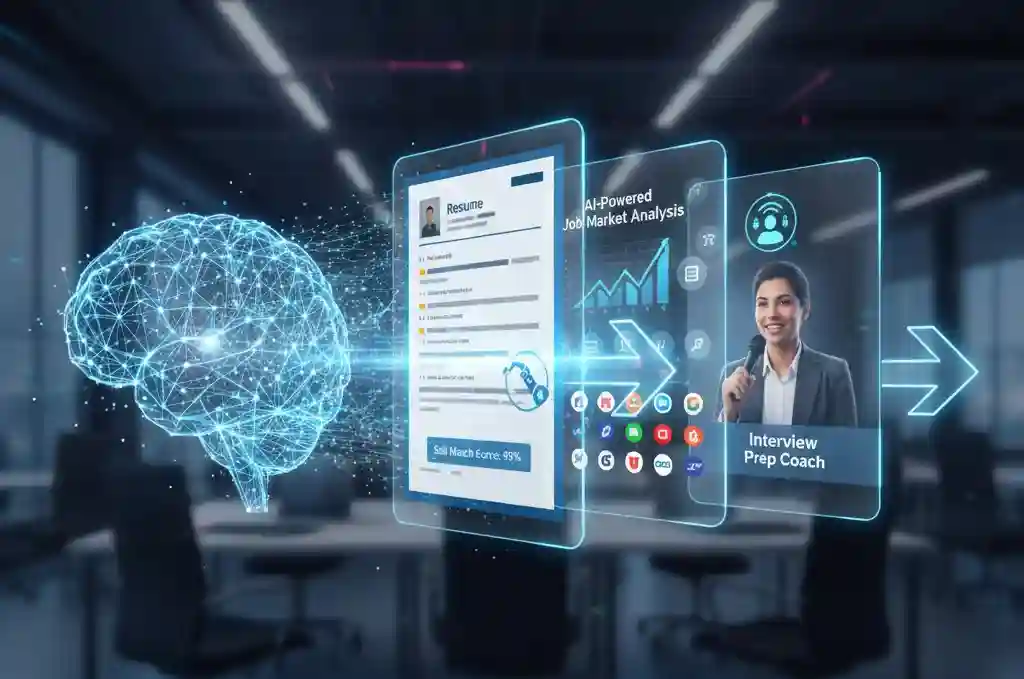
It is at this point that artificial intelligence (AI) tools come in and change how job seekers prepare, present, and position themselves. Resume-building and job-searching with the help of AI is no longer a dystopian dream but a necessary habit that can put one in a much better position to get the right job.
Resume building is one of the most direct uses of AI tools. The feeling of using traditional resume writing is often overwhelming due to the fact that candidates have problems with presenting their achievements, the level of detail required, and how their profile fits into a given position they are seeking. Resume builders based on AI make this process easier by analysing job listings and personalising resumes to showcase the most pertinent skills and experiences. Indicatively, on certain websites, users have the option of pasting the job description of the position they are aiming to fill, and the AI will make suggestions to change the wording, format, or sequence of sections to align with the job specifications. This not only conserves time but also makes the resume bypass ATS filters by being tightly matched with keywords that recruiters are searching for.
AI also gives clarity to job seekers as it reveals strengths and weaknesses on their resumes. Most AI resume systems provide a grading system that analyses a resume on various parameters like clarity, keyword match, readability, and structure. This feedback assists the candidates in improving their resumes in an objective manner as opposed to guesswork. Moreover, AI is able to suggest stronger action verbs, recommend quantifying achievement, and identify redundant or vague phrases. As an example, an AI tool can propose an improved resume by saying that the person managed a team of ten people and did it successfully, rather than being responsible for managing a team. These are small yet essential alterations that enhance the possibility of attracting the attention of a recruiter.
Cover letter writing, which most candidates consider a boring exercise, is also being transformed by AI tools. Similar to resumes, AI has the potential to tailor cover letters to particular job descriptions and companies. AI enables job seekers to create personalised applications, at scale, by creating drafts that reflect a candidate's experiences, skills, and motivations in a structured way. Candidates can apply to various job opportunities using personalised cover letters with minimum effort, rather than using generic ones and are likely to be engaged by recruiters.
Regarding the job search process, AI-based solutions serve as smart helpers by filtering through extensive job boards and career portals to offer the most useful opportunities. Most job boards now rely on AI to suggest jobs based on the candidate profile, past searches, and past applications. Contrary to manual searches, which may be time-consuming and overwhelming, AI also makes sure that the candidate is exposed to roles that match his/her skills, experience, and career aspirations. This is not only time-saving, but it also avoids missed opportunities that might be hidden in the job listings. Moreover, AI can even forecast which companies are most likely to hire according to industry trends and hiring patterns and allow candidates to target their search more strategically.
The other benefit of AI tools is that they can be used to simulate and prepare interviews. AI-powered virtual interview coaches interpret answers to typical interview questions, tone, clarity, and confidence, and give constructive feedback. They can even analyse facial recognition to determine body language and eye contact during the video interviews. Through AI practice, applicants will be able to develop confidence, discover areas to improve, and refine responses prior to their meeting with a recruiter. Such preparation will be priceless in a competitive job market where even minor details can be the difference between a deal and a deal breaker.
The other way AI improves the job search is through networking. Most professional networks rely on AI to suggest connections, show us recruiters who are hiring in a given field, and recommend communities or groups to which we belong. These features may be used by candidates to increase their professional networks, which is often a decisive factor in securing employment. Even some AI tools write outreach messages in networking, so that candidates can write professionally and effectively without being generic. This automation eliminates fear of contacting someone but preserves that personal aspect, making networking a less intimidating and more effective experience.
One of the most important aspects of the process of finding a job nowadays is maximising the online presence, especially on LinkedIn. Now AI can be used to analyse LinkedIn profiles, detect weaknesses, and recommend improvements, e.g. more effective headlines, better summaries, or more detailed descriptions of skills. They also make sure that the profiles are optimised to search based on keywords; therefore, the recruiters can easily identify the candidates using search. As LinkedIn tends to be a digital version of a resume, maintaining it in a presentable and recruiter-friendly state can make a tremendous difference, and AI can offer the knowledge to accomplish this effectively.
Although the use of AI tools has immense benefits, it is also vital to apply them wisely. Over-reliance is also one of the risks, as resumes or cover letters prepared by an AI machine learning can be too robotic, or may lack any authenticity or reflect on the individuality of the candidate. AI-generated generic material is easily identified by recruiters, and this works against them. The optimal solution is to apply AI as the underpin or helper instead of a substitute. The candidates are advised to make the AI suggestions personal and add their personal experiences, stories, and personality to make them more human and relatable. AI finds its application in the case of human judgment and creativity.
The other constraint that should be remembered is that AI tools can only be as useful as the information on which they are trained. There is a probability that some tools will suggest things that are too general, old-fashioned, or unrelated to a certain industry. So, AI-generated suggestions could always be checked with the information about the current industry standards and job requirements by the candidates. Critical evaluation of the recommendations will keep the resume and job applications concise, precise and on track with the expectations of the real world.
Another important issue is the ethical application of AI in the job search. Other candidates might also ask themselves whether they have an unfair edge when they utilise AI tools. But AI does not generate new qualifications; it simply aids in bringing out the already existing qualifications and showcasing them in a better way. Candidates can make good use of AI as long as they apply it in an honest and transparent manner, as opposed to looking like a fraudulent instrument. Recruiters are actively employing AI to sort through applications and evaluate candidates, and thus, job seekers utilising AI tools are merely equalising the field.
Another highly exciting way AI can be used in the job search is its capacity to democratize opportunities. Professional resume writing services or career coaches were previously considered costly and unavailable to all people. Personalisedd career support can be offered by AI to a larger audience at a significantly lower cost, and job seekers with various backgrounds have an equal chance to compete. This democratisation might result in an increase in merit-based recruitment, where potential employees are evaluated based on their competence and experience instead of their professionalism in having their resumes professionally edited with external assistance.
In the future, the inclusion of AI in the resume creation and job search will become even more profound. The tools of the future will not only analyse resumes but also constantly update them, considering career progress, suggesting upskilling opportunities and even predicting career paths. To the job seeker, this translates to the fact that the adoption of AI is not a one-time thing but rather a serious, long-term change in the way careers are going to be handled. Mastering how to utilise AI devices today will allow the candidates to be ready to work in a world where AI will become part of professional development and mobility.
To sum up, AI tools are changing resume-making and job searching to be smarter, more efficient, and more personalised. They assist candidates in adjusting their applications to the job description, optimising for ATS systems, creating personalised cover letters, locating relevant opportunities, preparing for interviews, and enhancing their online persona. Meanwhile, they conserve time, alleviate stress and provide access to career support which was previously restricted to a select few. For individuals who want to deepen their practical understanding of these technologies, enrolling in an Artificial Intelligence course in Gurgaon can further strengthen their ability to use AI tools strategically in real-world career scenarios.The way to become successful is, however, to treat AI as a collaborator, not a replacement, and to merge the effectiveness of technology with the authenticity of personal experience. Striking the right balance allows job seekers not only to shine in a competitive market but also to feel more confident and empowered in their career ventures.