If you’ve ever wondered how Netflix predicts thumbnails you’re most likely to click, or how AI tools compress large image datasets without losing key features, VAEs are often behind the scenes. In this blog, we’ll explore what VAEs are, why they’re revolutionary, and how they’re transforming the way AI handles data compression and learning.
What are Variational Autoencoders (VAEs)?
A Variational Autoencoder is a type of generative model—a neural network that learns how to encode input data into a compact form and then decode it back to something close to the original. Think of it as a very smart zip file: it doesn’t just compress, it also understands the underlying patterns in the data.
Traditional autoencoders compress input into a latent representation but often lack control over how that space is structured. VAEs solve this by introducing probabilistic constraints—they don’t just learn a point in the latent space, they learn a distribution. This makes them excellent for tasks that require generating new samples or compressing data while keeping meaningful features intact.
Why VAEs Are Important in AI
Before VAEs, deep learning models for data compression worked, but they often produced rigid or low-quality reconstructions. VAEs added flexibility and probabilistic reasoning, making them more robust for real-world tasks. Some reasons VAEs matter:
- They learn a smooth latent space where similar inputs cluster together.
- They can generate new data samples, not just compress existing ones.
- They excel in tasks where representation matters—like anomaly detection, recommendation systems, and semi-supervised learning.
How VAEs Work: A Simple Breakdown
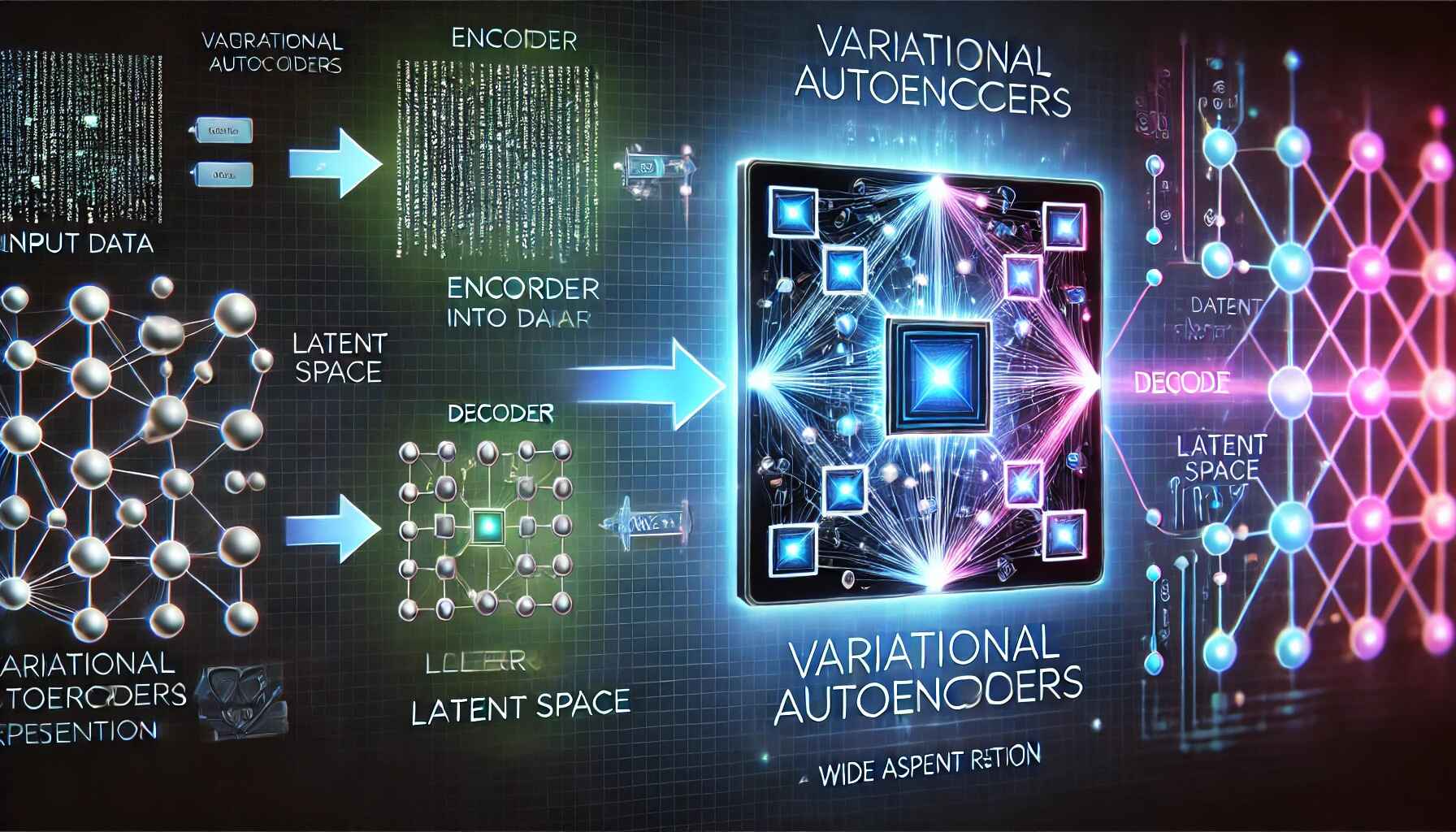
A VAE consists of three main parts:
1. Encoder
The encoder compresses the input (say, an image) into a set of parameters that describe a probability distribution (mean and variance).
2. Latent Space
Instead of mapping inputs to a single point, the VAE maps them to a distribution in the latent space. This ensures that nearby points in the latent space correspond to similar data points.
3. Decoder
The decoder takes a sample from this latent distribution and reconstructs the original data.
This design not only compresses data but also allows the model to generate new, unseen samples by sampling from the latent space.
VAEs for Data Compression
1. Compact Representations
VAEs create low-dimensional latent representations of high-dimensional data. For example, a 256×256 image can be compressed into a latent vector of just a few hundred dimensions.
2. Noise-Tolerant Compression
Because the latent space is probabilistic, VAEs handle noise better than traditional autoencoders. This makes them useful for compressing imperfect data, like scanned documents or medical images.
3. Feature Preservation
Unlike traditional compression techniques (like JPEG), VAEs don’t just shrink the file size—they also preserve meaningful features. This is why they’re used in fields like bioinformatics or autonomous driving where losing subtle patterns could be catastrophic.
4. Real-Time Applications
VAEs can be trained for on-the-fly compression, which is critical in edge computing, streaming, and IoT devices where bandwidth and storage are limited.
VAEs for Representation Learning
1. Learning Structured Latent Spaces
The latent space of a VAE can be visualized as a map where similar data points cluster together. This is invaluable for tasks like clustering, classification, or anomaly detection.
2. Transfer Learning
A VAE trained on one dataset can often be adapted to another related dataset because it learns generic representations of the data.
3. Semi-Supervised Learning
VAEs can work even when labels are scarce. By learning an unsupervised representation first, they make supervised tasks (like classification) easier.
4. Generative Capabilities
Perhaps the most exciting part: VAEs can generate new data. For example, after training on faces, they can produce entirely new but realistic faces.
Real-World Use Cases of VAEs
1. Image Compression and Restoration
Companies use VAEs to compress images for faster loading times while preserving quality. They’re also used in denoising and restoring damaged images.
2. Healthcare
VAEs are used to compress medical scans into manageable sizes for storage and transmission, while still preserving diagnostic details.
3. Anomaly Detection
VAEs can learn the “normal” distribution of data and then flag anything that doesn’t fit. This is used in fraud detection, cybersecurity, and predictive maintenance.
4. Natural Language Processing
VAEs can be applied to text, compressing large vocabularies into latent spaces that make tasks like text generation or topic modeling more efficient.
5. Content Recommendation
Streaming platforms use VAE-based recommendation systems to encode user preferences and predict what content they’re likely to engage with next.
Advantages of Using VAEs
- Better generalization: VAEs don’t memorize data—they understand its structure.
- Probabilistic modeling: They can express uncertainty, making predictions more robust.
- Data generation: VAEs aren’t limited to reconstructing—they can create new, synthetic data.
- Scalability: VAEs work well on large datasets.
Limitations of VAEs
- Blurry Outputs: VAEs sometimes produce less sharp images than alternatives like GANs.
- Training Complexity: Balancing reconstruction loss and regularization can be tricky.
- Computational Cost: VAEs can be heavy on resources for very large datasets.
VAEs vs Other Generative Models
- VAEs vs GANs: GANs often generate sharper images but can be harder to train. VAEs are more stable and offer interpretable latent spaces.
- VAEs vs Diffusion Models: Diffusion models produce stunningly detailed images but require more computational resources. VAEs are faster for compression tasks.
The Future of VAEs in AI
As AI applications demand faster, more efficient learning, VAEs will likely evolve to handle even larger datasets and multimodal inputs (images + text + audio). Researchers are already combining VAEs with other models—like GANs (VAE-GAN hybrids)—to get the best of both worlds.
For anyone interested in AI course in Noida, data science course in Noida, or machine learning course in Noida, understanding VAEs isn’t just a nice-to-have skill; it’s a career booster.
How to Get Started with VAEs
- Learn the basics: Brush up on autoencoders, latent spaces, and probabilistic modeling.
- Hands-on practice: Use Python libraries like TensorFlow or PyTorch to build your first VAE.
- Explore datasets: Start with MNIST (handwritten digits) or CIFAR-10 (images) to experiment with compression and generation.
- Read research papers: The original VAE paper by Kingma and Welling (2013) is a great starting point.
FAQs
1. What is the main difference between a VAE and a regular autoencoder?
A regular autoencoder maps inputs to fixed latent points. A VAE maps inputs to probability distributions, allowing for smoother latent spaces and generative capabilities.
2. Can VAEs replace traditional compression algorithms like JPEG?
Not yet. While VAEs can compress images, they’re still more resource-intensive than traditional codecs. However, for feature-rich data where patterns matter, VAEs outperform traditional methods.
3. Do VAEs work only for images?
No. VAEs can be applied to text, audio, and even structured data—anywhere compression and representation learning are valuable.
4. Are VAEs better than GANs?
It depends. VAEs are more stable and interpretable, while GANs produce sharper visuals but are harder to train. For compression and latent space learning, VAEs are superior.
5. How do VAEs help in semi-supervised learning?
VAEs learn representations of unlabeled data, which can then be used to improve classification tasks with limited labeled data.
Final Thoughts
Variational Autoencoders are a cornerstone of modern AI, bridging the gap between compression and learning. They allow machines not just to store information efficiently, but also to understand and generate new data a critical step toward truly intelligent systems.
Whether you’re a student, developer, or data scientist, learning VAEs can open doors to cutting-edge applications in image processing, healthcare, NLP, and beyond.