If Else Program in C with Examples: Explained Simply
In the world of programming, decision-making is crucial. Whether you're building a basic calculator or a high-end software application, your code must be able to make choices. This is where the "if else" statements in C programming come into play.
If you're enrolled in a Python Programming Course in Noida, you might be focusing on Python right now. But having a solid understanding of C, especially control statements like "if else," gives you a rock-solid foundation in logic and syntax, which will help you in any language, including Python.
If Else Program in C with Examples: Explained Simply
Mr. Bambam Yadav / 1 days
0
4 min read
In this article, we'll simplify the concept of "if else program in C" with easy-to-understand examples, syntax, real-world use cases, practical applications, and frequently asked questions.
What is an If Else Statement?
Think of it like this: you're hungry. If you have food at home, you eat it. Else, you order something. That's essentially how an if-else statement works.
In C programming, the if else statement allows your program to make decisions based on conditions. It's a basic form of control flow, and it's something you'll use in nearly every program you write. Understanding this logic opens doors to more complex programming structures such as loops, switch cases, and even object-oriented logic in other languages.
Syntax of If Else in C
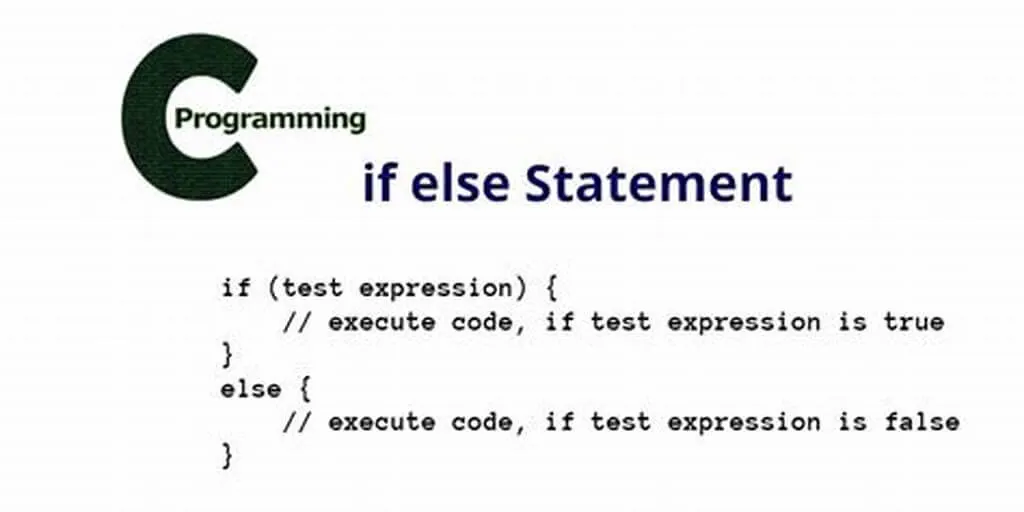
Here's the basic syntax:
                           if (condition) {
                                // Code to execute if condition is true
                            } else {
                                // Code to execute if condition is false
                            }
condition: This is an expression that returns true or false.
The code inside the if block runs if the condition is true.
Otherwise, the code inside the else block runs.
Flowchart Representation
If you are a visual learner, a flowchart can help:
Start →
Evaluate condition →
If true → Execute if block → End
If false → Execute else block → End
Simple If Else Program in C
Let’s write a basic program to check if a number is positive or negative.
                          #include

                            int main() {
                                int number;
                                printf("Enter a number: ");
                                scanf("%d", &number);

                                if (number >= 0) {
                                    printf("The number is positive.\n");
                                } else {
                                    printf("The number is negative.\n");
                                }

                                return 0;
                            }
Output:
                           Enter a number: -5
                            The number is negative.
This is as simple as it gets. You check a condition, and based on whether it’s true or false, you execute one of the two code blocks.
Nested If Else Example
Sometimes, you want to make more than just a binary decision. You can nest if-else statements to handle more cases.
                           #include

                            int main() {
                                int number;
                                printf("Enter a number: ");
                                scanf("%d", &number);

                                if (number > 0) {
                                    printf("Positive number\n");
                                } else if (number < 0) {
                                    printf("Negative number\n");
                                } else {
                                    printf("Zero\n");
                                }

                                return 0;
                            }
This example introduces else if, which helps you check multiple conditions.
Real-Life Example: Voting Eligibility
Here's a practical example that checks if someone is eligible to vote.
                           #include

                            int main() {
                                int age;
                                printf("Enter your age: ");
                                scanf("%d", &age);

                                if (age >= 18) {
                                    printf("You are eligible to vote.\n");
                                } else {
                                    printf("You are not eligible to vote yet.\n");
                                }

                                return 0;
                            }
If Else Ladder: Multiple Conditions
When you have several conditions to evaluate, you can chain them using an if-else-if ladder.
Example: Grade Evaluation
                           #include

                            int main() {
                                int marks;
                                printf("Enter your marks: ");
                                scanf("%d", &marks);

                                if (marks >= 90) {
                                    printf("Grade A\n");
                                } else if (marks >= 75) {
                                    printf("Grade B\n");
                                } else if (marks >= 60) {
                                    printf("Grade C\n");
                                } else if (marks >= 40) {
                                    printf("Grade D\n");
                                } else {
                                    printf("Fail\n");
                                }

                                return 0;
                            }
Practical Applications of If Else in C
Form Validation: Check if user inputs are valid.
Banking Software: Validate transactions and balances.
Games: Evaluate win/loss conditions.
IoT Devices: Run different commands based on sensor values.
Data Processing: Perform logic checks on data before processing.
Comparison with Python's If Else
Feature
C Programming
Python Programming
Syntax
Curly braces {}
Indentation
Boolean values
0 = false, non-zero = true
True, False
Simplicity
More verbose
More readable
Speed
Faster execution
Slower but flexible
While you're focusing on the Python Programming Course in Noida, knowing how Python's elegant syntax simplifies things compared to C helps you appreciate both languages better.
Benefits of Mastering If Else Logic
Strengthens logical thinking
Essential for learning advanced topics like loops, recursion, and functions
Forms the basis of competitive programming
Helps debug and write cleaner code
Common Mistakes to Avoid
Using = Instead of ==:
Always use == for comparison.
Missing Semicolon:
C requires semicolons after every statement.
Unnecessary Nesting:
Avoid deeply nested conditions; it makes code harder to read.
Incorrect Boolean Expressions:
Ensure logic expressions are well-formed and meaningful.
Practice Problems
Check if a number is even or odd.
Determine if a character is a vowel or consonant.
Compare three numbers to find the largest.
Leap year checker.
Simple calculator using if else.
Advanced Usage: Ternary Operator
For simpler conditions, C offers a shorthand called the ternary operator:
                           int a = 10, b = 20;
                            int max = (a > b) ? a : b;
                            This is equivalent to:
                            if (a > b) {
                                max = a;
                            } else {
                                max = b;
                            }
How If Else Prepares You for Real Projects
Learning if else may seem elementary, but it's the foundation of:
Authentication systems (checking usernames/passwords)
E-commerce sites (applying discounts based on conditions)
Game development (responding to player actions)
Automation scripts (making decisions based on input/output)
FAQs About If Else in C
Q1: Can I use multiple if conditions without else?
Yes, but using else if is more efficient when conditions are related.
Q2: Is it necessary to have an else block?
No, it's optional. But it's good practice to handle all possible outcomes.
Q3: How does this compare to Python’s if else?
The logic is similar. Syntax and readability differ. Python uses indentation.
Q4: Can if else be used inside loops?
Absolutely. It's very common to combine loops and conditional logic.
Q5: Is learning C helpful for other languages?
Yes. Learning C gives you low-level insights into how programming languages work.
Q6: What is the scope of an if else block?
The scope is local to the block unless variables are declared globally.
Q7: Can we nest multiple if else inside each other?
Yes, but be cautious. Too much nesting makes code hard to read.
Q8: How do I debug an if else block?
Use printf() statements to print variable values and check condition evaluations.
Q9: Can I use logical operators in conditions?
Yes. Combine conditions using &&, ||, and ! for more complex logic.
Q10: What is the best way to master if else?
Practice. Write small programs daily. Analyze existing open-source code.
Final Thoughts
Learning to use if else effectively is a cornerstone of good programming. Whether you're into system-level programming or high-level scripting languages, control flow plays a vital role.
If you're serious about coding, pairing your Python Programming Course in Noidawith C programming basics will give you a big leg up. C helps you think logically, and once you master these control structures, you can apply them anywhere—web development, app design, game coding, or data science.
The beauty of programming lies in the decisions your code makes. With the if else construct, you're teaching your program to think, respond, and act accordingly. It’s not just a tool—it’s a philosophy in the world of logic.
So go ahead, write those if else statements, make mistakes, debug them, and grow. That’s how programmers are made.
Keep learning. Keep coding. Your journey has only begun.