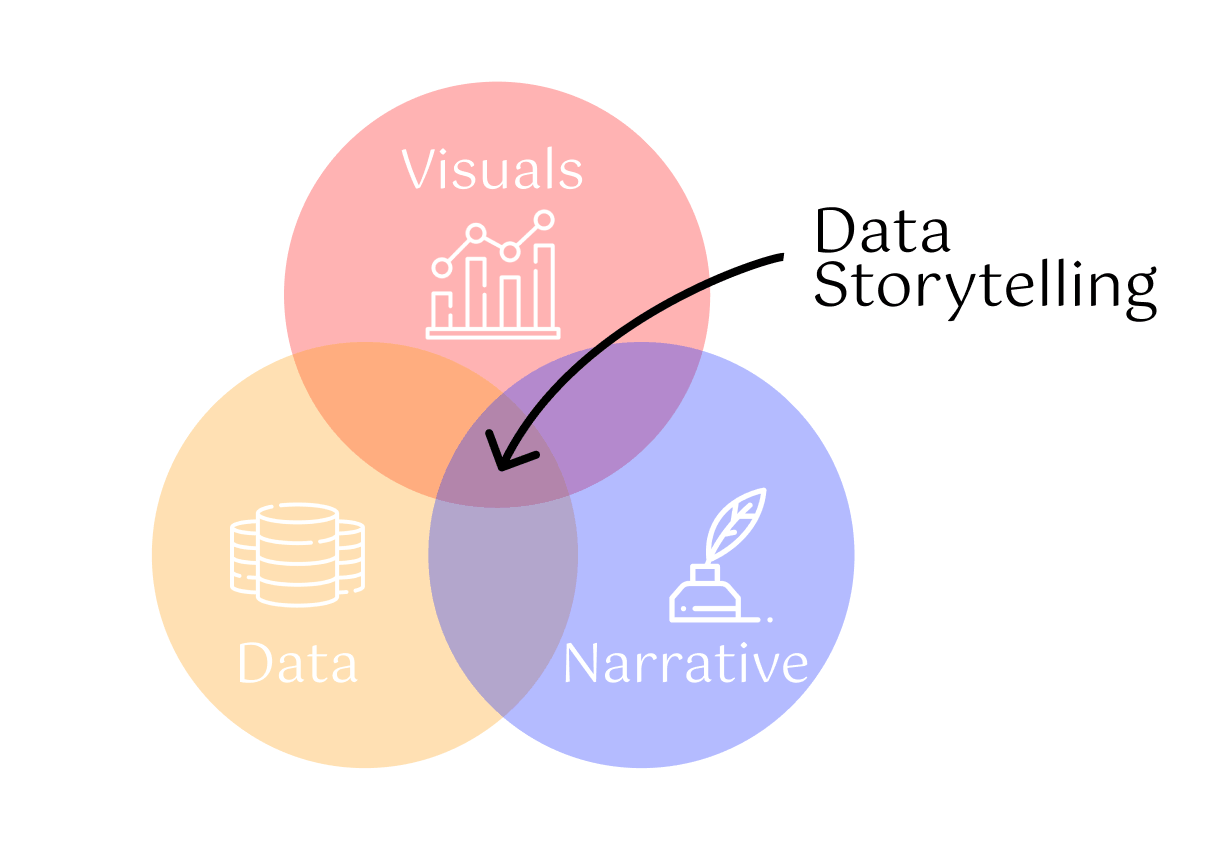
The art of storytelling in data analytics bridges this gap. Storytelling turns the columns of numbers, graphs, and dashboards into a narrative, which appeals to human feelings, makes sense, and encourages decision-makers to take action wisely.
Data storytelling can be thought of as the art of providing context to statistics. Data should not flood people with information that leaves a feeling of confusion; instead provide clarity that answers serve. Imagine a firm that records a decline in customer retention by 20 per cent. The figure is worrying but it does not tell why it occurred or what it means going forward. It is vital to provide a narrative that accompanies data, like customer dissatisfaction over the speed of service or the newly emerging competition in the market. This story enables stakeholders not only to be familiar with the problem but also to connect it to the bigger picture of company development and customer service. Data storytelling is a nearly hidden process of placing facts within a frame easier to perceive and memorize so that they reach beyond the analytics team and affect the general audience successfully.
One of the most successful things about storytelling in data analytics is that it makes data relatable. Stories have always been the way people in the world make sense of this world, using myths and legends in ancient times and case studies and success stories in business today. Stories help build a relationship of empathy and understanding that is not always created by pure statistics. As an example, when a healthcare report merely mentions that hospital readmission rates are down by 15 per cent. However, once expressed in the context of a story about how fewer patients are returning to the hospital, and how they can actually spend more time with their families, the data values become more reflective to a customer. The advantage of storytelling is that it links data and information to real experiences of people, making them interesting and not just informative.
In practice, there is little that is purely accountable by figures. Executives, managers, and policymakers tend to react to accounts that focus on the why and how of data. This is where storytelling can serve as a mediator between analysis and action. As an example, when presenting sales to the leadership, one cannot simply demonstrate sales trends or market share. A data analyst who is able to develop a story about changing customer trends, new competitive threats, or the effectiveness of certain initiatives will be much more convincing to the leadership team about where to invest. Numbers are used to make decisions but stories are used to convince. This skill to convince is why data storytelling has become such an important competency in analytics.
Moreover, data analytics are given structure and sequence via storytelling. Big data is usually chaotic, confusing and very bulky, and it takes significant insight to determine useful information. A good storyline binds together the most pertinent details, filters out everything that is incidental, and forms a stream that the listener or reader can follow. As a novelist crafts chapters to create tension, leading to resolution, data storytellers work to structure their discoveries in the same manner, moving sequentially to problem, insight, solution. This design avoids information overloading and helps the audience understand what is best to believe without being diverted by insignificant information.
Visualizations can be viewed as the foundation of data analytics, yet lacking the content of storytelling, even the most mature parent will fall short of communicating effectively. A chart might show a downturn in quarterly earnings, but unless augmented with a narrative indicating possible causes and outcomes, it will be misinterpreted or simply ignored. Storytelling presents the interpretive level that animates visualizations. An example is a line graph that is positive which may indicate that there is an increasing traffic of people on the webs; however, the exposition that most such traffic is in geographies that are irrelevant and that all such traffic does not result in conversion alters the context completely. The visual itself is not the value, but what is behind it.
Affect is another important aspect of a data analytics story. Data can be objective, but decisions are made based on human emotions. Stories are also used to trigger emotions that can spur engagement and commitment. A nonprofit that reports that it served 5,000 families in one year can definitely prove it with that figure. A story about a single family that was the beneficiary of that program, accompanied by the general statistic, produces an even stronger appeal to the heart. People are more likely to remember and act on a story that moves them than a statistic that merely informs them. This combination of emotion and evidence is what makes storytelling so powerful in the analytics space.
The importance of storytelling in data analytics is also pertinent because it establishes trust. Qualitative data may be scary to individuals without a technical background. Pages of charts, percentages, and tables are known to turn off audiences or render them distrustful of the results. When an analyst tells a story that provides meaning to the data in terms people understand, relating it to familiar situations, and describing the practical implications, trust starts to build. Storytelling demonstrates that the analyst can not only interpret the figures but also the concerns and context of the audience listening. This strengthens validity and creates the probability that the audience will adopt and take action based on the insights provided.
The purpose of storytelling goes beyond mere communication of information or statistics; it can also be used to drive vision and creativity. When numbers are presented in a powerful narrative, they tend to show opportunities or problems that numbers themselves can never expose. As an example: A data-led story on the declining youth activity in a brand may not only report the issue but also lead to creative brainstorms on new campaigns, platforms, or new product lines. By arranging data within a larger narration of a change, growth, or risk, analysts can lead organizations into outthinking and innovating, instead of only reacting to emergent issues.
Besides, to make analytics inclusive, storytelling is paramount. A data literacy level will not be the same across everyone in an organization, and it is unrealistic to expect that everyone can interpret complex data independently. Storytelling balances the power dynamic in terms of information by making it accessible to all, even those with no technical know-how. By making the data-driven discussion accessible through the use of relatable analogies, real-world examples, and simple narratives, analysts manage to make the discussion easier to understand and contribute to by diverse audiences. This inclusivity not only democratises data but also provides a broader spectrum of perspectives in decision-making.
Besides organizational decision-making, the concept of storytelling in data analytics is imperative in creating societal narratives to nudge societal transformation. Data-driven stories are often used by governments and international organizations to create awareness of such as climate change, poverty, or public health. The statistics of the increase in the global temperature can be abstract, but along with the narrative about communities facing drought and flood or food insecurity, the message becomes clear and compelling. They inspire action, marshal resources and instil a sense of shared responsibility in a way that can never be achieved with numbers alone.
The role that storytelling plays in data analytics has also been boosted by technology. Intuitive tools such as Power BI, Tableau and other visual intelligence tools facilitate the creation of interactive and visually compelling dashboards. However, the most effective dashboards are ones that integrate storytelling into the design, including leading the user through the problem and to solutions. How modern tools have made possible a more dynamic storytelling puts into perspective the interactivity with audiences, being able to dive into the different angles of the data, but still with a narrative, helping to sideline them. The capability to integrate technology and storytelling will only increase in value as analytics progresses.
Lastly, the actual effectiveness of storytelling about data analytics is transforming data into action. All data is wasted without action, yet when presented as a narrative, data becomes something that leads to measurable improvement. Whether this is a company that wants to make its operations more efficient, a government that wants to create more effective policies, or a nonprofit seeking to rally people around its cause, storytelling helps make the data count, which is its final goal. For learners strengthening these practical skills through a Data Analytics course in Noida, understanding how to combine insights with compelling narratives becomes a critical advantage. Insights delivered through stories become memorable, persuasive, and actionable, creating a lasting impact far beyond what isolated numbers can achieve.
In conclusion, storytelling is not an accessory in data analytics; it is a necessity. It gives meaning to numbers, humanises insights, and connects with emotions in ways that pure analysis cannot.