Concepts of Python Exceptions and Errors
In Python, an error is an issue with the code that fails to allow the code to work as desired. There are two broad categories of errors which are syntax errors and exceptions. Syntax Error Syntax errors happen when the interpreter of a particular language (Python in this case) comes across, wrong code syntax, like wrong keyword, wrong parenthesis etc. These become evident before a program is run and needs to be logged in order to run the program.
On the contrary, exceptions occur when the program is running and at some point something out of exception happens and gives rise to some abnormal outcome. An instance where exceptions occur is when the user divides a number by zero or tries to access a file that is unavailable. Exceptions are unlike errors caused by syntax. They happen in syntactically sound code and must be dealt with before the program causes a termination.
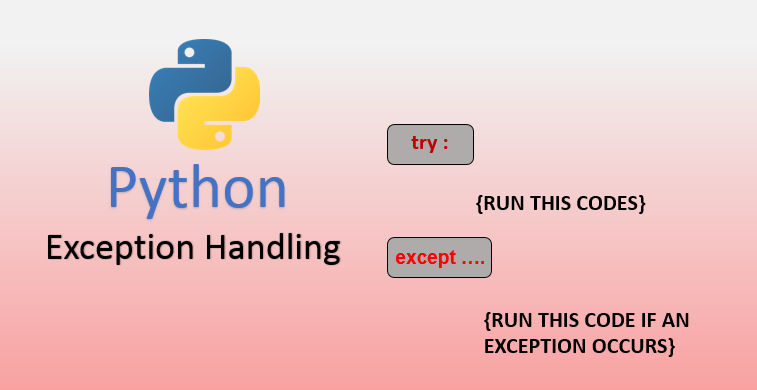
Python exceptions are objects that signify a run-time error. Python creates an exception object when an exception occurs and tries to find a handler with the help of the try-except-clause. When an exception occurs and no handler can be found, the program breaks off and traces back to the point of error.
Key Exception Handling Keywords
The exception handling in Python makes use of a number of keywords:
try: Is a placeholder (block) of code where there can be exceptions.
except: Mentions the exception handlers of the exceptions thrown in the try block.
else: Conditional block to be used when there are no exceptions during running of the try block.
lastly: Code that executes no matter what an exception happens.
manual raising of an exception: To manually raise an exception.
assert: A debugging utility, which is tested and throws AssertionError on non-truth.
Real World Use of Exception Handling
It employs the use of try and except Blocks
The simplest method of exception handling in Python is to place potentially erroneous code in a try block, and errors that will occur after this code is executed in an except block or blocks that will correspond to each type of error that is expected. Execution pauses and jumps to the nearest code except that fits an exception.
Example:
Copy Code
try:

result = 10/0

except ZeroDivisionError:

print("Division by zero.")
It catches this ZeroDivisionError and provides a friendlier message to the user rather than ending the program in an abrupt manner It is possible to process exceptions different types in separate except blocks:
Copy Code
try:

my_list = print(my list)

except ZeroDivisionError:

print("Division by zero.")

except IndexError:

print("The index is out of range.")
This makes clarity and correct diagnosis of problems.
Raising Exceptions
The python gives developers the experience of deliberately throwing exceptions by use of the raise keyword. This can be helpful in imposing restrictions or suspension of execution in case conditions are not satisfied.
Example:
Copy Code
def set_number(num):

in case num is greater than 5:

raise ValueError(f"The maximum number should not be more than 5. ({num=})")
Descriptive messages help in debugging and control within the program through raising an exception.
Taking else and finally
The else code executes only in case there is no exception raised in the try block. It is appropriate when dealing with a code that must be run only when there is a successful try.
a finally block will always run code to clean up after itself such as closing files or releasing resources even with exceptions.
Example:
Copy Code
try:

file = open("data.txt")

data= file.read()

except FileNotFoundError:

print("Can not find file.")

else:

print("The file was read successfully.")

finally:

file.close()

print("The file is closed.")
This strategy will ensure the management of the resources and transparency in the flow of the program.
Excellent Python Exception Handling Guidelines
The following are the best practices to write maintainable experienced Python programs:
Exception specific: Use specific exception catching instead of bare except clause because all the exceptions can be captured and may conceal unexpected errors and become tricky to debug. Rather, catch exceptions which you anticipate and in which you can do something useful.
avoid big blocks: Do not use keep blocks just to cover lots of code, as only the statements that could result in an exception should be contained in a keep block. This localization is easier to understand and maintain a flow of control.
ExceptionsLog exceptions that you catch and, even when you handle the exception, do so to assist with diagnostics and auditing.
Avoid empty passes: Do not do such things as pass empty except blocks (e.g., except Exception: pass) since these exceptions will not be signalled, a silent pass.
Create custom exception classes: You should use your own class of exceptions by extending the base Exception class in the domains specific to your error to mirror your error.
Clean up with finally: The resource cleanup operations can be performed using finally even when exceptions are not raised.
Assertions are only used, they can be used for debugging only: since during the development they can detect programming mistakes but can be turned off in production, so do not use them as important runtime checks.
More Features of Python Exceptions Handling.
Exception handling abilities have been added to recent Python versions (3.10 and 3.11):
Structural pattern matching: Allows matching types of exceptions in a match-case statement, which is more readable in the handling of multiple exceptions.
Exception groups: The Python 3.11 version introduced exception groups that can be used in managing multiple exceptions handled in parallel in asynchronous programming.
Fin-grained line numbers: Debugging is also simplified since tracebacks are now able to highlight specific sub-expression that is causing the exceptions.
Exception notes: Exception add could be noted by the add_note() method by the developers with informative notes.
PEP 654: Introduces a more efficient means of processing nested exceptions, so as to debug a complex workflow, like multiprocessing, more easily.
Such properties offer the capacities of strong error handling in present-day Python programs.
How to learn Python Exception Handling Uncodemy Courses
Those who are interested in learning more about exception handling in Python can take extensive courses of Uncodemy, which are adjusted to different levels of skills:
Robust Curriculum: The Python courses fundamentally taught in Uncodemy include exception handling concepts such as, try-except, except, finally block, Exception raising, and also custom exceptions. This well-organized method also makes foundational to advanced concepts mastered.
Practical Experience: The students would be committed to practical sessions such as working with various exception types, nested try block and file activities. Such a practical training instills confidence and expertise in dealing with errors.
Flexible Learning: Uncodemy offers offline as well as online courses in various locations such as Mohali, Noida, Delhi and Chennai, which caters to the various learning needs.
Careers Support and Placement Assistance: Other than education, Uncodemy provides careers support and job placements to the student so as to use their new proficiency in the job market.
Exception Handling Expert Modules: Exception handling expert modules outfit learners with skills to write professional quality Python code which can continue operations even in the event of errors.
After taking Python training courses with Uncodemy, students will not only learn the theory, but will acquire realistic skills, necessary to start their professional career in programming.
Summary
Python exception handling is a needed tool to author robust software which is able to handle errors in a graceful fashion. Keywords such as try, except, else, finally, raise, and assert are essential in order to take care of exceptions. The quality of code is improved by best practices like catching particular exceptions, keeping the try blocks focused, logging errors, and finally cleaning up with finally. The new features of Python include increasingly expressive and powerful exception handling tools.
To the people who prefer productized learning, Uncodemy provides comprehensive material, projects, self-study options, and career support, and it is an excellent option when it comes to learning or enhancing your own Python exception handling abilities.
Handling exceptions well enhances program stability but also leads to a rise in productivity of the developer, as it makes applications easier to maintain and understand, and user friendly.
Wish to learn the topic of Python exception handling? Then you should remember to get a solid foundation by going through the entire course on Uncodemy to get expert training on Python and then grow your career in coding.