Introduction to Queues in Data Structures
Mr. Bambam Kumar Yadav/ 3 days ago - 15
- 11 min read
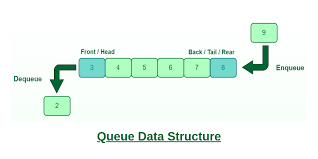
What Is a Queue?
A queue is a linear data structure that places elements into a unique order (First-In, First-Out (FIFO)). The first element put on a queue is the first to be removed. This can be compared to a person in line for tickets to a movie theater; they are the first one there, so they get the first ticket.
Key Concepts:
FIFO Principle: The first item added to a queue is the first item removed (FIFO).
Two Ends: items are added on the rear (end), and removed from the front (start).
Ordered Processing: ensure tasks or data are processed in the order they were received. This is important for fairness and scheduling.
Common Example: think of a line to get on a bus; the first person to the bus stop gets to get on the bus first.
Main Parts of a Queue
Front: Points to the element that will be removed next
Rear: Points to where the new element will be added
Size: Current Elements
Capacity: Maximum Elements a queue can have.
Basic Operations in Queues
Queues support a set of foundational operations required for effective data management:
| Operation | Description |
|---|
| Enqueue | Add an element to the rear of the queue |
| Dequeue | Remove and return the element from the front of the queue |
| Peek/Front | View the element at the front without removing it |
| isEmpty | Check if the queue is empty |
| isFull | Check if the queue is full (for fixed-size queues) |
These operations are part of hands-on modules in Uncodemy's Data Structure course, allowing students to implement and experiment with real code scenarios
Types of Queues
There are many unique forms of queues, each with specific uses.
1. Simple (Linear) Queue
The classical FIFO arrangement.
Items inserted at the rear are deleted at the front, all while maintaining ordering.
Typical uses for simple queues include basic scheduling, buffering, and executing tasks sequentially.
2. Circular Queue
The last element connects first element, creating a circle.
The circular structure helps to use space better by wrapping around if it reaches the array boundaries (solves "false overflow" problem).
Commonly used in resource allocation, streaming buffering, and CPU scheduling.
3. Priority Queue
Each item inserted is given a priority.
Each priority queue serves an item based on its priority, regardless of the order of production.
Typical uses for priority queues include job scheduling and simulation.
4. Double-Ended Queue (Deque)
A deque allows items to be inserted and deleted from either the front or the rear.
For some algorithms and caching procedures, the deque is useful.
These variations are further dissected with designed projects and practical exercises as a part of Uncodemy's style of learning.
Real-World Applications of Queues
- Operating System Task Scheduling: Manages processes and print jobs to ensure fairness (FIFO model).
- Web Servers and Networks: Buffers requests and load balances,
- Depth-first search (Graphs): Queues order the work to be done in many algorithms, about which nodes to visit next.
- Messaging systems: Buffer and deliver messages in communication systems.
- CPU/resource allocation: Circular queues can manage resources efficiently in time-sharing systems.
Queue Implementation: How Are Queues Built?
Queues can be represented as follows:
- Arrays: fixed-size queues, with relatively simple logic, which should be used with small and predictable workloads.
- Linked Lists: dynamic queues that grow and shrink, which help implement the kind of queue for applications with unpredictable demand.
In Uncodemy's Data Structure course, students get to implement both queues using an array and a linked list with practical experience and examples on time/space complexity, performance, trade-offs, and tendencies to make coding errors.
Step-by-Step: Queue Operations
Insert (Enqueue)
- Check if the queue is full (only applies to limited capacity queues)
- If not full, increment the rear pointer and add the element
- Update the size
Remove (Dequeue)
- Check if the queue is empty.
- If not empty, remove the element at the front.
- Increment the front pointer and update the size.
isEmpty / isFull
These methods are helpful for preventing underflow (removing from an empty queue) or overflow (adding to a full queue in static implementations).
Visualization: How a Queue Works
Think of a queue as a tunnel. Elements “enter” at the rear and “exit” through the front. As operations progress:
- The rear pointer advances with every insertion.
- The front pointer advances with every removal.
- In dynamic queues, pointers wrap around or nodes are dynamically created and destroyed.
Circular and Priority Queues in Practice
Circular Queues: Be efficient and handle the inefficiencies of simple queues that have wasted space after several dequeue operations. Circular queues help with data streaming, buffering, and round-robin CPU scheduling by making sure that every space is reused.
Priority Queues: Typically implemented via heaps, a priority queue is to serve elements with a higher meaning (priority) before others. Some common use cases include handling packets to and from a network, simulation systems, and event-driven programming.
Uncodemy's Data structure course provides the theory, and then shows students from all over how to code their own circular queues and priority queues in hands-on labs to cement their learning into practical algorithms and case studies.
Common Queue-Driven Algorithmic Patterns
Breadth-First Search (BFS): When exploring graphs, queues let you visit nodes level by level. This is super important for finding the shortest routes, solving mazes, and fixing network issues.
Sliding Window Techniques: Queues, sometimes deques, keep an eye on stuff in a moving window. This helps figure out the biggest or smallest parts of an array, making solutions good and easy to follow.
Level Order Traversal in Trees: Binary trees are explored one level at a time. A queue stores the nodes you need to visit. This is key for working with data that's structured like a hierarchy.
Topological Sorting: For directed acyclic graphs, queues help handle nodes without incoming blocks. This creates correct process orders for scheduling or building systems.
Task Scheduling: Servers and processors with multiple threads use queues to handle jobs. This evens out the load and makes the most of resources.
Queues vs. Other Linear Data Structures
| Feature | Queue (FIFO) | Stack (LIFO) | Linked List |
|---|
| Access | Front/Rear only | Top only | Anywhere |
| Use Case | Scheduling, Buffers | Undo/Redo, Recursion | General purpose |
| Removal | Always front | Always top | Any position |
How Queues Are Taught in Uncodemy's Data Structure Course
- Understand the Idea: Start with easy-to-see examples like waiting in line.
- Code Together: Practice coding using both arrays and linked lists.
- Real Projects: Create things that are actually used, like scheduling jobs or handling messages.
- Test Yourself: Check your knowledge with quizzes about different queues and how well they work.
- Get Help: Watch videos, talk to experts to get your questions answered.
- Always Available: Access course stuff and code when you need it to review.
Queue Up for a Strong Data Structures Foundation
Understanding queues is super important for school tests and job interviews. Uncodemy's Data Structure course walks you through it, step by step, with projects that let you see how it all works. You won't just learn about queues; you'll actually use them in projects, interviews, and everyday tech problems. Whether you're making apps or getting ready for a coding interview, queues keep your code organized and running smoothly. So, get your queue knowledge in order and get ready to code with certainty!
Frequently Asked Questions (FAQs)
Q1: What is the main advantage of using a queue data structure?
A: Queues ensure orderly processing—first-come, first-served—making them ideal for scheduling, resource allocation, and fair handling of tasks.
Q2: How is a circular queue different from a linear queue?
A: Circular queues reuse empty slots by wrapping around, maximizing storage efficiency, while linear queues may leave unused spaces after deletions.
Q3: Are queues only used in computer science?
A: No, queue logic is found throughout everyday systems, banks, traffic signals, and customer service, which require sequential, fair service.
Q4: Does Uncodemy's Data Structure course include live coding and real projects on queues?
A: Yes, the course integrates practical labs, real project development, and interactive sessions to master queues and other fundamental structures.
Q5: Why do queues matter in programming interviews?
A: Queue-based questions test understanding of order, memory use, and efficiency—key areas for algorithm and systems design rounds.