Machine Learning (ML) has become the backbone of many smart applications and business decisions in today’s tech-driven world. From recommendation systems to customer segmentation, ML techniques are solving real problems across industries. One such fundamental technique is K-Means Clustering—a powerful algorithm that automatically finds patterns and groups in data without needing labels.
In this blog, we’ll explore K-Means Clustering in detail, understand how it works, see a real-life use case, and even go through a simple Python example. Whether you're a student, a data enthusiast, or a beginner exploring ML, this guide will walk you through the concept in the simplest terms.
🧠 What is Clustering in Machine Learning?
Before understanding K-Means, let’s first understand clustering.
Clustering is an unsupervised learning technique in machine learning. That means we give the machine data without any labels—no categories or tags—and it tries to find patterns on its own. The goal of clustering is to group similar data points together based on their features.
Imagine you have a basket of mixed fruits—apples, bananas, and oranges—but they’re unlabeled. You can group them by looking at their shape, size, and color. This is what clustering does: it groups similar things together based on characteristics.
✨ What is K-Means Clustering?
K-Means Clustering is one of the most popular and easiest clustering algorithms in machine learning.
Here’s the idea:
You specify the number of groups you want (this is K).
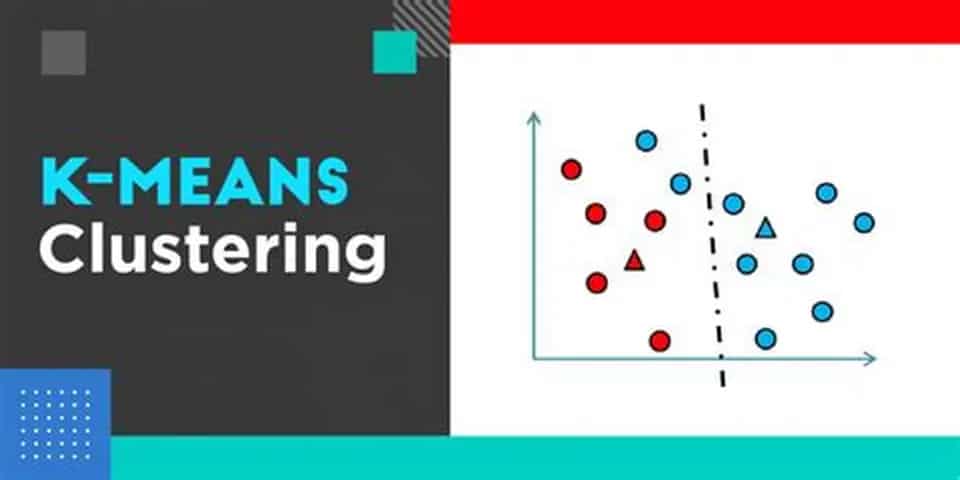
The algorithm finds K centers (called centroids).
It assigns each data point to the nearest centroid.
The centroids are then adjusted, and the process repeats until everything stabilizes.
Let’s understand this with a day-to-day analogy.
🍕 Analogy: Grouping Pizza Orders
Suppose you're running a pizza shop and want to understand your customers' ordering habits. You have order data based on:
Order amount
Number of pizzas
Time of day
Using K-Means Clustering, you can automatically group your customers into:
Office bulk orders
Family dinner orders
Individual lunch orders
Without labeling anything, the algorithm identifies patterns and clusters similar customers together.
🔄 How K-Means Clustering Works (Step-by-Step)
Let’s break down the algorithm step-by-step in the easiest terms:
Step 1: Choose the Number of Clusters (K)
You decide how many clusters (groups) you want. Example: 3.
Step 2: Place Centroids
The algorithm randomly places K centroids (points that represent the center of a cluster).
Step 3: Assign Data Points
Each data point is assigned to the nearest centroid, creating K groups.
Step 4: Recalculate Centroids
The centroids are moved to the average position of all points in that cluster.
Step 5: Repeat
Steps 3 and 4 repeat until the positions of the centroids don’t change much. This is called convergence.
Done!
You now have K groups, each with similar data points.
🧪 Real-World Use Case: Customer Segmentation
📊 Scenario:
You are a marketing manager at an e-commerce company. You want to group your users based on their shopping behavior to personalize marketing campaigns.
🧾 Data You Have:
Total spending
Number of orders
Visit frequency
Location
Using K-Means, you set K = 4 and let the algorithm find 4 customer segments. You might get:
Segment 1: High spenders with frequent orders (Premium Customers)
Segment 2: Budget shoppers who purchase often (Loyal Bargain Hunters)
Segment 3: Occasional high spenders (Seasonal Shoppers)
Segment 4: Inactive users
Now, you can send:
Premium discounts to Segment 1
Flash sales to Segment 2
Re-engagement emails to Segment 4
This is how K-Means Clustering adds real business value.
💻 Python Code Example (Simple)
Here’s a basic Python implementation using scikit-learn:
from sklearn.cluster import KMeans
Copy Code
import numpy as np


# Sample customer data (spending vs frequency)

data = np.array([

    [100, 10], [200, 20], [300, 30],

    [10, 1], [20, 2], [30, 3],

    [500, 40], [550, 45], [600, 50]

])


# Create KMeans model with 3 clusters

model = KMeans(n_clusters=3, random_state=42)

model.fit(data)


# Output centroids and labels

print("Centroids:\n", model.cluster_centers_)

print("Cluster Labels:\n", model.labels_)
🛠 Where is K-Means Used in Real Life?
K-Means is widely used across industries. Here are some practical applications:
Industry
Use Case
E-commerce
Customer segmentation, product recommendations
Healthcare
Patient grouping based on symptoms and history
Banking
Grouping transactions for fraud detection
Social Media
Analyzing user behavior and content interaction
Retail
Store inventory categorization
Education
Grouping students based on performance and engagement
✅ Advantages of K-Means Clustering
Simple and Fast: Easy to understand and implement.
Efficient for Large Datasets: Works well even on big data.
Scalable: Can be adapted for large-scale applications.
Versatile: Useful across various domains and industries.
⚠️ Limitations of K-Means Clustering
Need to Choose K: You must manually set the number of clusters.
Sensitive to Outliers: Outliers can skew cluster results.
Works Best with Circular Clusters: If clusters are irregularly shaped, performance drops.
Random Initialization: May give different results if centroids are randomly placed differently.
❓ How to Choose the Right K?
Choosing the right value of K is crucial.
📉 Elbow Method:
This is the most popular technique.
Run K-Means with different values of K (e.g., 1 to 10)
Plot the cost (called inertia) against the number of clusters
Look for the “elbow” point in the curve where the gain slows
That point is often the best choice for K
📚 Want to Learn K-Means with Real Projects?
If you're excited to learn more about clustering, machine learning models, and real industry projects, we highly recommend you check out the Machine Learning Using Python course in Noida by Uncodemy.
This course includes:
Basics to advanced machine learning techniques
Real-world case studies like customer segmentation, prediction models, and fraud detection
Hands-on projects with Python, scikit-learn, and more
Expert mentorship and industry-focused training
Whether you're a student or a professional, this course will guide you step-by-step into the world of ML.
🙋♀️ FAQs on K-Means Clustering
Q1. Is K-Means Clustering supervised or unsupervised?
A: K-Means is an unsupervised learning algorithm because it doesn’t use labeled data.
Q2. What does “K” stand for?
A: “K” stands for the number of clusters you want to form.
Q3. Can K-Means handle non-numeric data?
A: No, K-Means works only with numerical data. Text data must be converted using techniques like TF-IDF or embeddings.
Q4. Can K-Means be used in image processing?
A: Yes! K-Means is used for image compression, color quantization, and pattern recognition.
Q5. How do I improve K-Means performance?
A: Use normalization, remove outliers, and experiment with different values of K using the Elbow Method.
🏁 Final Thoughts
K-Means Clustering is a beginner-friendly yet powerful technique in machine learning. It lets you automatically group data, discover hidden patterns, and make intelligent decisions—without requiring labeled datasets. From customer segmentation to image processing, the applications are vast and practical.
If you're ready to master not just K-Means, but a whole range of ML algorithms with practical exposure, we highly recommend the Machine Learning Using Python course in Noida by Uncodemy. It’s a career-launching course designed for real success in today’s AI-driven world.