Cloud Based and Hybrid Data Warehouses
Their extreme scalability, flexibility, and cost effectiveness (commonly charged on a pay-as-you-go basis) are yet another reason why cloud data warehouses are rapidly becoming the preferred enterprise solution. The organizations can use these platforms to scale resources to avoid unwanted over-provisioning or under-provisioning based on varying workloads. A March 2026, survey of 259 qualified respondents, the majority in North America, found that 58.2 percent of companies were researching or considering modernization to cloud data warehouses. Also, cloud data warehousing helps to reduce expenses through the administration of resources and decrease operational costs as well as make reduced investments in frontends and upkeep.
On-premises Hybrid modals that integrate the cloud data warehouses with on-premises systems, are becoming increasingly popular. The models enable businesses to store confidential information on-premises, and to exploit the elasticity of the cloud to perform real-time analytics and AI tasks. Although a survey conducted by TDWI in 2021 pointed out that 53 per cent of the companies used on-premise data warehouses and 36 per cent operated cloud-based data warehouses, the growth direction is towards cloud-based data warehouses. Cloud database platforms such as Snowflake, Microsoft Fabric and Google BigQuery get to be dubbed as the future because of their scalability, flexibility, cost-effectiveness and capacity to augment the performance of queries to be run.
Analytics and Processing of Real-Time Data
The growing demand for timely information is motivating the use of real-time data processing capacities. Innovations, such as streaming technologies and advanced analytics frameworks, are being incorporated into modern data warehouses in order to process incoming data in real-time so that organizations can respond fast to changes in the market. Such change allows making better decisions within the operations and customer experience optimization. Applications which require real-time processing and analysis include fraud detection, operational dashboards and tactical decision making. According to a survey done in March 2026, 63.7 percent of companies were either researching or considering real-time analytics.
Real-time data warehouses update data continuously whereas in the traditional data warehouses the data is mostly stored in a batch manner and is therefore less current. Data warehousing can be done in real time by use of tools such as Snowflake, Google BigQuery and Amazon Redshift. Real-time analytics is implemented through the use of a streaming data ingestion, in-memory databases with real time dashboard design.
ADA + AI/ML Integration
Artificial intelligence (AI) and machine learning (ML) have been getting incorporated into the architecture of data warehouses in order to manage and analyze data better. Automation of data quality checks, management of metadata and query optimization is being performed via use of AI-driven tools. The advanced analytics also rely on such technologies and allow predictive modeling and anomaly detection. This is achieved by integrating AI into the data warehouse to derive a higher degree of knowledge and hence better the total process of decision-making. This is based on a KPMG GenAI survey which showed that 50 percent of leaders find that GenAI investments should generate considerable value by improving current products by analyzing customer data. Adoption rates of AI and ML in analytics are predicted to hit 40% annually by the year 2026.
Nevertheless, for successful application of AI, data inadequacies, especially data quality and governance, and the complexity of unstructured data need to be addressed. The versatility and sheer amount of unstructured data (text, video, image, audio) required to train models, which can hardly be governed, managed, and secured, is a specific challenge to generative AI (GenAI). In spite of these issues, GenAI can automate manual data management and governance artifacts, including the generation of metadata labels, the annotation of lineage information, augmentation of data quality, and increased data cleansing capacity, policy compliance administration, and data anonymization.
Data Lake House convergence
There is also the convergence of the data warehouses with the data lakes. Data lake houses are a hybrid of data lakes and data warehouses with all the important attributes of those: scalability, flexibility, and performance. Using this unification approach enables organizations to store all their structured, semi-structured and unstructured data in a single location and at the same time carry out complex analysis. Organizations that require to scale how much data is processed within its organization, how fast and with how little cost will require data lake houses in the future but they are already currently being employed to hasten new business cases such as IoT insights and real time insights. The market size of data lake houses will increase by 22.9 percent every year on average, reaching over 66 billion dollars by the year 2033.
Data fabric and Data Mesh
New horizontal data architectures are forming in the form of data mesh and data fabric in order to combat data silos of the past. Data mesh is a model of decentralizing data ownership and data governance and enabling individuals within an organization to control and distribute their data as a product. Data fabric instead is the connective tissue that unifies and virtualizes data of a wide variety of sources. The combination of these approaches makes a more agile, easier to work and acceleration over a data infrastructure, as it would crossover the ease of data sharing and access to knowledge. As an illustration of the problem, grocery giants used a data mesh with a data fabric to overcome silos and make data more readily available and to make means of effective decision-making based on the data. Although suggestive, these strategies are premature and organizations implementing them might experience difficulty of implementation and lack of available tools.
Fine tuned Data Governance and Security
As data grows bigger and more complicated, effective governance and security structures are important. The next generation data warehouses are adopting state-of-the-art security processes that include encryption, role-based access control (RBAC) and monitoring in real-time to impose data integrity, regulatory compliance and mitigate threats and vulnerabilities as they develop. Improved metadata governance and data lineage are also some of the effectiveness through which trust can be maintained in data-driven decision-making. The most concentrated efforts of organizations are on more effective data security (54 percent), data quality practices (48 percent), and data governance frameworks (45 percent). MDM practices are also critical, so that when streaming of the data is done only correct, consistent, and validated master data is streamed
Automation and Self Service Analytics
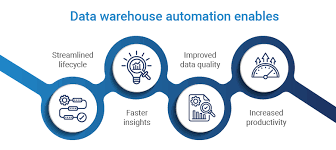
Automation is also an important part of today's data warehouses where not only the error prone manual impact is eliminated but also the IT resources are left free to engage in newer and more strategic projects. The data pipeline is smoothened by automated integration, data cleansing and transformation processes. Self-service analytics products allow business users to find and use data as well as analyze it to encourage a data-driven organizational culture based on organization-wide data-driven decision-making. As well, maintenance on infrastructures is reduced when automating the roles of technical management.
Market outlook and Best Practice of Data Warehouses
It demonstrates the importance of the global data warehousing market as it is projected to achieve a value of over $30 billion in 2026 and $51.18 billion in 2028. The current, 2026 modern data warehouse design places its main focus on speed, intelligence and integration, where it is possible to retrieve data from a number of sources and crunch that all in real-time, driving machine learning pipelines and providing on-demand intelligence.
There are some best practices with regard to data warehousing in 2026 and these are:
A Clear Strategy: Companies have to define the use case of their data warehouse, real-time decision-making, reporting, or driving a machine learning model.
Application of a powerful Data Model: An effective warehouse must use a powerful data model. Such an approach, flexibility over predefined join paths, is urged to use the 3NF model (third normal form).
Focus on Effective Data Integration: Effective ETL (Extract, Transform, Load) or ELT (Extract, Load, Transform) flows are a must. The use of the capabilities of modern warehouses to achieve transformations at scale and built-in workflows of ELT are viewed as the future.
Paying attention to Data Quality and Governance: Automatization of the data quality checks, introducing high-quality data governance implementations (such as Alation or Collibra) will guarantee the data quality, provide the data lineage trace, and implement protection policies.
Migration to the Cloud: The Cloud-based platform will help to be able to scale, to be more flexible, to have lower costs and support the query performance, and it can become very important in the future and present needs.
By using AI and Machine Learning: AI powered insights should be facilitated in data warehouses, anomaly detection should be automated and forecasts should be enabled, through platforms such as Databricks and Amazon SageMaker.
Designing Sustainable Data Warehouses: Designing Sustainable Data Warehouses: Minimizing the compute and storage resources and utilizing the renewable energy sources are a few steps to creating an environmentally friendly data warehousing approach.
Planning for the future: although not yet commonplace, learning about quantum algorithms and quantum systems, as well as hybrid systems, can actually give a serious edge in the future.
Uncodemy Training Courses in Data warehouse architecture in 2026
Uncodemy has a variety of courses to assist new professionals in staying current with such shifts, such as:Data Warehouse Architecture Trends 2026": The course provides the latest updates of the cloud-based data warehouses, real-time analytics, and AI integration with real-life examples of designing and implementing a modern data warehouse architecture.
Modern Data Architecture and Cloud Data Warehousing : This is the course that will be devoted to the basics of cloud data warehousing, such as the possibility of scaling, cost optimization, and incorporation of recent technologies, such as AI, and machine learning.
Advanced Data Governance and Security in Data Warehouses: This course will learn on how to create and deploy effective data-governing frameworks, and the safety of sensitive data and how to make sure that there is compliance on regulatory procedures in the ever-changing data environment.
This is an opportunity to adopt these trends and keep learning and updating the skills that qualify them to become the frontiers of change in 2026 and beyond in shifting data warehouse architecture.