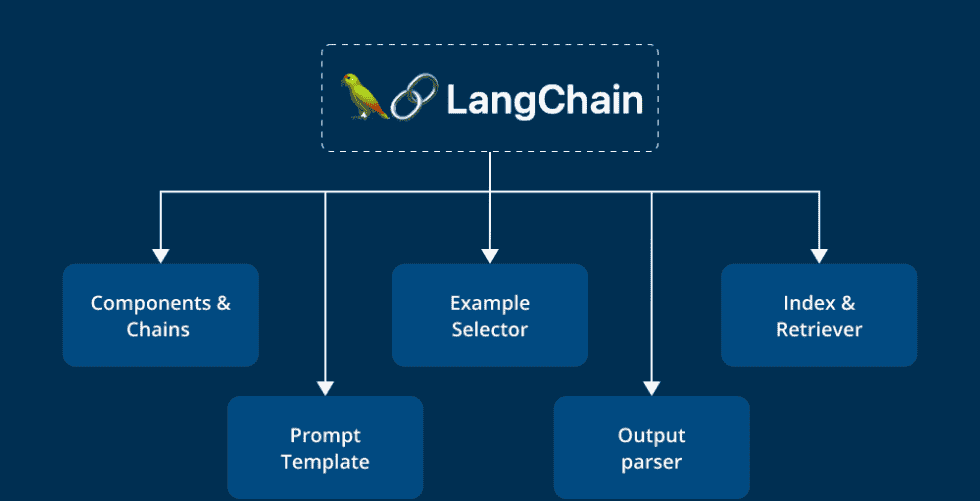
LangChain is designed to bridge the gap between raw language models and real-world projects. It provides pre-built components, chains, and agents that help developers manage tasks such as question-answering, summarization, code generation, and multi-step reasoning. With LangChain, developers don’t need to worry about the low-level details of connecting a model to data sources, APIs, or other software systems. Instead, they can focus on creating high-value applications that leverage AI effectively.
Key Features of LangChain for Developers
LangChain provides several features that make it particularly appealing for developers:
1. Chains: Chains allow developers to link multiple operations together, enabling multi-step reasoning. For example, a workflow might first extract data from a document, summarize it, and then generate a response based on that summary.
2. Agents: Agents are tools that allow language models to make decisions and take actions dynamically. They can call APIs, retrieve external data, or trigger other processes based on context.
3. Memory: LangChain supports memory components that let applications remember previous interactions, which is crucial for building chatbots or AI assistants that can maintain context over multiple sessions.
4. Integrations: LangChain integrates seamlessly with APIs, databases, and document stores, allowing developers to access real-world data dynamically rather than relying solely on static input.
Real-World Applications of LangChain
LangChain’s flexibility makes it suitable for a variety of practical projects. Here are some examples:
1. Intelligent Customer Support Systems
Customer support chatbots often require understanding user queries, retrieving relevant information, and providing helpful responses. Using LangChain, developers can build AI-powered support agents that not only respond to frequently asked questions but also retrieve data from internal knowledge bases, CRM systems, or product documentation. By integrating memory, these bots can maintain a conversation’s context and provide a more personalized user experience.
For example, a retail company can implement a LangChain-based bot that answers customer queries, tracks order status, and escalates complex issues to human agents while maintaining conversation history. This reduces response times and increases customer satisfaction.
2. Automated Content Generation
Content creation is another domain where LangChain shines. Developers can use chains to automate blog writing, social media post generation, or email drafting. By combining retrieval chains with generative models, AI can pull information from relevant sources and generate content that is coherent, accurate, and context-aware.
For instance, a marketing team can deploy a LangChain application that takes a topic, gathers relevant news or research, and produces draft articles that human writers can then refine. This significantly speeds up the content creation process and ensures consistency in tone and style.
3. Personal AI Assistants
LangChain enables the creation of personal AI assistants capable of performing tasks like scheduling, note-taking, or summarizing documents. By integrating external APIs and memory components, these assistants can adapt to a user’s preferences and provide proactive suggestions.
Imagine a project management assistant that reads emails, extracts deadlines, schedules tasks in a calendar, and provides daily summaries of project progress. LangChain’s chains can coordinate these tasks sequentially, while agents can dynamically decide what actions to take based on context.
4. Document Understanding and Summarization
Businesses often deal with large volumes of text data–contracts, reports, research papers, or technical manuals. LangChain allows developers to create applications that read, understand, and summarize documents efficiently.
For example, a legal tech application can ingest contracts, extract key clauses, and summarize obligations or risks. Developers can build retrieval chains that query specific sections of documents and feed them into language models for summarization or analysis. This reduces manual effort and ensures critical information is highlighted.
5. Knowledge Base Question-Answering
LangChain can also power question-answering systems over large datasets. By integrating with databases or document stores, developers can allow users to ask natural language questions and receive accurate, context-aware answers.
For example, a university might build an AI assistant that answers student queries about course materials, schedules, or academic policies. By using LangChain’s memory and retrieval chains, the assistant can provide precise answers, reference supporting documents, and maintain conversational context across multiple queries.
6. AI-Driven Data Analysis
LangChain isn’t limited to text generation–it can also assist in data analysis and reporting. Developers can build applications that take raw datasets, generate insights, and produce human-readable reports. By chaining steps like data retrieval, transformation, and explanation, LangChain ensures that AI-generated analyses are coherent and actionable.
For instance, a financial application could automatically analyze sales data, detect trends, and produce summary reports with charts and insights, making it easier for business teams to make data-driven decisions.
7. Code Generation and Automation
Developers can leverage LangChain for programming assistance, such as code generation, debugging, or workflow automation. By integrating with version control systems, APIs, and IDEs, LangChain can create tools that automatically write, test, or document code.
For example, an AI-powered assistant could generate boilerplate code for repetitive tasks, provide suggestions for optimizing functions, or even automate deployment scripts. This accelerates development cycles and reduces human errors in software projects.
8. Multilingual Applications
LangChain can be used to create multilingual tools for translation, content localization, or cross-language data processing. By integrating translation APIs and language models, developers can build applications that understand and generate content in multiple languages.
For instance, a global customer support system could provide real-time translations of user queries and responses, ensuring a consistent experience for users across different regions.
9. Research and Knowledge Extraction
Researchers can use LangChain to extract insights from academic papers, patents, or technical documentation. By automating information retrieval and summarization, LangChain helps researchers save time and focus on higher-level analysis.
An AI application could scan thousands of research papers, identify relevant findings, and summarize them in structured formats. This is particularly useful in fields like medicine, law, or engineering, where staying updated with literature is critical.
10. AI-Orchestrated Workflows
LangChain also excels at building multi-agent AI workflows, where multiple models interact to perform complex tasks. Developers can orchestrate sequences of models, integrate APIs, and make conditional decisions using LangChain’s agent architecture.
For example, a content moderation system could use one AI model to detect offensive content, another to categorize it, and a third to suggest corrective actions–all coordinated in a single workflow.
Why Developers Prefer LangChain
Developers love LangChain for its flexibility, scalability, and efficiency. It eliminates much of the repetitive plumbing work involved in connecting language models to real-world applications. By offering chains, agents, memory, and integrations, LangChain allows developers to focus on problem-solving and innovation instead of infrastructure.
Its open-source nature also encourages community contributions, plugin development, and experimentation, making it a continually evolving ecosystem. Whether building chatbots, AI assistants, or research tools, LangChain reduces complexity while maintaining full control over the AI pipeline.
LangChain has proven to be an indispensable tool for developers looking to build real-world AI applications. Its architecture simplifies the integration of language models into practical projects, enabling automation, efficiency, and scalability. From customer support systems to content generation, multilingual tools to AI-powered assistants, LangChain provides the framework, flexibility, and structure necessary to bring AI ideas to life.
Final thoughts
LangChain is not just another developer framework –it’s a game-changer in how we think about integrating language models into real-world applications. What sets it apart is its ability to take something as complex as AI reasoning and break it down into manageable, modular components. Whether it’s through chains for structured workflows, agents for dynamic decision-making, or memory for maintaining context, LangChain gives developers the building blocks to create solutions that are both intelligent and practical.
For beginners, one of the most exciting aspects covered in this Artificial Intelligence course is how approachable the framework is. You don’t need to build massive infrastructure or reinvent the wheel. LangChain’s pre-built tools allow learners to focus on solving real-world problems, from building smart chatbots to automating document analysis. At the same time, this Artificial Intelligence course also showcases advanced possibilities for experienced developers, including multi-agent systems, knowledge retrieval pipelines, and AI-powered automation—without sacrificing flexibility or control.
As the AI landscape evolves, frameworks like LangChain will play a central role in shaping how businesses and individuals adopt intelligent tools. It empowers developers to bridge the gap between raw language models and real-life use cases, making AI more accessible, functional, and scalable.
Whether you’re working on your first AI side project or building a production-grade enterprise solution, LangChain offers a solid foundation. With its growing ecosystem and active community, now is the perfect time to experiment, build, and innovate using LangChain.
Uncodemy empowers learners and professionals to master in-demand tech skills through practical, real-world training. By focusing on hands-on learning, industry relevance, and strong mentorship, Uncodemy helps individuals confidently step into their careers. It’s not just about courses–it’s about building future-ready talent for a fast-evolving world.