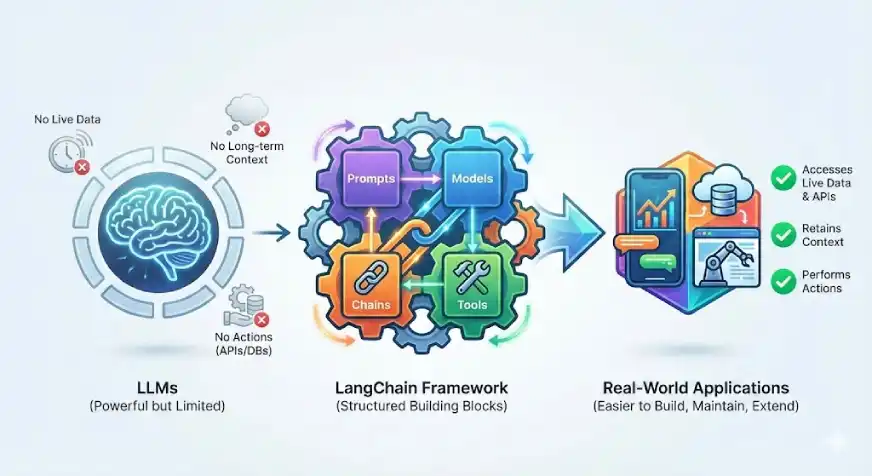
Nevertheless, this does not have to be a problem. LangChain is not just a different approach or a higher-level model-it is the new generation of smarter, more flexible AI-based solutions. LangChain allows developers to harness the core power of language models efficiently alongside other aspects such as logical memory databases, API, and custom. By doing this, it opens the gates for designing AI operational streams which match up exactly with the requirements of the human world.
One of the important facets of LangChain is its power to transform from an onlooker and a one-off to a more engaging and interactive use of AI. Herein, the article serves as a full breakdown of LangChain, its operating principle, benefits, use cases, problems, and a forecast of its future.
What exactly is LangChain?
LangChain is an open-source toolkit that aims to ease the use of language models in diverse applications and pretty much any environment. It essentially connects the decision-making acumen of LLMs with external gadgets and predefined processes through code.
It would really be helpful to view the AI model as a powerful brain, while the LangChain framework represents the nervous system which connects the brain with the rest of the body, that is, the arms, legs, and senses. The latter does not make the AI less smart but rather, it upgrades the AI’s cleverness by bringing it context, memory, and other resources to the table for interaction.
For example, a standard AI model might just rely on its training data to provide an answer related to a company’s policy. Meanwhile, the same query processed with LangChain may first access the organization’s policy repository, then gather a customer’s records and subsequently, produce a response that aligns with the given context. Therefore, technologies like LangChain go way beyond the concept of a mere instrument or a tool - it becomes a complete framework responsible for creating AI solutions that simulate human-like thought processes.
Why Developers Choose LangChain
LangChain is chosen by developers and embraced by companies more and more over time because this product perfectly pinpoints the most important problems of large language models and proposes the most logical solutions:
- Bridging Knowledge Gaps: LLMs are not able to update themselves automatically. The presence of LangChain allows them to access updated data through APIs, databases, and so on.
- Contextual Interaction: From the perspective of embedded memory, targeted communication can grasp the content that was talked about in previous talks and thus not repeat and be redundant in the answers given.
-
- Custom Workflows: The developers have the liberty to craft these activities into workflows where multiple steps such as interpreting, retrieving data, analyzing, and responding can be performed in a continuous flow.
-
- Flexibility in Model Choice: LangChain does not limit a user to only one AI vendor because it is compatible with multiple AI providers thus, a user has the freedom to select whichever provider suits his/her needs best.
-
- Scalable Integration: This feature makes it possible to design a solution for a small project then making it grow over a period of time and converting it into a company solution without having to change the core design.
-
Such features help LangChain not only to be a technological tool but also to be a business enabler that provides organizations with the room to gain the most from AI.
Core Components of LangChain
To really get a thorough understanding of LangChain you should look at its different core components; all of them have an important function in enabling the user to make custom workflows.
1. Language Models
Ultimately, the core of LangChain is the language model, whether it be GPT, LLaMA, Claude, or any other LLM. LangChain just provides a more organized and structured environment that allows the better utilization of these models.
2. Prompts and Chains
Prompts are specific documents or instructions that guide an AI on what and how to answer. LangChain extends this concept with chains, representing the connections between the prompt and the next AI action. The chain can, for instance, first digest a document, then translate and finally make a report of it.
3. Memory
Memory is what characterizes conversational LangChain. Instead of seeing every input as isolated, the system can still remember previous questions, decisions, or responses. Due to this feature, memory has a great use in chatbots, tutoring software, or research tools.
4. Agents and Tools
On the other hand, Agents in a LangChain workflow are like the resources that support the executive function. They decide what tool to use according to the question. For example, if a user gives the command to a financial chatbot to calculate the interest, then the agent may call a calculator API to do the calculation before the final explanation is generated.
5. Data Integration
LangChain helps users to use data from different sources such as PDFs, Excel files, and even databases or web pages. This allows designing the AI workflow that not only learns from the training data but also reasons from the given real-time knowledge.
How LangChain Operates in Real-World Scenarios
To understand the work of LangChain, let’s see some practical examples:
- Healthcare Assistance: A chatbot that would interact with a patient can be aware of the memory of the previous conversation if the patient describes/helps the symptoms, checking for the perfect answer in the hospital database with the support of data integration, and then giving the answer with the help of both reasoning and real data.
-
- Legal Document Analysis: Lawyers can utilize the LangChain flow to upload contracts, and it can assist in summarizing, identifying potential dangers, and even finding similar laws in external databases.
-
- Customer Support: Rather than offering generic answers, support bots designed using LangChain could first analyze the customer’s history, get the most recent status of the order, and then present the most relevant solution.
-
In all these cases, LangChain does not simply come up with one answer; it selects, organizes, and executes a series of steps combining reasoning, memory, and data retrieval to provide accurate and actionable results.
Advantages of Using LangChain
LangChain offers numerous benefits, not all, but some of the most notable are:
- Dynamic Responses: Instead of relying on static knowledge, apps built on LangChain can connect to live sources.
-
- Natural Conversations: Since context and memory are available, interactions tend to be smoother and closer to the natural human conversation.
-
- Adaptability: Practically any company from the finance, the education industry, and so on can customize the workflows according to their needs.
-
- Efficiency: The automation of chains results in the reduction of manual work and the acceleration of the processes involving decision-making.
-
- Future-Ready Design: Since LangChain is not bound to one model, developers can switch models as the technology changes.
-
Being able to expand and modify with time makes LangChain a perfect pick for AI long-term development.
Applications Across Industries
LangChain is not restricted only to a certain field of work; its flexibility allows it to be applicable in different sectors:
- Business Operations: The business can automate monotonous tasks that involve the generation of reports, and customer onboarding, etc.
-
- E-commerce: Customized shopping helpers that remember what the user likes and also synchronize with the available stock.
-
- Education: Tutors that learn the preferred coaching style of a student from past interactions.
-
- Research: Tools that pull complete information from multiple academic sources, summarize it, and recommend new research directions.
-
- Healthcare: Patient support systems that merge historical records with up-to-date information.
-
Every application becomes more efficient when it incorporates LangChain since it links knowledge, reasoning, and memory.
Key Challenges and Limitations
Even with his strengths, LangChain is not without difficulties:
- Learning Curve: Newbies might find it difficult to grasp the idea of prompts, agents, and chains.
-
- Dependence on LLM Accuracy: The correctness of outputs still heavily depends on the base model.
-
- Resource Consumption: The process of running multiple steps or integrating a large database can be both costly and time-consuming.
-
- Ethical Concerns: The misuse of workflows might cause biased or misleading outputs, which is a risk if the issue of careful monitoring is left aside.
-
The mentioned problems push for designing more thoughtful, continuous monitoring and responsible usage.
Future Outlook of LangChain
With the development of AI adoption, LangChain is likely to become even more crucial. The future may introduce:
- Simpler Interfaces: Making it non-technical people workflows building skills.
-
- More Efficient Memory Systems: Making the system more affordable and accurate.
-
- Enterprise Integration: Getting more synergy with tools like CRM platforms, ERP systems, and data warehouses.
-
- Ethical Safeguards: The built-in systems for eliminating the bias and increasing the transparency.
-
In most respects, LangChain symbolizes the waypoint to where AI development is moving towards user-interaction, data-awareness and contextual-consideration.
Conclusion
Within no time, LangChain has established itself as one of the major frameworks in the AI ecosystem. It essentially allows the applications to extend the limits of large language models (LLMs), memory, tools, and structured workflows and go way beyond mere text generation.
Customer support, healthcare, education or research – LangChain’s versatility makes it suitable for all these and more, besides, real-life use cases are where it excels.
Its potential lies not only in what it is capable of doing today, but also in how it is gradually evolving. The arrival of developers, businesses, and researchers would be none other than the LangChain platform to design more intelligent, more reactive, and more human-oriented AI systems. For aspiring professionals who wish to build expertise in such advanced AI frameworks and real-world implementations, enrolling in an AI course in Delhi can provide structured learning and practical exposure aligned with industry demands.
In the nearest future, it is very likely to turn into a lead in the building and launching of custom-made AI workflows, making it even more important for learners to strengthen their foundation through a comprehensive Artificial Intelligence course in Delhi focused on modern AI tools and workflow development.
Frequently Asked Questions
Q1. What problem does LangChain solve?
LangChain manages the problem of utilizing language models in real-world scenarios that call for conversations with external tools, memory systems, and live data sources.
Q2. How does LangChain improve chatbot design?
LangChain can bring additional power to chatbots by implementing memory and contextual workflows. It makes sharing of fixed and general answers impossible, rather, the conversations allow recalling of past states, checking of databases, and the provision of pertinent responses.
Q3. Can LangChain integrate with my company’s existing systems?
Of course, LangChain was created to interface with databases, APIs, and even internally developed tools. Subsequently, this makes it good for businesses that have AI technology laid on top of their infrastructure.
Q4. Is LangChain free to use?
Besides the fact that LangChain itself is open-source, there are costs depending on the use of language models, APIs, or external services integrated into the workflows.