In the world of computer science and programming, one of the fundamental challenges is comparing two sequences—whether they are strings, arrays, or other data structures—and identifying the parts they have in common. This problem, known as the Longest Common Subsequence (LCS), is an important topic taught in any Algorithms Course in Noida because of its wide applications in areas like bioinformatics, text comparison, data compression, and version control systems. For beginners, understanding the LCS algorithm opens the door to mastering dynamic programming, a powerful approach used to solve optimization problems efficiently.
This article provides a student-friendly, detailed explanation of the LCS problem, its applications, and the step-by-step coding implementation. By the end, learners will not only understand the logic behind the LCS algorithm but will also be able to apply it practically using Python or any other programming language they choose.
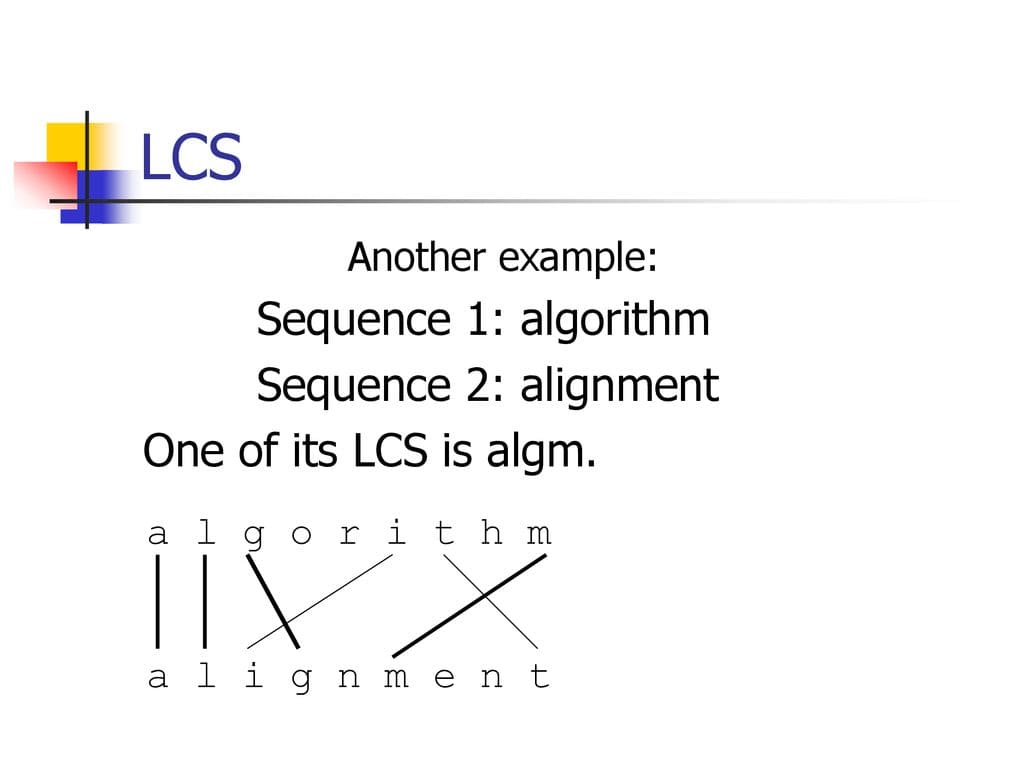
The LCS(Longest Common Subsequence) problem can be defined as follows: Given two sequences (for example, two strings), find the length of the longest subsequence present in both. A subsequence is a sequence that appears in the same relative order but not necessarily contiguously.
To illustrate, consider the strings “ABCDEF”and “AEBDF”. Their longest common subsequence is “ABDF”, which has a length of 4. Notice that the characters appear in the same order in both strings, but they are not necessarily adjacent.
It is important for students enrolled in an Algorithms Course in Noidato recognize that the LCS is not the same as the longest common substring. A substring requires continuity, while a subsequence only requires relative ordering.
Real-World Applications of LCS
Why should beginners care about LCS? Understanding the LCS problem goes beyond theoretical interest. Here are a few real-world applications where the LCS algorithm plays a critical role:
Text Comparison:Tools like diff and version control systems (Git, SVN) use LCS to compare files and track changes between versions.
Bioinformatics:LCS is used to analyze DNA or protein sequences to identify similarities between genetic material.
Data Compression:Some compression techniques rely on identifying repeated subsequences.
Spell Checkers and Auto-correct:Algorithms use LCS-like methods to suggest corrections based on common patterns.
These applications make it essential for students in an Algorithms Course in Noidato develop both a theoretical understanding and a hands-on ability to implement LCS.
Naive Approach to Solving LCS
At first glance, one might try to solve the LCS problem using a simple recursive approach that explores all possible subsequences. While this works conceptually, it is highly inefficient, especially for long sequences.
The naive recursive approach has an exponential time complexity (O(2^n)), which means that as the input size increases, the computation time grows unmanageably large. This inefficiency makes it unsuitable for practical applications, leading to the need for a more optimized solution: dynamic programming.
Dynamic Programming Approach
Dynamic programming (DP) is a strategy used to break down problems into overlapping subproblems, solve each subproblem once, and store its result for future reference. For the LCS problem, this means filling out a table where each cell represents the LCS length for a specific pair of prefixes of the two sequences.
Here’s how it works:
Define a two-dimensional table dp where dp[i][j] holds the length of the LCS of the first i characters of sequence A and the first j characters of sequence B.
Initialize the table with zeros.
Fill in the table using the following rules:
If the characters match (A[i-1] == B[j-1]), set dp[i][j] = dp[i-1][j-1] + 1.
If the characters do not match, set dp[i][j] = max(dp[i-1][j], dp[i][j-1]).
The value in the bottom-right corner of the table (dp[m][n]) gives the length of the LCS.
By using dynamic programming, the time complexity reduces to O(m*n), where m and n are the lengths of the two sequences. This makes it feasible to apply the LCS algorithm to large sequences efficiently.
Step-by-Step Code Implementation
Now let’s walk through the implementation of the LCS algorithm using Python. Students enrolled in an Algorithms Course in Noidacan follow along and even adapt this code for use in other programming languages like C++ or Java.
                             def lcs(X, Y):
                                m = len(X)
                                n = len(Y)
                                dp = [[0] * (n + 1) for i in range(m + 1)]

                                # Build the dp table in bottom-up fashion
                                for i in range(m + 1):
                                    for j in range(n + 1):
                                        if i == 0 or j == 0:
                                            dp[i][j] = 0
                                        elif X[i - 1] == Y[j - 1]:
                                            dp[i][j] = dp[i - 1][j - 1] + 1
                                        else:
                                            dp[i][j] = max(dp[i - 1][j], dp[i][j - 1])

                                # Backtrack to find the LCS string
                                lcs_str = ""
                                i, j = m, n
                                while i > 0 and j > 0:
                                    if X[i - 1] == Y[j - 1]:
                                        lcs_str = X[i - 1] + lcs_str
                                        i -= 1
                                        j -= 1
                                    elif dp[i - 1][j] > dp[i][j - 1]:
                                        i -= 1
                                    else:
                                        j -= 1

                                return dp[m][n], lcs_str

                            # Example usage
                            A = "ABCDEF"
                            B = "AEBDF"
                            length, sequence = lcs(A, B)
                            print(f"LCS length: {length}")
                            print(f"LCS sequence: {sequence}")
Explanation
This code first builds a two-dimensional dp table and fills it according to the LCS rules. Then it backtracks from the bottom-right corner to reconstruct the actual LCS string. Finally, it returns both the length and the sequence itself.
Students are encouraged to test the program with different input strings, such as "AGGTAB" and "GXTXAYB", to see how the LCS changes.
Variations of the LCS Problem
Beyond the basic LCS problem, advanced learners and students in an Algorithms Course in Noidamight encounter variations, including:
Print all LCS sequences:Instead of just one LCS, generate all possible longest common subsequences.
Space-optimized LCS:Use only two rows instead of the full table to reduce space complexity.
LCS for three strings:Extend the LCS algorithm to handle three sequences instead of two.
These variations deepen one’s understanding of dynamic programming and problem decomposition.
Common Pitfalls and How to Avoid Them
Beginner programmers often face a few common challenges when learning to implement the LCS algorithm:
Off-by-one errors:Remember that the dp table is of size (m+1) x (n+1) to accommodate the base case where either string has zero length.
Misunderstanding subsequence vs. substring:Ensure the code handles non-contiguous matches, not just continuous substrings.
Inefficient recursion:Avoid using the naive recursive solution without memoization, as it is too slow for large inputs.
By practicing these careful implementations, students can avoid these errors and gain a stronger grasp of LCS.
Tips for Beginners
For those taking anAlgorithms Course in Noida, here are a few suggestions to master the LCS algorithm:
Visualize the dp table:Draw the table by hand or print it out to understand how the values are being filled.
Trace small examples: Work through short strings manually to see how the algorithm progresses.
Experiment with edge cases:Try cases with empty strings, identical strings, or completely different strings.
Reimplement in other languages:Coding the algorithm in Python, C++, or Java improves fluency across platforms.
These practices help solidify understanding and prepare learners for algorithm-based interviews or advanced coursework.
Conclusion
The LCS (Longest Common Subsequence) algorithm is a cornerstone topic in dynamic programming and an essential concept for students pursuing an Algorithms Course in Noida. By mastering this algorithm, learners develop critical thinking and problem-solving skills that are transferable across many domains, from text analysis to bioinformatics.
Through this article, beginners are introduced to the fundamental logic behind LCS, a step-by-step dynamic programming solution, and a working Python implementation. Regular practice with LCS not only strengthens algorithmic intuition but also builds a strong foundation for tackling more complex computational problems.
In summary, the LCS problem is much more than an academic exercise—it is a practical tool with wide-ranging applications. By dedicating time to learn, practice, and experiment with the LCS algorithm, students set themselves on a path toward becoming confident and capable programmers, ready to take on challenges in both academic settings and real-world scenarios.