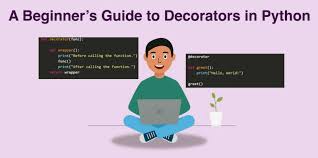
Python Decorators
A Python decorator at the fundamental level is a callable (typically a function) that accepts a function as an argument and augments or alters its actions without actually changing the specified function itself. Decorators also facilitate separating concerns because the extra functionality can be added by wrapping the functions.
Decorators act by producing a wrapper function within the decorator which invokes the targeted initial function and may perform further actions both prior and subsequent to the identical source code. As an example, this pattern is appropriate to log calls, track execution, or impose access control.
In Python, the decorator syntax consists of putting an @decorator_name line in front of a definition of a function, which is syntactic sugar for:
function = decorator(function)
This style makes functions first class items, as they can be passed as the argument, returned, and assigned to the variables just like other objects in Python.
Applications of Python Decorators in the Real World
1. To Records of the Calls to Functions
Logging functions with decorators is one of the most popular applications of decorators. As an example, via a decorator it is possible to have the time of a function's activation and arguments automatically logged, without altering the source code of the called function.
2. execution time measurements
A decorator will even be able to time how long a particular function is taking to execute and this is priceless in the event that there is need to optimize performance. The decorator captures the time before the call and after the call to the function to determine the time difference.
3. Caching / Memoization
When a computation included in a function is expensive, decorators can be used to cache the result on a call, so expensive recalculation is not done later when arguments are the same. This is much more efficient specially when dealing with recursive functions like computations to the Fibonacci series.
4. Access Control Access/Authentication
In web frameworks, decorators are widely applied to restrict the execution of the functions by executing user authentication, authorization, and privilege checks. As an example, a decorator can verify that the user is logged in before being granted access to a secured resource.
5. Pegging, Rate Enforcement
Decorators may also be used to restrict the frequency of a function call in order to prevent abuse or excessive requests, e.g. APIs requests rate.
6. Plugin Registration
The decorators are able to define functions as a part of the system in the form of plugins having a registry that can be kept in dictionary or list format. This auto-register setting will make work easy in terms of managing plugins.
7. Adding Metadata
Decorators can associate appropriate metadata or annotations with functions, like specifying the unit of values that a function produces, or with arbitrary tags on functions.
Decorator Patterns Sophisticate
Python can do more elaborate things than simple function decorators:
Decorators Chaining Decorators: Using a series of decorators on a function, with each decorator taking the output of the prior.
Arg Decorators: High-order decorator functions that take arguments in order to have flexible behaviour control.
Class Decorators: contributing to the concept of decorators; decorators are classes that implement __call__ and allow stateful decorators, which can monitor usage statistics.
Decorating Classes: In order to change or add something to the class behaviour or characteristics, decorating with the entire classes is made.
Uncodemy Python Decorators 101
When it is already time to learn decorators in Python at a deeper level and use it in practical tasks, Uncodemy introduces detailed courses with the content to match your learning rates.
Why Python Uncodemy?
Uncodemy is one of the most recognized training institutions recognized to feature professional training, hands-on curriculum and interactive learning space. They offer basic to advanced classes where you get to learn the decorator in Python as well as the other classes and have exercises on these classes so that you have a real world experience.
- The knowledgeable trainers of the leading firms take you through the ideas.
- Flexibility on the time when classes are held.
- Projects are used to reinforce knowledge by doing experiments.
- Placement fee with a discount.
- Follow up to continue even after the course completion.
- Availability of precious learning material.
This course is designed to introduce newcomers and experienced programmers to the Pythonic style of writing and how to use decorators to make the most out of their code productivity and quality in software creation, data science and automation.
Taking a course with Uncodemy will give you the power to master Python decorators and many more concepts that will provide a basis on which to build a successful career as a coder.
Summary
The Python decorators are a must-have for the developers who are interested in writing a quality and sustainable code. They could provide useful features, such as logging, caching, rate limiting, and authentication, utilized in software engineering and data science pipelines, but it can also facilitate more unique improvements. It can be an enjoyable experience to learn about decorators, and with the guided approach towards learning (as with the Python courses in Uncodemy), it becomes feasible to do so.
Using the systematically defined directions, and taking advantage of the examples from practice, you may develop a catchy and influential blog about the Python decorators that will educate and empower your readers to perform such a wonderful Python feature in their codes.
In case you may be interested to learn more about Python and decorators, it can be recommended to take Python training courses offered by Uncodemy, where going through a hands-on course and receiving feedback and help on the way to creating your coding might be of benefit.
With all this coverage, you now have the resources and background you need to become intelligent quicker on decorators in Python and you are now more equipped when it comes to handling expert codes as well as content creation services. Now that you have gotten an intro to decorators when will you start experimenting with decorators and changing your Python code bases?