Fields of Python Regular expressions
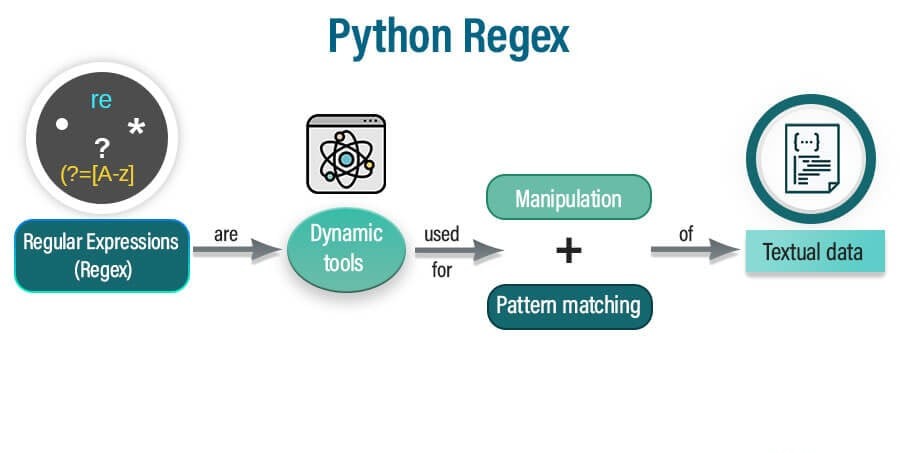
A regular expression is a pattern of specialized characters that are used in the execution of searches. Regular expressions are native in Python as the re module allows using them, i.e., searching patterns in specific strings.
Regular expressions The theory and practice
The use of the re.search() is typical when one intends to discover the first occurrence of a regex pattern in a string. The result of re.search() can be a match object in case of a match and something other than None otherwise in whatever version. Normally an if is used after a successful search to make sure of the match. An example is match = re.search(pat, str) sets the result, and then to use the group as match.group() returned in case of success. Unescaped strings can be used with recommendations to use so-called raw string, a pattern string prefixed with r (e.g., r'word:\w\w\w'), to pass backslashes without modification, which can be used very effectively in regular expressions. Simple characters, which have their usual meanings and can match exactly with themselves, and meta characters, which bear a special semantics.
Maps to one of the characters which is not the newline \n Word character ( \w ) is either a lower case letter, a lower case number or underscore ( `` ). That is, 1.3 would find its equivalent in foo123bar as 123.
Its upper-case, \W, is followed by some character that is not a member of a word, the non literal of the non literal image of its upper-case. The upper case bar, \W is the character that can have a match with any character other than a word.
Character Whitespace (\s): Anything that matches any character that is a white space (or space,newline,return,tab or form feed). We can describe S as any character, which is not whitespaces.
Decimal Digit d: number (``7 . One of the characters that do not exist in the decimal number system is character D.
Word Boundary ( \b ) This is the word and non word character boundary. Position B tips the contrary way and possesses not a word boundary position.
Start (^) and End ($): ^ was to correspond to any point at the beginning of the string and $ was to correspond to any point at the end of string.
Escape (): suppresses special interpretation of other characters e.g. not to be treated as a literal ellipsis or a literal slash.
Repetition, and Quantifiers,
Quantifiers make the regular expressions even more powerful because they dictate how many times a previous pattern should repeat.
And (-) : Influences one or more of the levels of the pattern of character on the left-hand of the pattern meaning. An example is that i+ equals i or two or more i.
Asterisk (): It desires it or some repetitions of the pattern, on the left hand of it.
News Command Inquiry (?), 7 th. A zero or one of the patterns can be compared to a zero or a one of the right.
Quantifies, such as + and which are by default, i. e. will match as far as possible. In order to make them non-greedy (i.e. match the shortest possible string) a ? may be added e.g. .? or +?. Acylation and inverted sets Another way to produce non-greedy matching is with square brackets and an inverted set to match against any character that is *not* >, e.g. to match any character other than >.
Grouping and Character Classes
A character set is written as square brackets (``) and matches any one character contained in the set. An example is the expression `` matches 'a', 'b', or 'c'. Ranges can also be used in character classes, e.g. any lower case alphabetic character or any digit. The caret ^ as the first character within a pair of square brackets complements the set, and matches any character outside that set ( e.g., ` matches any non-digit character).The so-called group feature, defined by putting parentheses ( ) round some part of the pattern, allows retrieving particular sections of whatever was matched. match.group(1) will extract the first group, match.group(2) the second, etc., and match.group() will take the whole match. This is effective where it is used in separating the username and the host of an email address.
findall() and sub() Methods
The re.findall() feature is super potent, since it locates non-overlapping matches of a design in a string and produces a list of strings as the outcome. When the pattern contains two or more groups of parentheses, findall() gives a list of tuples, the tuples containing the data of the extracted groups. Such as, in an email pattern such as r'(+)@(+)', findall() will give back a list of ('username', 'host') tuples. The entire process can also be done on the actual text of files and matches all the way in simply one go.The re.sub(pat, replacement, str) command locates all occurrences of a pattern and replaces them in a given string. The replacement string may also employ any captured groups in the initial match by using \1, \2, etc.. A specific example is a modification of email addresses that replace the email hosts at google.com with email hosts at yo-yo-dyne.com with r'\1@yo-yo-dyne.com being used as the replacement.
The mistakes and decisions of tests (Regex)
Patterns are shocking and it takes much time to debug patterns. An imagination process, its application to a small part of text and a print out of the result of the findall() could be one work flow. When no matches are found, loosen the pattern; when the wrong number are found, tighten the pattern one step at a time.The flags which can optionally change behavior to be passed after the pat and str parameters (e.g., re.search(pat, str, re.IGNORECASE)) also allowed.
re.IGNORECASE: are not case sensitive.
re.DOTALL: Causes the metacharacter dot (.) to be more than we avariciously match the newline characters which it would otherwise avoid.
re.MULTILINE: Enables the use of the + and + tokens to match the beginning of any line in a multi-line string and the end of any line in a multi-line string as well, and not the beginning of the whole string and the end of the whole string.
python regex applications
Whether Python is being used to do advanced string manipulation or to recognize patterns, regular expressions are out of the question.
They find application in many areas where they perform problems that entail text data.
Phone Number and Email extraction and identification
The most common application is as an email address validation and look up mechanism. Such a pattern as r'+@+' may match complete email addresses such as those that include such characters as hyphens and periods that are common in usernames and domain names. In the same way, phone numbers can be validated and extracted with the help of regex.
Changing and Data Cleaning
Data cleaning and transformation of sloppy data rely on regex. As an example, it may be applied to retrieve certain data points within a piece of unstructured text, normalize format, or even eliminate any unwanted characters.
It is especially applicable in such areas as data science and natural language processing.
Log files processing
Web scripting regex can be used to extract and evaluate log files in order to determine particular activities, mistakes, or user actions in IT and system administration.
One can devise patterns that will ably fit timestamps, errors codes, IPs, or special messages in the log entries.
Web scraping and information retrieval
Regular expression is useful in scraping websites to extract particular information within the HTML or XML information, e.g., the URLs, the price of a product, or the article titles.
It provides a convenient method of locating multiple varieties of types of information on web pages.
Manipulation and Text Processing
Regex is very great in parsing text into words, searching and replacement of text, and working with sub-content in large strings.
These are such activities as tokenization, search of certain keywords or phrases, mass replacement. As an example, re.sub() may be used to substitute all occurrences of an expression, and in addition, some of the original match can be included in the substitution.
Refactoring and Analysis
Developers can use regex to analyze some code e.g., locating a particular set of function calls, variable names, or regularities within a source code. It may also help to refactor, transforming the code present in a systematic manner.
Coding in Uncodemy Upping Your Regex Game
Uncodemy provides in-depth Python training programs that instruct a learner on the very fundamentals of Python right through to more advanced python programming skills such as use of Regular Expressions. They are offered in small courses that enable a learner to have skills that can be used in real life.
Features and Advantages of the Courses
The courses in Python offered by Uncodemy in places such as Noida and Gurgaon offer a number of features that are meant to result in a good quality learning experience.
Skilled Trainers: The trainers in the field are industry professionals who have a long record of experience in leading companies. Let us take the example of Mr. Rajesh, an expert MERN Full Stack Developer with more than 10 years of experience and a pro who has a good base in Python programming.
Inclusive Curriculum: The curriculum has been developed by IIT faculty and experts of the industry, and it would include basic to advanced concepts of Python. It is oriented on the practical aspects and practical experience in the industry.
Practicals and Experiments: The learners undergo practical assignments, experiments, and real-life projects to get industrial experience and hands on at the face of their skills. The examples of the projects such as Topic Modeling on News Articles, Netflix Movies and TV Show Clustering, and Company Bankruptcy Prediction are some of the topics to be discussed in the projects.
Flexibility in Learning: Uncodemy provides both offline (classroom) and online Python classes so that Uncodemy students can learn in the most convenient way according to their schedules.
Placement assistance: One of the major strengths of the Python courses offered by Uncodemy is that they will also guide you in doing the placement once you have completed the course. This encompasses resume building, interview coaching and links with some of the most outstanding companies making them employment-ready and able to get an in-between into the job market without a hiccup. Priyanka who is the Head of HR & Placement controls training and recruitment with the perspective of ensuring a smooth placement of the students.
Cheap Cost: Uncodemy also offers high-quality Python courses at affordable and clear Python course fees.
Practicality to Regex Mastery
Although the exemplified course categories of the Uncodemy platform do not explicitly feature dedicated courses on the individual concepts of the so-called "Python Regex", the conceptual training packages Seetastic.com inclined to offer in general cover the fundamental principles of strings handling and re module. Since regex functionality is quite well supported in Python, it is most likely that Python courses, in general, and practical and data science-related courses, in particular, would have extensive coverage of the theory of regular expressions. The feature of exploratory practice presented in the Uncodemy curriculum as the focus on hands-on projects and real-life applications indicates the practical attitude to such an aspect of the curriculum as text processing that largely depends on regex.
Career Impact
The programming language with a high demand in the job market is Python, and knowledge of this language, coupled with regex skills, can alter career prospects in the field of technology. Uncodemy students passing out of Python and especially those with placement are likely to bag competitive salary offers of 4 lacs to 10 lacs per annum in tech-specific areas such as Gurgaon. Examples of career paths that one can choose to pursue are data analyst, software developer, and machine learning engineer. The experience of Python is extremely on demand, so the focused training is appealing to the tech enthusiasts.
To sum up, being proficient at Python Regular Expressions is a promising skill that can be helpful as long as one is dealing with textual data and has vast applications in diverse fields of issues in technology. Uncodemy has one of the best platforms to learn Python because it offers a rigorous curriculum, well-trained teachers, hands-on projects, and good placement services so it can be a good deal to any aspiring programmer who wants to grow his or her skills, including skills on working with regexes.