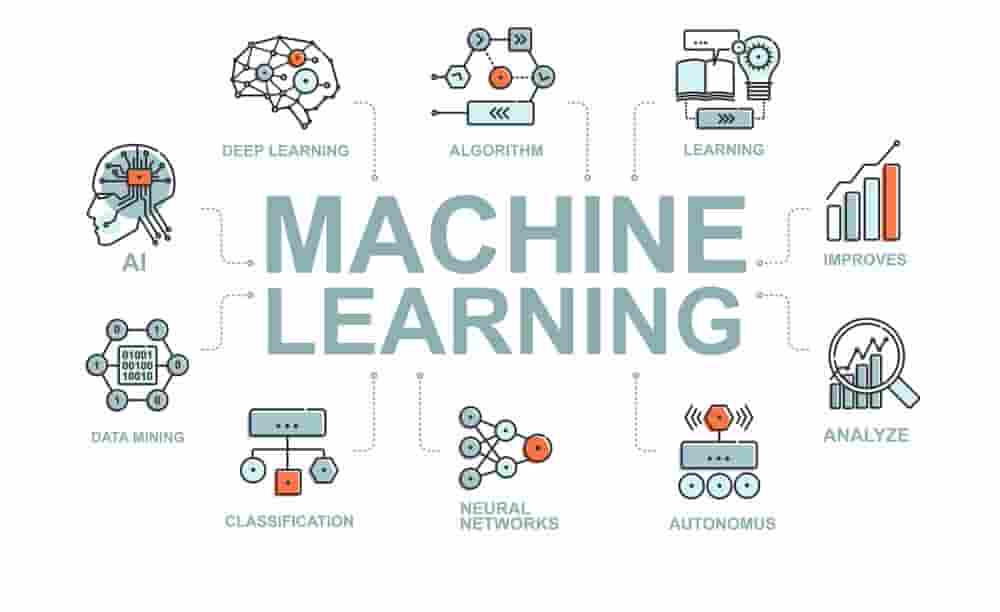
This guide is for IT folks who want to make that move. It's split into simple parts: basics, main ML ideas, more complex stuff, projects and putting things into action, and always learning. Each part builds on the last, so you learn machine learning step by step.
Part 1: Getting the Basics Down
Before you get into the details of models, it's important to get the basics right. IT people already have a benefit when it comes to programming and how systems work, but there are some areas needs focused time.
Knowing How to Code
Python is the main language for ML because it's easy to read, has a lot of tools, and a strong support group. If you know Java, C++, or other languages, you'll find Python easier to learn. You should know not just the code itself, but things like how data is organized, how to handle errors, how to design things in a clear way, and how to break code into modules. Tools like Git for keeping track of changes, Jupyter notebooks for writing code, and pip or conda for managing environments are also important.
Math and Stats
ML uses a lot of math, like linear algebra, calculus, and probability. If you don't know these, algorithms might seem confusing.
Important stuff includes:
- Linear Algebra: vectors, matrices, dot products, eigenvalues. These form the base of things like PCA and neural networks.
- Calculus: derivatives, partial derivatives, and gradients, which are needed for making models better.
- Probability and Statistics: knowing about distributions, Bayes’ theorem, hypothesis testing, and confidence intervals.
You don't have to be a math expert, but you should be able to understand the basics to make sense of algorithms and fix problems.
Working with Data
Data is key to ML. Unlike normal IT, where systems run on set rules, ML uses datasets that are often messy and big.
You should know how to:
- Collect data using APIs, databases, or web scraping.
- Clean data, like dealing with missing info and strange values.
- Change data, including setting scales and converting categories.
- Look at data using charts from libraries like matplotlib, seaborn, or plotly.
SQL is still needed for getting data from databases, and pandas and NumPy are Python libraries that are essential for working with data.
Part 2: Understanding Key ML Ideas
Once you have the basics, the next step is to learn the key algorithms and how machine learning works from start to finish.
Supervised Learning
This is the most used type of ML. It's about predicting results based on data that has labels.
For example:
- Regression: predicting numbers like house prices or sales.
- Classification: predicting categories like spam or not spam.
Common algorithms include linear regression, logistic regression, decision trees, Naive Bayes, support vector machines, and ensemble methods like Random Forests or Gradient Boosting (XGBoost, LightGBM).
Unsupervised Learning
Here, the system finds hidden patterns without labels. You can look into:
- Clustering (K-means, DBSCAN) for grouping customers or network activity.
- Dimensionality reduction (PCA, t-SNE) for making data simpler.
- Anomaly detection for finding unusual activity for security or fraud.
How to Judge a Model
A big change from IT to ML is knowing how to measure success. ML models aren't always perfect. Instead, they're measured using things like accuracy, precision, recall, F1-score, AUC-ROC (for classification), and RMSE or MAE (for regression). You also need to understand things like bias-variance and cross-validation to make sure your models are reliable.
Making Data Useful
Data often needs to be changed to work well in a model. Making, changing, and picking the correct parts of the data is often more important than the model itself.
Ways to do this include:
- Turning categories into numbers.
- Changing number scales.
- Removing data that doesn't matter.
ML Process
You need to learn the whole ML process: getting data, cleaning it, splitting it up, training models, measuring how well they work, and getting them ready to use. This makes sure a project is more than just code, but a helpful solution.
Part 3: Looking into More Complex Topics
After learning the core ML ideas, you can explore more advanced areas.
Deep Learning
Neural networks make things like computer vision and language processing possible. You should start with:
- The basics of perceptrons, activation functions, and backpropagation.
- Tools like TensorFlow or PyTorch.
- CNNs for image recognition.
- RNNs and advanced versions like LSTMs and GRUs for data that comes in a sequence.
Natural Language Processing (NLP)
With chatbots, translation tools, and voice assistants becoming popular, NLP is a key area. You should focus on:
- Cleaning text (tokenization, stemming, lemmatization).
- Representing text (Bag of Words, TF-IDF, Word2Vec, GloVe).
- Transformers and BERT, GPT.
Computer Vision
For IT people in healthcare, manufacturing, or security, computer vision is very useful. Skills include image classification, object detection, segmentation, and using transfer learning to save time.
Reinforcement Learning
Although it's more specialized, reinforcement learning is growing in robotics and gaming. Key ideas include agents, environments, rewards, and Q-learning.
Making Things Big
IT people who know about cloud and distributed systems can use that knowledge for ML. Learning about Spark, Hadoop, or distributed ML is needed for dealing with big datasets. Cloud services like AWS (SageMaker), GCP (Vertex AI), and Azure (ML Studio) can help to make scaling and deploying easier.
Part 4: Projects, Putting into Action, and Real-World Use
Knowing things isn't enough. You need to complete projects to show what you can do.
Building Projects
Start with simple projects:
- Predicting house prices.
- Classifying emails.
- Figuring out how people feel about social media posts.
Then, move to projects like recommendation systems, time series forecasting, or finding unusual activity in real-time. Each project should go from getting the data to putting the model to use.
Putting into Action
This is where IT skills are important. Real-world models need to be added to applications.
This includes:
- Making models into APIs using Flask or FastAPI.
- Using Docker for packaging and Kubernetes for managing.
- Watching models for issues and retraining them when they don't work well.
Ethics
AI ethics are important. You need to make sure things are fair, avoid being biased, and protect privacy. Tools like SHAP and LIME can help explain predictions to people who don't know a lot about tech.
Version Control
Just like DevOps changed IT, MLOps is changing ML. Learn to use version control for data and models, write automated tests, and set up CI/CD for models.
Part 5: Always Learning
ML changes quickly. You need to always learn.
Staying Up-to-Date
Read research, subscribe to newsletters, join webinars, and participate in communities like Kaggle or GitHub. You can also help with open-source projects to learn and get noticed.
Picking a Specialization
Once you're comfortable, pick an area to focus on:
- NLP for chatbots and translation.
- Computer vision for medical images.
- Time series for finance and forecasting.
- Reinforcement learning for robotics or gaming.
Soft Skills
Being able to communicate and understand business is also important. Being able to explain a complex model in simple terms is very valuable. Talking about data, showing it in charts, and talking to stakeholders helps connect tech to business.
Timeline
A plan for nine months might look like this:
- Months 1-2: Coding, math, data handling, SQL, visualization.
- Months 3-4: Supervised and unsupervised learning, small projects.
- Months 5-6: Deep learning basics, specialization in NLP or CV, medium projects.
- Months 7-9: Putting into action, making things big, advanced specialization, building a portfolio.
In Conclusion
For IT people, getting into data science with machine learning is doable and worth it. Their background in programming and systems helps, especially with putting things into action. You'll need to invest time in math, stats, and data.
By following a plan, learning the basics, exploring algorithms, diving into advanced topics, building projects, and always learning, IT people can become ML experts ready for today's jobs. It takes time, but with hard work, it can be done in a year. In a world where data is valuable, those who can make sense of it using machine learning will always be needed.