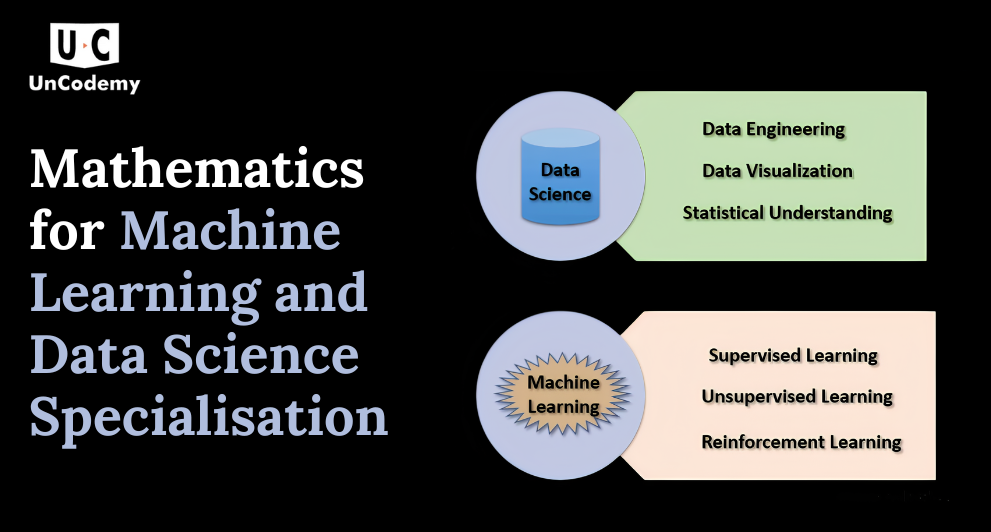
Mathematics for Machine Learning and Data Science Specialisation
Imagine trying to build a skyscraper without a solid foundation — it wouldn’t stand tall
for long, right? The same applies to machine learning and data science. Mathematics forms the backbone of
these fields, empowering students and aspiring data scientists to unlock complex patterns, make predictions,
and create groundbreaking algorithms. Let’s break it down step by step!
Why is Math Essential for Data Science?
“Pure
mathematics is, in its way, the poetry of logical ideas.”
-Albert Einstein
Mastering math for data science allows you to:
- Grasp core data science concepts like probability, statistics, and linear algebra.
- Build accurate mathematical models to represent real-world problems.
- Understand the intricacies of algorithms and data structures for efficient computing.
- Excel in a data scientist role by making data-driven decisions with confidence.
Key Mathematical Concepts for Machine Learning & Data Science
Let’s walk through the essential branches of math that every budding data scientist should
know:
1. Linear Algebra: The Language of Data
In data science, data is often represented as matrices or vectors. Linear algebra helps us
manipulate these structures, enabling algorithms like Principal Component Analysis (PCA) and Singular Value
Decomposition (SVD).
Example: Imagine you have a dataset with 1000 features — linear algebra helps
you reduce dimensionality, keeping only the most important features while preserving information.
2. Calculus: The Engine of Optimization
Training machine learning models involves optimization, and that’s where calculus comes in.
Derivatives help algorithms like gradient descent minimize loss functions, improving model
accuracy.
Example: When training a neural network, calculus helps calculate the slope of error
functions, guiding the model to make better predictions over time.
3. Probability & Statistics: The Science of Uncertainty
Understanding data means understanding uncertainty. Probability helps us model randomness,
while statistics lets us draw conclusions and test hypotheses.
Example: Spam detection uses Bayes’
theorem to calculate the probability of an email being spam based on past data.
4. Discrete Mathematics & Graph Theory
Algorithms and data structures rely heavily on discrete math. Graph theory is crucial for
tasks like social network analysis, recommendation systems, and even Google’s PageRank
algorithm.
Example: Finding the shortest path in Google Maps involves graph traversal algorithms like
Dijkstra’s or A*.
Real-World Applications of Math in Data Science
Mathematics isn’t just theoretical — it powers real-world applications like:
- Recommendation Systems: Linear algebra helps create matrix
factorization models for personalized content.
- Natural Language Processing: Probability and statistics drive
language models like GPT.
- Computer Vision: Calculus optimizes convolutional neural networks
(CNNs) for image recognition.
Building Your Math Toolkit as a Student
Learning math for machine learning might feel overwhelming, but every expert was once a
beginner. Here’s how you can build your math skills:
- Start Small: Master the basics — algebra, functions, and equations.
- Visualize Concepts: Use graphs and diagrams to make abstract ideas
tangible.
- Practice, Practice, Practice: Solve problems daily to solidify your
understanding.
- Leverage Online Resources: Platforms like Uncodemy, Coursera, and
YouTube offer free tutorials.
The Road to Becoming a Data Scientist
“Without
mathematics, there’s nothing you can do. Everything around you is mathematics. Everything around you is
numbers.”
-Shakuntala Devi.
A data scientist’s role involves more than coding — it’s about turning data into actionable
insights. Mastering mathematical concepts equips you to:
- Build and interpret predictive models.
- Design efficient algorithms for large-scale data processing.
- Make informed decisions based on rigorous data analysis.
Final Thoughts: Embrace the Power of Math
Although the journey may be challenging, the rewards are tremendous. Mathematics reveals the magic behind machine learning algorithms and data science, empowering you to transform raw data into powerful solutions. To strengthen these essential skills, Uncodemy's Data Science course in Greater Noida offers hands-on training with real-world projects and industry-relevant tools.
So, grab your notebook, sharpen your pencil, and dive into the world of math — because every formula you learn brings you one step closer to becoming a data science maestro!



















