Memory Layout in C: Stack, Heap, Data Segment
Mr. Bambam Kumar Yadav/ 3 days ago - 15
- 11 min read
In case you ever wondered why, sometimes, your program works perfectly fine on your machine and crashes on your friend's computer, or why that recursive function suddenly stops working when you increase the size of the input, then the answer lies mostly in memory management in C. So let's delve into this very crucial topic that every serious C programmer needs to dig into.
What Exactly Is Memory Layout in C?
Imagine your memory as this big building with several floors. Just as in a typical apartment building, each floor might serve a different purpose: the ground floor might be occupied by shops, the second floor by offices, with the rest of the floors set aside for residential apartments. Just like that, a good analogy for RAM being divided into different sections, each one with a particular purpose.
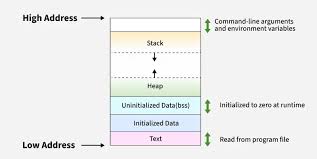
The memory layout in C mainly comprises four segments: the text segment, which is the segment for your real code, the data segment for global and static variables, the heap for dynamic placement, and the stack for local variables and function calls. Each of these areas has its own rules and limitations, which directly affect the behavior of your program.
Understanding this layout remains beyond theoretical knowledge. While working on real-life projects, mainly relating to embedded systems or performance-critical applications, knowing where your data is in the memory may be the difference between a working program and a mysteriously crashing one.
The Text Segment: Where Your Code Lives
In this text segment, the contents of your compiled program instructions are stored. That is the C code after it has been translated into the machine language that the processor understands. The interesting thing about this text segment is that most of the time it is read-only program cannot change the code during execution, and that is a good thing from the perspective of security and stability.
The compiler converts all your functions, loops, and conditional instructions into a set of machine instructions. These instructions are placed in the text segment at the time your program begins execution. The size of this section is fixed during compile time and never changes during program execution.
This read-only nature of the text segment is why code execution cannot be generated on the fly in normal C, as is possible in more interpreted languages such as Python or JavaScript. And so while on the one hand, this attribute makes C very fast and very predictable, it also limits some of the dynamic programming practices with which you may be familiar in other languages.
The Data Segment: Home of Global and Static Variables
Data segment for your global variables and static variables. Now comes the interesting part: the data segment is split into two subsections-uninitialized and initialized data segments.
The initialized data segment stores global and static variables that are explicitly given values in code. For example, if int global_counter = 100; is declared very much over the top of your program, then that variable with its initial value of 100 goes into the initialized data segment.
The uninitialized data segment, or BSS, is the area into which the global and static variables are put when you don't explicitly initialize them. It is the operating system's task to initialize them to zero; for this reason, global integers begin as 0, and global pointers start as NULL unless you do it yourself.
The most important thing to realize about the data segment is that variables kept in this segment exist for the lifetime of the program itself. Unlike local variables that may pop in and out with function calls and returns, global and static variables in the data segment remain from the time your program starts.
The Stack: Fast, Organized, but Limited
Now we get to one of the most important parts of the memory layout in C – the stack. If you've ever heard someone talk about "stack overflow" (not the website, but the actual programming concept), they're referring to this particular section of memory.
The stack behaves exactly like a stack of plates in your kitchen–plates are put onto the top back; they are taken from the top front. In C programming terms, every time you call a function, a new "stack frame" gets pushed onto the stack. This frame contains the function's local variables and parameters, the return address, and possibly other matters of bookkeeping.
And here's why the stack is so fast: accessing variables that live on the stack is ever so efficient! When the processor communicates about a particular variable, it always knows where the top of the stack is. When you declare a local variable in a function like int temp = 42;, the compiler determines where that variable will be in relation to the stack pointer, making the access practically instantaneous.
But this efficiency comes with a significant limitation – size. The stack is typically much smaller than other memory areas, often just a few megabytes. This is why recursive functions that go too deep, or functions that declare large local arrays, can cause stack overflow errors. When you exceed the stack's capacity, your program crashes, often without much ceremony.
The stack also has another interesting property – it automatically manages memory for you. When a function returns, its entire stack frame is automatically removed, effectively "deallocating" all the local variables at once. This is why local variables disappear when their function ends, and it's also why returning a pointer to a local variable is such a dangerous mistake.
The Heap: Flexible but Requires Discipline
The stack provides automatic memory management and quick performance, but the heap offers both flexibility and large memory capacity. Dynamic memory allocation occurs in the heap through functions such as malloc(), calloc(,) and realloc(). The heap operates without following the last-in-first-out sequence that the stack uses.
Memory allocation can occur at different locations in the heap without restrictions regarding allocation order or deallocation order. The heap serves ideally for cases where runtime memory requirements are unknown or when memory needs to outlive individual function execution. Flexibility requires users to handle their responsibilities properly.
The free() function needs to be used for every heap-allocated memory block after it is no longer needed. When memory remains unfreed, it creates a memory leak. Using memory after freeing it leads to undefined behavior, which might cause program crashes or silent data corruption. The heap operates at a slower pace than the stack when it comes to both memory allocation and memory access. When a program requests memory using malloc(), the system must examine the heap to locate an appropriate free memory block, which requires processing time.
Accessing heap memory can also be slower due to cache locality issues, especially if your allocated blocks are scattered throughout the heap. Managing heap memory effectively is one of the skills that separates novice C programmers from experienced ones. It requires careful planning, consistent coding practices, and often the use of debugging tools to catch memory-related errors.
How These Segments Work Together
Understanding each memory segment individually is important, but the real magic happens when you see how they work together in a complete C program. Consider a typical function call: the function's code is in the text segment, its local variables are on the stack, it might access some global configuration data from the data segment, and it could allocate temporary working memory from the heap. This interaction becomes even more interesting when you consider function pointers, which are addresses in the text segment stored as data, or when you have global pointers in the data segment that point to heap-allocated memory.
The memory layout in C provides the foundation that makes all these complex interactions possible and predictable. Performance considerations also come into play when you understand how these segments interact. Stack access is fast, heap access is slower, and data segment access falls somewhere in between. Knowing this can help you make informed decisions about where to store your data for optimal performance.
Wrapping Up: Why This Knowledge Matters
The memory layout understanding in C programming serves dual purposes because it enhances programming interview success and colleague impression (while potentially benefiting both). This knowledge enables you to develop efficient and reliable, and maintainable programs. Your understanding of stack and heap, and data segments enables you to choose appropriate data storage locations and function design methods and to avoid typical memory issues that affect many C programs.
The essential knowledge you gain from Uncodemy's C programming course in Noida or self-learning will stay with you throughout your programming career. The main advantage of C programming arises from its ability to provide direct machine-level access while maintaining sufficient abstraction for productive development. Through memory layout comprehension, you gain access to the machine-level domain, which grants you both control and responsibility that make C programming fulfilling.
Frequently Asked Questions (FAQs)
Q: What happens if I try to access memory outside my program's allocated space?
A: This typically results in a segmentation fault (segfault) on Unix-like systems or an access violation on Windows. Your program will crash because the operating system protects memory that doesn't belong to your process.
Q: Can I increase the stack size if my program needs more stack memory?
A: Yes, most operating systems allow you to increase the stack size through compiler flags, linker options, or system calls, but there are practical limits, and it's often better to move large data structures to the heap.
Q: Why do global variables automatically initialize to zero, but local variables don't?
A: Global variables are stored in the data segment, and the operating system zeros out this memory when loading your program. Local variables are on the stack, which contains whatever data was previously there from other function calls.
Q: Is heap memory always slower than stack memory?
A: Generally, yes, but the difference depends on usage patterns. Heap allocation is slower than stack allocation, and heap access can be slower due to cache effects, but the difference might not be noticeable in many applications.
Q: What's the biggest mistake beginners make with memory management?
A: Forgetting to free heap-allocated memory (causing memory leaks) and trying to use memory after it's been freed (causing undefined behavior). Both can be avoided with careful coding practices and good debugging tools.