In the ever-evolving landscape of computer science, algorithms are the heartbeat of effective and efficient programming. One of the most reliable and widely used sorting techniques, especially in the field of Design and Analysis of Algorithms (DAA), is the Merge Sort algorithm. Known for its elegant use of the "divide and conquer" strategy, this algorithm provides both speed and stability.
This article explores the merge sort algorithm in DAA in a simple yet comprehensive way. With practical explanations, real-world analogies, and essential code snippets, the content is designed to guide learners step-by-step through the conceptual and practical aspects of this powerful sorting technique.
Before diving into merge sort, let us take a quick step back and understand what sorting really means. Sorting is the process of arranging elements in a specific order, typically in ascending or descending format. Whether it's organizing files alphabetically, ordering numbers, or ranking search engine results, sorting plays a crucial role in the usability and speed of software systems.
There are many sorting algorithms, such as Bubble Sort, Selection Sort, Insertion Sort, Quick Sort, and of course, Merge Sort. Among these, merge sort stands out for its consistent time complexity and suitability for handling large datasets.
What is Merge Sort?
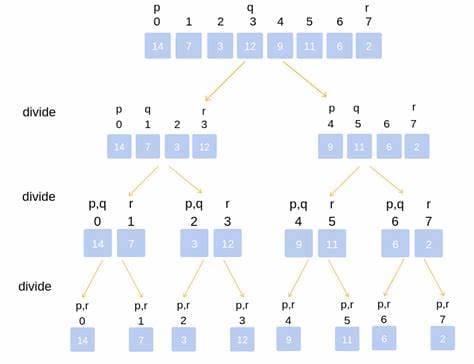
Merge Sort is a recursive sorting algorithm based on the divide-and-conquer paradigm. The main idea is to divide the array into halves, sort each half, and then merge the two sorted halves back together. This approach continues recursively until all the individual elements are sorted and merged.
Think of it like this: Imagine you're trying to sort a deck of playing cards. Instead of trying to sort the whole deck at once, you split the deck into two equal halves. You then sort each half individually and finally merge the two sorted halves. This is essentially how merge sort works, but in a computational form.
How Does Merge Sort Work?
Here is a breakdown of the key steps involved:
Divide:The array is recursively split into two halves until each subarray contains a single element.
Conquer:Each pair of subarrays is merged into a sorted subarray.
Combine: The subarrays are gradually merged back together to form a sorted array.
Why Merge Sort is Important in DAA
From a DAA perspective, merge sort is significant for several reasons:
It has a guaranteed time complexity of O(n log n), which makes it efficient.
Unlike quick sort, it is stable and doesn't degrade in performance on already sorted arrays.
It lays the groundwork for understanding recursive problem-solving and memory management.
These reasons explain why merge sort is an essential part of the curriculum in a Python Programming Course in Noida, especially in modules focusing on algorithm design and analysis.
Merge Sort Algorithm – Step-by-Step Explanation
Let us now walk through the algorithm using a simple example. Suppose we have the following array:
[38, 27, 43, 3, 9, 82, 10]
Step 1: Divide
Split the array into halves until we get single-element arrays:
Now start merging the subarrays while sorting them:
[27] and [43] merge to [27, 43]
[38] and [27, 43] merge to [27, 38, 43]
[3] and [9] merge to [3, 9]
[82] and [10] merge to [10, 82]
[3, 9] and [10, 82] merge to [3, 9, 10, 82]
finally, [27, 38, 43] and [3, 9, 10, 82] merge to [3, 9, 10, 27, 38, 43, 82]
At the end, we get a fully sorted array.
Python Code Implementation
Here’s a simple Python implementation of the merge sort algorithm:
                           def merge_sort(arr):
                            if len(arr) > 1:
                                mid = len(arr) // 2
                                left_half = arr[:mid]
                                right_half = arr[mid:]

                                merge_sort(left_half)
                                merge_sort(right_half)

                                i = j = k = 0

                                while i < len(left_half) and j < len(right_half):
                                    if left_half[i] < right_half[j]:
                                        arr[k] = left_half[i]
                                        i += 1
                                    else:
                                        arr[k] = right_half[j]
                                        j += 1
                                    k += 1

                                while i < len(left_half):
                                    arr[k] = left_half[i]
                                    i += 1
                                    k += 1

                                while j < len(right_half):
                                    arr[k] = right_half[j]
                                    j += 1
                                    k += 1
This code may look intimidating at first, but once the logic of splitting and merging is clear, it becomes quite intuitive. It's encouraged that students test this code with different inputs to fully grasp its working.
Time and Space Complexity
One of the reasons merge sort is widely used and taught in courses like the Python Programming Course in Noida is its well-defined complexity:
Best Case Time Complexity:O(n log n)
Average Case Time Complexity:O(n log n)
Worst Case Time Complexity: O(n log n)
Space Complexity: O(n) due to the use of temporary arrays
This consistent performance makes it suitable for scenarios where reliability is more important than speed in the average case.
Advantages of Merge Sort
Merge sort is not just efficient; it also brings several benefits that make it ideal for certain applications:
Stable Sorting:Preserves the original order of equal elements.
Works Well with Linked Lists:Because random access is not required.
Predictable Runtime:Performance doesn’t degrade with specific input patterns.
These characteristics are often emphasized in academic discussions around the merge sort algorithm in DAA, highlighting its practical relevance.x
Real-World Applications
Though students often learn merge sort in isolation, its practical applications span various domains:
Databases: For sorting large volumes of data stored on disk.
External Sorting:Used when data is too large to fit into memory.
Parallel Processing: Merge sort can be effectively implemented in parallel, boosting performance.
File Systems: Sorting file names, sizes, or timestamps efficiently.
Understanding these real-world use cases helps learners appreciate why merge sort isn’t just another theoretical concept but a real tool used in daily computing.
Merge Sort vs Other Sorting Algorithms
When compared with other popular algorithms:
Bubble Sort and Selection Sort are much slower with O(n^2) time complexity.
Quick Sortis generally faster but has a worst-case performance of O(n^2).
Heap Sort is not stable and has a slightly more complex implementation.
Merge sort strikes a balance between speed, stability, and predictability, making it a reliable choice.
Merge Sort in Competitive Programming and Interviews
Merge sort is frequently discussed in coding interviews and competitive programming contests. Being able to implement and explain merge sort clearly gives candidates a strong advantage.
Interviewers may ask:
To code merge sort from scratch
To explain the recursion and merge steps
To compare it with other sorting algorithms
To optimize merge sort for linked lists
Therefore, having a solid grasp on this topic is indispensable for aspiring developers and computer science students.
Tips for Learning Merge Sort
Start Small:Begin with a 4-element list to understand the division and merging.
Draw Diagrams:Visualize the recursive calls and merged arrays.
Dry Run: Manually walk through the code with a sample input.
Practice Variants:Implement merge sort for strings, objects, and in descending order.
Students in a Python Programming Course in Noida are encouraged to not just memorize the algorithm but engage with it through hands-on practice.
Conclusion
Merge sort is more than just an algorithm it’s a blueprint for thinking about problems in a structured, recursive manner. With its consistent performance and clean logic, it serves as an excellent introduction to algorithm design and analysis. For students pursuing a Python Programming Course in Noida, understanding the merge sort algorithm in DAAopens up pathways to more advanced topics like divide-and-conquer strategies, recursion, and performance optimization.
As one becomes more fluent in programming, merge sort remains a reliable companion—not just as a tool, but as a conceptual cornerstone in the broader journey of becoming a competent and thoughtful software developer.