Merge Sort Algorithm Working and Code Implementation
In the world of computer science and software development, sorting algorithms play a pivotal role in organizing data efficiently. Whether someone is working on a simple application or developing a large-scale system, the ability to sort data accurately and quickly can greatly impact the overall performance of the system. Among the many sorting techniques available, merge sort stands out for its reliability, efficiency, and elegant divide-and-conquer strategy. For students and professionals enrolled in an Algorithms Course in Noida, mastering merge sort is essential, not only for academic success but also for real-world programming challenges.
Merge Sort Algorithm Working and Code Implementation
Mr. Bambam Yadav / 1 days
0
4 min read
This article provides a comprehensive explanation of the merge sort algorithm, its working principles, detailed code implementation, and its significance in various practical applications. By the end of this exploration, readers will gain a solid understanding of why merge sort remains one of the most celebrated sorting algorithms in computer science.
Introduction to Merge Sort
Merge sort is a comparison-basedsorting algorithm that uses the divide-and-conquer paradigm. It was invented by John von Neumann in 1945 and has since become a fundamental part of algorithm courses and computer science education. In essence, merge sort breaks down a problem into smaller subproblems (divide), solves each of these smaller subproblems (conquer), and then combines the results to produce the final sorted array (combine).
Unlike simpler sorting methods such as bubble sort or insertion sort, merge sort consistently delivers good performance, regardless of the input data’s order. Its time complexity of O(nlogn)O(n \log n) makes it one of the most efficient sorting algorithms available, especially for large datasets.
For students enrolled in an Algorithms Course in Noida, understanding merge sort offers a window into the broader world of algorithmic thinking and design, demonstrating how powerful solutions can emerge from a simple yet structured approach.
How Merge Sort Works
To fully appreciate merge sort, it is essential to break down its three main stages:
1. Divide
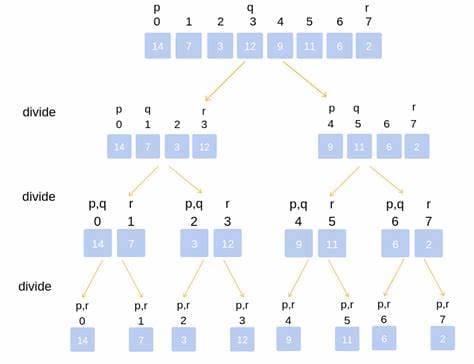
The first step of merge sort involves splitting the unsorted list into two approximately equal halves. This division continues recursively until each sublist contains only one element. At this point, each sublist is trivially sorted because a single element does not need any further sorting.
2. Conquer
Once the input array has been divided into the smallest possible sublists, the algorithm begins the process of merging them back together. This step involves comparing the elements of each sublist and combining them in a sorted manner.
3. Combine
During the merging process, two sorted sublists are merged to form a larger sorted list. This merging continues recursively until the entire array is rebuilt as a sorted structure.
For example, if the input array is [38, 27, 43, 3, 9, 82, 10], merge sort will divide it into smaller subarrays like [38, 27, 43] and [3, 9, 82, 10], continue splitting them further, sort the smallest sublists, and then merge them back step by step until the sorted array is [3, 9, 10, 27, 38, 43, 82].
In an Algorithms Course in Noida, students often work through such examples by hand or in code to visualize how merge sort systematically breaks down and rebuilds data.
Code Implementation of Merge Sort
To solidify understanding, it is helpful to walk through a complete code implementation of merge sort in a programming language like Python.
                               def merge_sort(arr):
                                if len(arr) > 1:
                                    mid = len(arr) // 2  # Finding the middle of the array
                                    left_half = arr[:mid]
                                    right_half = arr[mid:]

                                    merge_sort(left_half)  # Recursive call on the left half
                                    merge_sort(right_half)  # Recursive call on the right half

                                    i = j = k = 0

                                    # Copy data to temp arrays left_half[] and right_half[]
                                    while i < len(left_half) and j < len(right_half):
                                        if left_half[i] < right_half[j]:
                                            arr[k] = left_half[i]
                                            i += 1
                                        else:
                                            arr[k] = right_half[j]
                                            j += 1
                                        k += 1

                                    # Checking if any element was left
                                    while i < len(left_half):
                                        arr[k] = left_half[i]
                                        i += 1
                                        k += 1

                                    while j < len(right_half):
                                        arr[k] = right_half[j]
                                        j += 1
                                        k += 1
This code divides the array recursively and merges the sorted halves in place. It demonstrates the beauty of recursion and the systematic merging process that underpins the algorithm.
Students enrolled in an Algorithms Course in Noidaare often encouraged to experiment with such code, modifying it to handle edge cases or adapt it to different data structures.
Time and Space Complexity
Understanding the efficiency of merge sort requires an analysis of its time and space complexity.
Time Complexity: In all cases (best, average, and worst), merge sort operates in O(nlogn)O(n \log n) time because the list is divided in half logn\log n times, and each merge operation takes linear time O(n)O(n).
Space Complexity:Merge sort requires additional space proportional to the size of the input array (O(n)O(n)) because it creates temporary arrays to hold the split and merged data.
This predictable performance makes merge sort a preferred choice for large datasets, especially when stability (preserving the original order of equal elements) is important.
Applications of Merge Sort
Students often wonder where merge sort is used in practice and why it remains relevant despite the existence of other fast algorithms like quicksort or heapsort. The answer lies in its stability, predictability, and ability to handle large datasets efficiently.
1. External Sorting
When datasets are too large to fit into memory (such as in database systems), merge sort becomes essential. External merge sort breaks the data into manageable chunks, sorts each chunk in memory, and then merges the sorted chunks using efficient I/O operations.
2. Linked Lists
Merge sort works particularly well with linked lists, where random access is not possible, and algorithms like quicksort perform poorly. Since merging two sorted linked lists can be done in linear time, merge sort’s divide-and-conquer approach is naturally suited for this data structure.
3. Inversion Counting
In competitive programming and algorithmic problems, merge sort can be adapted to count the number of inversions in an array (i.e., pairs of elements that are out of order). This task is often used as an advanced exercise in an Algorithms Course in Noida.
4. Parallel Computing
Merge sort is highly parallelizable because the two halves can be sorted independently before merging. This makes it suitable for distributed systems and parallel computing environments, where workload distribution is essential for performance.
Merge Sort vs. Other Sorting Algorithms
It is important for students to understand how merge sort compares to other sorting techniques.
Quicksortis often faster in practice but has a worst-case time complexity of O(n2)O(n^2).
Heapsort guarantees O(nlogn)O(n \log n) performance but is not stable.
Insertion sortand bubble sortare simpler but inefficient on large datasets.
Merge sort offers a balanced combination of speed, stability, and predictability, making it an essential tool in any programmer’s toolbox.
In an Algorithms Course in Noida, students learn to analyze these trade-offs and choose the right algorithm for a given context.
Challenges and Optimization
While merge sort is efficient, it does have some drawbacks, particularly its space usage. Implementing an in-place merge sort is a challenging but valuable exercise, as it reduces the extra memory needed for temporary arrays.
Another optimization involves switching to insertion sort for very small subarrays, as insertion sort performs better on small datasets due to its low overhead. Hybrid approaches, such as Timsort (used in Python’s built-in sort()), combine merge sort’s power with insertion sort’s efficiency to deliver excellent real-world performance.
Students in an Algorithms Course in Noidaare often introduced to these hybrid strategies as part of advanced coursework or projects.
Best Practices for Learning Merge Sort
To truly master merge sort, students should go beyond theoretical understanding and focus on:
Hands-on coding: Writing, debugging, and testing the algorithm from scratch.
Visual tracing:Drawing diagrams to follow how arrays split and merge.
Comparative analysis:Implementing multiple sorting algorithms and comparing their performance on various datasets.
Exploring optimizations:Investigating how the algorithm can be adapted or improved for specific use cases.
An Algorithms Course in Noidaprovides the structured learning environment, mentorship, and practice problems necessary to develop these skills.
Future Relevance of Merge Sort
With the explosion of data in modern computing, sorting algorithms continue to play a vital role in systems design, data processing, and software engineering. Whether in large-scale data centers, embedded systems, or cloud platforms, efficient sorting remains a foundational challenge.
Students who develop a deep understanding of merge sortposition themselves to tackle more advanced algorithmic problems in the future, including parallel algorithms, distributed systems, and performance-critical applications.
Conclusion
Merge sort represents a beautiful example of how simple algorithmic ideas can yield powerful and efficient solutions. Its divide-and-conquer approach, stable sorting behavior, and predictable performance make it a timeless choice in the programmer’s toolkit.
For anyone enrolled in an Algorithms Course in Noida, mastering merge sort is not just an academic requirement; it is an investment in building the problem-solving mindset and technical expertise needed to excel in today’s data-driven world. By understanding how merge sort works, writing robust code implementations, and exploring its practical applications, students prepare themselves to take on complex challenges with confidence and creativity.