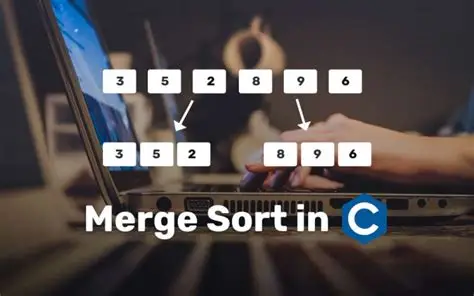
In the realm of computer science and programming, sorting algorithms are a cornerstone of efficient data management. Among various techniques, merge sort is one of the most powerful and widely taught due to its stable and predictable performance. Particularly in C programming, where memory and performance optimization are critical, understanding merge sort provides an essential foundation for tackling more advanced topics. Students looking to deepen their knowledge can explore practical concepts like merge sort as part of a reputed C Programming Course in Noida.
Merge sort is a divide-and-conquer algorithm that splits a given array into smaller sub-arrays, sorts them, and then merges them back into a single sorted array. It is known for its efficiency and consistency, especially when compared to other algorithms such as bubble sort or insertion sort.
The concept of divide-and-conquer involves three main steps:
Dividethe unsorted array into two approximately equal halves.
Conquer by recursively sorting each half.
Combine the sorted halves back together.
Merge sort is particularly suitable for large datasets as it guarantees a time complexity of O(n log n) in the best, average, and worst-case scenarios.
Why Learn Merge Sort in C?
Merge sort in C is often taught to students because C allows a low-level view of memory and array management. Learning merge sort in this language provides insights into recursion, memory allocation, pointer arithmetic, and modular programming. That’s why it’s a staple in curricula like the C Programming Course in Noida, which focuses on building a strong programming foundation.
Merge Sort Code in C: A Step-by-Step Explanation
Let’s now break down the merge sort code in C and understand how it operates under the hood.
                           #include

                            // Function to merge two subarrays
                            void merge(int arr[], int left, int mid, int right) {
                                int i, j, k;
                                int n1 = mid - left + 1;
                                int n2 = right - mid;

                                // Temporary arrays
                                int L[n1], R[n2];

                                // Copy data to temp arrays
                                for (i = 0; i < n1; i++)
                                    L[i] = arr[left + i];
                                for (j = 0; j < n2; j++)
                                    R[j] = arr[mid + 1 + j];

                                // Merge the temp arrays back into arr[]
                                i = 0; j = 0; k = left;
                                while (i < n1 && j < n2) {
                                    if (L[i] <= r[j]) { arr[k]="L[i];" i++; } else j++; k++; copy remaining elements of l[], if any while (i < n1) r[], (j n2) function to implement merge sort void mergesort(int arr[], int left, right) (left mid="left" + (right - left) 2; first and second halves mergesort(arr, mid); 1, right); merge(arr, mid, print an array printarray(int size) for (int i="0;" size; i++) printf("%d ", arr[i]); printf("\n"); main() arr[]="{12," 11, 13, 5, 6, 7}; arr_size="sizeof(arr)" sizeof(arr[0]); printf("given is:\n"); printarray(arr, arr_size); 0, 1); printf("sorted return 0; pre>
Step-by-Step Explanation
Let’s now dive into the working of this program.
Initialization:The main function defines an array and calculates its size. Before sorting, the original array is printed using the printArray() function.
Sorting:The array is passed to mergeSort(), which recursively breaks it into smaller parts. Each time it finds two subarrays, it calls the merge() function to combine them in sorted order.
Merging:Inside the merge() function, two temporary arrays are created to hold the values from the two halves. These are compared element by element and merged back into the original array in sorted order.
Final Output:After the recursive merging is complete, the sorted array is printed.
Visualizing Merge Sort
To better understand the process, consider the array: [12, 11, 13, 5, 6, 7]
Step 1: Split into two halves: [12, 11, 13] and [5, 6, 7]
Step 2: Further split each half: [12] [11, 13] and [5] [6, 7]
Final merge: [11, 12, 13] and [5, 6, 7] → [5, 6, 7, 11, 12, 13]
Time Complexity Analysis
Merge sort is celebrated for its consistent performance. Here's a breakdown:
Best Case:O(n log n)
Average Case:O(n log n)
Worst Case:O(n log n)
Space Complexity: O(n) due to the temporary arrays used during merging.
Because merge sort divides the array into two halves and takes linear time to merge, the depth of the recursive calls becomes log n, and at each level, the merge operation takes O(n) time. Hence, the total time is O(n log n).
Use Cases of Merge Sort
Merge sort is especially useful in scenarios where stability and consistency are required. Some notable use cases include:
Sorting linked lists:Since linked lists do not allow random access, merge sort works well due to its sequential merging.
Large datasets:The guaranteed O(n log n) performance makes it suitable for big data operations.
External sorting: When data cannot fit into memory, merge sort helps in breaking it into smaller parts and merging them efficiently.
Comparison with Other Sorting Algorithms
Students often wonder how merge sort compares to other common sorting techniques.
Bubble Sort: Takes O(n²) time, hence inefficient for large arrays.
Quick Sort:Faster on average, but has a worst-case time of O(n²), which merge sort avoids.
Insertion Sort:Efficient for small or nearly sorted datasets but scales poorly.
Recursive vs Iterative Merge Sort
The implementation discussed is recursive. However, iterative merge sort is also possible and avoids stack overflow in cases of very large arrays. In iterative merge sort, subarrays are merged in a bottom-up manner rather than dividing top-down.
Still, for educational purposes and simplicity, recursive merge sort is most commonly taught in beginner-level programs like the C Programming Course in Noida.
Challenges Faced by Beginners
While learning merge sort, students often face a few hurdles:
Understanding Recursion:The recursive nature of merge sort can be confusing at first.
Managing Indices:Carefully calculating mid-points and array bounds is crucial.
Memory Management: In C, dynamic allocation of temporary arrays (instead of fixed-size arrays) is more efficient.
With consistent practice and by tracing code with dry runs, these challenges can be overcome. Enrolling in a practical-oriented C Programming Course in Noida can also help in tackling these issues with guided mentoring
Tips to Master Merge Sort in C
Try dry-running the code with pen and paper for small arrays.
Write your own version from scratch without copying to better understand flow.
Use print statements inside recursive functions to visualize the call stack.
Debug by checking array content after every merge.
Conclusion
Merge sort is a fundamental algorithm every aspiring programmer must understand. It not only enhances the understanding of recursion and array manipulation but also sets the stage for learning advanced concepts like multi-threading and memory optimization. The example of merge sort code in C discussed above provides a solid blueprint to grasp its practical implementation. Whether one is learning independently or as part of a structured C Programming Course in Noida, merge sort serves as a core building block in algorithmic thinking.
Its stable performance, guaranteed time complexity, and applicability to real-world problems make it a favorite in both academia and industry. Once a student is comfortable with merge sort, they are better equipped to approach other complex sorting and data-processing algorithms with confidence and clarity.