Nested If Else Statement in C with Examples: Your Friendly Guide to Mastering Decisions
Have you ever wondered how programs make decisions? Like, how does your ATM decide to give you money only if you have enough balance? Or how does a website decide whether to log you in or show an error? The secret lies in something called conditional statements and in C programming, one of the most powerful ways to handle these conditions is with nested if else statements.
Nested If Else Statement in C with Examples: Your Friendly Guide to Mastering Decisions
Mr. Bambam Kumar Yadav / 2 weeks
0
5 min read
What’s a Nested If Else, Really?
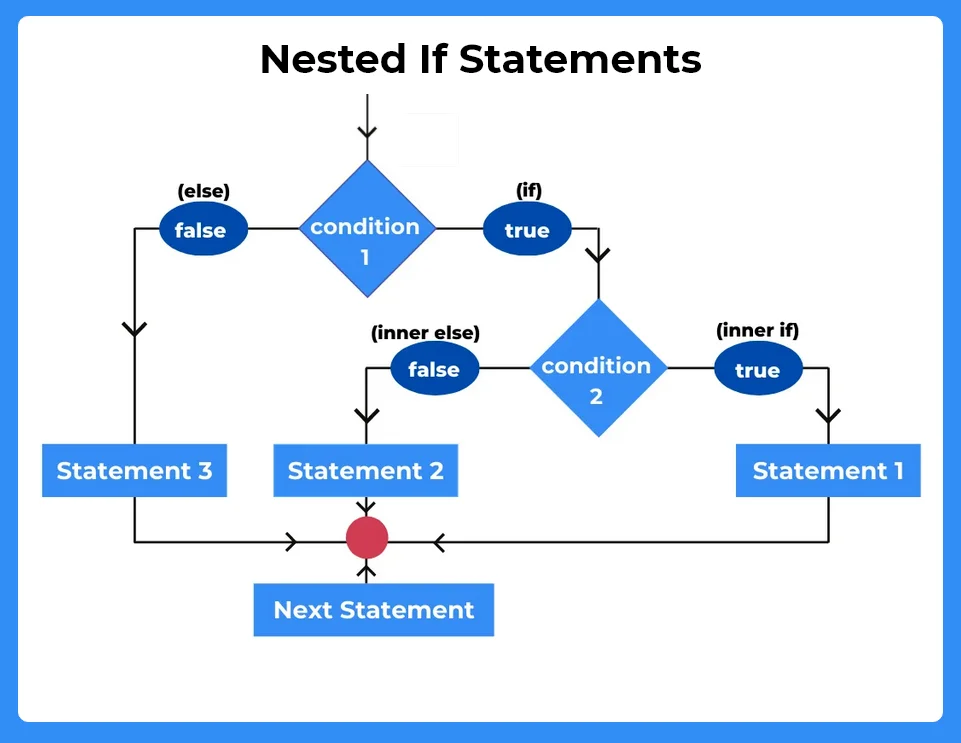
Imagine you're deciding what to wear. First, you check if it’s raining. If yes, you might check if it's also cold before choosing a raincoat or a warm jacket. If not raining, maybe you decide between a t-shirt and a hoodie based on the temperature.
This is a perfect example of nested if else in real life! You make a decision (if it’s raining), then make another decision inside that first one (if it’s cold). In C, it looks something like this:
                        if (raining) {
                            if (cold)
                                wearRaincoatWithSweater();
                            else
                                wearRaincoat();
                        } else {
                            if (cold)
                                wearSweater();
                            else
                                wearTShirt();
                        }
                        Pretty intuitive, right?
Let’s See a Simple C Example: Positive, Negative, or Zero
                        #include

                        int main() {
                            int number;
                            printf("Enter a number: ");
                            scanf("%d", &number);

                            if (number >= 0) {
                                if (number == 0)
                                    printf("The number is zero.\n");
                                else
                                    printf("The number is positive.\n");
                            } else {
                                printf("The number is negative.\n");
                            }

                            return 0;
                        }
Why do we use nested if else here?
Because first we want to check if the number is non-negative. Inside that, we want to separate zero from positive numbers. This helps us handle each scenario step by step, like following a logical conversation with your code!
Real-World Inspired Example: Student Grading System
                        #include

                        int main() {
                            int marks;
                            printf("Enter your marks: ");
                            scanf("%d", &marks);

                            if (marks >= 0 && marks <= 100) { if (marks>= 90)
                                    printf("Grade A\n");
                                else if (marks >= 80)
                                    printf("Grade B\n");
                                else if (marks >= 70)
                                    printf("Grade C\n");
                                else if (marks >= 60)
                                    printf("Grade D\n");
                                else
                                    printf("Grade F\n");
                            } else {
                                printf("Invalid marks entered.\n");
                            }

                            return 0;
                        }
This example shows why nested if else is so useful: we validate the marks first and then decide the grade. Step by step, just like a teacher deciding your grade.
Why Learn Nested If Else in a C Programming Course in Noida?
AC Programming Course in Noida doesn’t just teach you syntax — it helps you think like a programmer. Here’s why learning nested if else there is so helpful:
Pitfalls (and How to Avoid Them!)
Too many nested levels: Ever seen a code that’s so indented it looks like a staircase? Deeply nested code can get messy fast. Try to keep it simple or use functions to break down logic.
Forgetfulness:Sometimes beginners forget an else or a closing brace. Always double-check!
Complicated conditions: If your conditions are too complex, consider using logical operators or simplifying before nesting.
A good instructor in aC Programming Course in Noida will guide you through these common mistakes and teach you good coding habits early on.
Practical Mini-Assignments (Try These!)
Write a program that checks if a person is eligible for a job. First, check if age is above 18. If yes, then check if they have a degree. Print a message accordingly.
Create a simple ATM simulator: Check if balance is sufficient, then check if the amount is a multiple of 500 before allowing withdrawal.
Make a menu-driven food ordering program that checks if the item is available, then checks quantity, and prints the total bill.
Doing these on your own (or as part of aC Programming Course in Noida) really builds confidence!
Pro Tips to Master Nested If Else
Use clear indentation to make nested structures easy to read.
Comment your code generously — future you will thank you!
Think of each if else like a flowchart. Visualize the branches before writing code.
Debug step by step: Print intermediate values to understand your program’s path.
Beyond Nested If Else
Once you’re comfortable, explore:
Switch statements: Great for multiple fixed options (like menu choices).
Ternary operator: For simple true/false decisions.
Modular functions:Move decision branches into separate functions to make code neat.
Why Noida Rocks for Learning C
Noida has a vibrant tech community with tons of opportunities.
You’ll find experienced mentors and real-world projects to work on.
Placement support helps you launch your career after completing your C Programming Course in Noida.
Networking events, hackathons, and meetups to grow your connections and skills.
Wrap Up
Nested if else statements might look scary at first, but they’re just like having a logical conversation with your computer. Once you break it down step by step, it’s actually fun — like solving a puzzle!
If you’re planning to kickstart your journey with a C Programming Course in Noida, mastering nested if else will give you a solid foundation to tackle bigger challenges confidently.
Ready to write your first nested if else? Let’s do it!
FAQs (Because We Love Questions!)
Q: Are nested if else statements hard to learn?
Not at all! With good examples and practice, they become second nature.
Q: Can I skip nested if else and just use switch?
Sometimes, but switch is limited to simple discrete choices. Nested if else handles more complex and range-based conditions.
Q: Is C still worth learning?
Absolutely! It builds strong logical thinking and is widely used in system programming, embedded devices, and even interviews.
Q: What if I get stuck?
Join a C Programming Course in Noida! Mentors and peers can help you debug and understand faster.
Keep experimenting and never be afraid to make mistakes. Happy coding!