Introduction
Nested if-else is quite an important component of the C language programming language which enables the programmer to manage several conditions in an organized manner. It allows programs to reach more complicated decisions making sure the flow of the execution can be adjusted to different situations.
In C language with formality and if -else statements you are able to test conditions within other conditions, giving more flexibility and control, in decision making. The construct is usually applied in programs that need to perform several levels of validations or logics.
We are now going to learn about how nested if-else operates, its syntax, examples and practical use to enable you utilize nested if-else in your C based program effectively.
What is the Nested if-else in C?
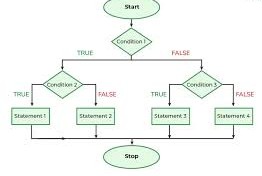
Nested if-else statement in C-In this type of statement an if-else statement is inside another. This enables a program to verify several conditions in a hierarchical way. The inner if or else statement will be evaluated only in case the outer if condition is consistently true. This comes in handy where decisions made are based on several interrelated conditions.
Syntax Components
Outer Condition (condition1): The outer one checks the main condition. When it results true the program goes into the outer block of the if.
Inner Condition (if condition2): Provided as part of the outer if, this condition is only evaluated when the outer condition evaluates to be true. It entitles further choices under the realm of the outer condition.
Outer Else Block: A block that is run when the outer condition is False without running the inner if.
Inner Else Block: Performed when the inner condition is not true however the outer one is true.
Advantage of Nested If Else in C Programming
Handles Complex Conditions: Enables the checking to be done in a structured manner in respect of multiple related conditions.
Hierarchy of Logic: This aids in straightforward logistically organizing the decision making.
Flexibility: Allows dynamic responses according to changes of conditions.
Minimizes Redundancy: Prevents redundancy of code through clustering of related conditions in block within block structure.
Enhances Specific-Use Reading: well-indented, structured code that contains nested if-else statements results in easier reading of complex decisions in C.
Application: Can be applicable in multi-level validations, including loan eligibility, grading and logins systems.
Combinations of Conditions: Merges dependent conditions, one decision impacts on another.
Facilitates Code Flow Control: Allows programs to be adaptive to varied situations without re-assessment of unconcerned factors.
The Main Mistakes That Should be Avoided Using Nested If-Else in C Language
Over-Nesting: Atypically writing excessive levels of nesting, which renders the code difficult to read as well as maintain.
Missing Curly Braces: The overlook of {} of several statements in the block, which makes errors in logic.
Confusing States: Elaborating conflicting or vague conditions which result in irregular behavior.
Redundant Conditions: the unnecessary repetition of the verification of the same condition.
Incorrect Indentation: There is not a good indentation, so it is hard to define the order of the conditions.
Jumping Edge Cases: Not allowing all the possible scenarios to be considered disregarding some of them, which results in incomplete logic.
Poor Logic: Failing to optimize order of conditions, and it results in unnecessarily evaluating conditions.
Mixed up or misplaced Else Blocks: Putting the corresponding blocks of the elif blocks in an incorrect place or not matching.
Employing Nested If In Affair of Else-If Ladder: Embellishing logic when an else-if ladder is all that one needs.
No Comments on Complex Logic: Failure to document the intention of nested statements, or take advantage of comments in C that makes it difficult to debug.
Applications and Uses of nested If-Else statement in C
Grading System: Grading with respect to marks and distinction on outstanding performance.
Loan Eligibility: Examination of age, income and credit rating with respect to loan approval.
Login authentication: Authentication of username, password and type of user (e.g. admin user or regular user).
Scholarship Eligibility: Assessment of factors such marks, level of income and achievements in extracurricular activities.
E-Commerce Discounts: The application of various discount rates on level of membership and quantity of purchase.
Classification by Triangle Type: Classify the triangle as an equilateral triangle, isosceles or scalene triangle by examining the sides.
Traffic Rules: Decisions are made according to the color of traffic lights and type of transport.
Product Warranty: Verify the validity of warranty-claims according to date of purchase and type of warranty.
Selection of Restaurant Menu: The selection of a menu defined by time and diet.
Insurance Premium Calculation: It is carried out by establishing the rates and age, health condition and coverage amount.
Uncodemy Courses Applicable on Nested IF Statements
Uncodemy is a training and development firm provider of different courses in technology areas that are demanded. Although this topic does not have a specific course called "Nested IF Statements," it is a fundamental aspect of the logic of programming, which is usually overseen in the course of programming in general.
The Python (Programming Language) Course Module in Uncodemy specifically covers this topic of conditional statements and some of these are the if statement, the if else statement, the if elif else statement and above all the distant if statement. This means that in the course of taking a Python course, the students will learn and be able to apply nested IF statements.
Another programming course involving Uncodemy is in Data Science, Full Stack Development, Software Testing, Digital marketing, Java Technology, Network & Security and other Programming courses besides Python. Considering that the concept of nested conditional logic is a fundamental concept in most programming courses and applications, there is a very high likelihood that courses in Full Stack and other areas of programming would also address the concept known as a nested IF statement in their course. As an example, nested if-else statements are a legal and normal way of doing some complex decisions in C programming language. Hence, this subject would be part of any Uncodemy course that entails programming basics.