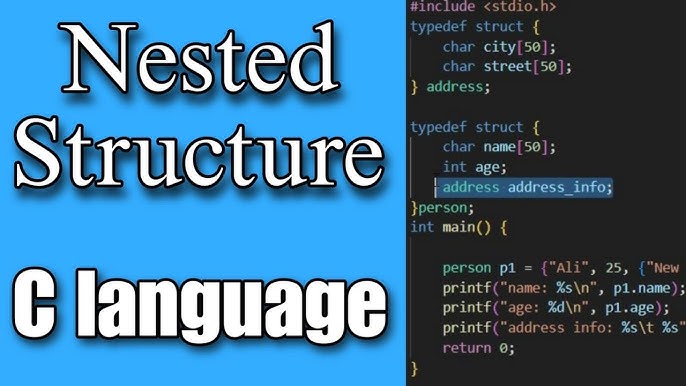
Nested Structure in C Programming: Explained with Examples
Imagine managing a student database where each student has their personal info, academic details, and contact information. You could create multiple structures to store these separately—or, you could embed one structure within another, making your code cleaner and more organized.
That’s where nested structure in C programming comes into play!
A nested structure is simply a structure within another structure. This allows us to logically group complex data types, especially when dealing with hierarchical or grouped information.
🔍 Definition:
A nested structure in C is a structure that contains another structure as a member.
This is especially useful for organizing complex data like:
1. Student profiles
2. Employee records
3. Inventory systems
4. Bank account management
Real-Life Analogy
Imagine you’re filling out a job application form. The form may have:
1. Personal details: Name, age, gender
2. Contact details: Phone, email
3. Job details: Department, salary
You can treat each of these sections as separate structures and nest them into one main Application structure.
Syntax of Nested Structure in C
c
CopyEdit
Copy Code
struct Inner {

    int x;

    float y;

};

struct Outer {

    int a;

    struct Inner innerData; // Nested structure

};
In this example:
1. Inner is nested inside Outer
2. Outer contains both its own variables and a structure of type Inner
Declaring and Accessing Nested Structure Members
🧾 Example:
c
CopyEdit
Copy Code
#include <stdio.h>

struct Date {

    int day;

    int month;

    int year;

};

struct Student {

    int id;

    char name[30];

    struct Date dob;  // Nested structure

};

int main() {

    struct Student s1 = {101, "Ananya", {15, 8, 2002}};

    printf("Name: %s\n", s1.name);

    printf("DOB: %d-%d-%d\n", s1.dob.day, s1.dob.month, s1.dob.year);

    return 0;

}
✅ Output:
makefile
CopyEdit
Name: Ananya
DOB: 15-8-2002
We access the nested fields using the dot operator multiple times: s1.dob.day, s1.dob.month, s1.dob.year
Why Use Nested Structures?
✅ Helps model real-world data more accurately ✅ Improves readability and organization ✅ Reduces redundant code ✅ Makes complex systems more modular and scalable
Nested Structures with User Input
Let’s take it a step further and allow user input for a nested structure.
✅ Use meaningful structure names (Address, Date, Student) ✅ Keep structures focused—avoid adding too many unrelated fields ✅ Use typedef to simplify declarations ✅ Don't over-nest; keep data models clean and readable ✅ Always initialize nested structures properly
Common Mistakes to Avoid
🚫 Confusing structure variable names with types 🚫 Forgetting to access nested members with proper dot notation 🚫 Trying to declare structure variables before defining the nested type 🚫 Overusing nesting where arrays or functions may be better suited
Real-World Applications
Application
Usage of Nested Structures
School Management System
Students with nested addresses and scores
Banking System
Customer details with account + KYC data
Hospital Management
Patients with nested medical history records
Payroll System
Employees with salary, attendance, tax info
In short, anywhere structured, hierarchical data is needed—nested structures are your best friend.
Learn Advanced C Programming with Uncodemy
If you’re interested in mastering C programming and understanding structures, pointers, dynamic memory, and real-world applications, the best way to learn is through hands-on experience.
That’s where Uncodemy’s C Programming Course in Noida comes in.
🎯 Why Choose Uncodemy?
✅ In-depth coverage of basic to advanced topics ✅ Real-world examples and projects ✅ Experienced mentors & personalized guidance ✅ Interview preparation & placement assistance ✅ Ideal for students, engineers, and upskillers
Whether you're preparing for college exams or job interviews, this course gives you the solid foundation you need.
Recap: What We Learned
🔹 A nested structure in C is a structure within another structure 🔹 Useful for organizing hierarchical or grouped data 🔹 Access members using dot (.) or arrow (->) operators 🔹 Helps write modular, scalable, and maintainable code 🔹 Widely used in applications like HR, banking, hospitals, and education systems
Final Thoughts
Learning how to use nested structures in C programming is like moving from basic house-building to architectural design. It allows you to create cleaner, more powerful, and real-world-relevant programs.
Whether you're creating a simple address book or a full-fledged hospital management system, nested structures help you think like a programmer—and structure like a pro.
So, why stop here? Dive deeper into real projects, build your confidence, and get certified with Uncodemy’s expert C programming course.