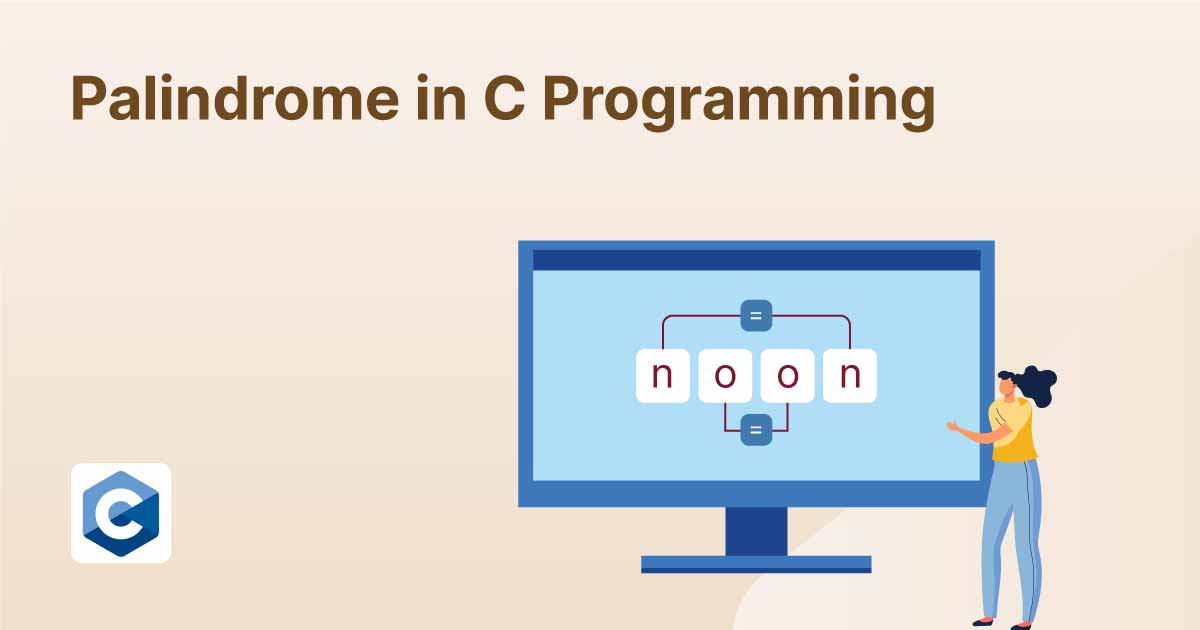
Palindrome in C with Multiple Code Implementations
Learning programming in C can be both fun and challenging, especially when working with logical problems
that test your understanding of loops, conditions, and strings. One such popular problem is checking
whether a number or string is a palindrome.
Palindrome in C with Multiple Code Implementations
Snehank Singh /
6 day
8
9 min read
This article takes a deep dive into palindromes in C, exploring what a palindrome
is, how it can be checked using various methods, and how mastering such problems is a great
stepping stone if you're pursuing a C Programming Course in Noida. Whether you are a beginner or
polishing your C programming skills, this guide will help you understand the logic, syntax, and
practical implementation of palindrome programs in C.
What is a Palindrome?
A palindrome is a word, number, phrase, or sequence that reads the same forward
and backward. Common examples include:
Words: level, radar, civic, madam
Numbers: 121, 1331, 12321
In programming, a palindrome is often used as a basic test problem to practice
working with loops, arrays, strings, and functions.
Why Learn Palindrome Programs in C?
Understanding how to implement a palindrome in C strengthens your core knowledge
of:
String manipulation
Number operations
Control structures (if-else, while, for)
Functions and modular programming
These concepts are fundamental in any C Programming Course in Noida and help form
the foundation for learning more advanced topics like data structures and algorithms.
Types of Palindrome Checks in C
There are two main types of palindrome problems:
Palindrome Number
Palindrome String
Let’s explore both with multiple C code implementations and explanations.
Checking Palindrome Number in C
Logic: To check if a number is a palindrome, we reverse it and compare it with
the original number. If both are the same, it’s a palindrome.
Method 1: Using While Loop
#include

int main() {
    int num, reversed = 0, remainder, original;
    printf("Enter a number: ");
    scanf("%d", &num);
    original = num;

    while (num != 0) {
        remainder = num % 10;
        reversed = reversed * 10 + remainder;
        num /= 10;
    }

    if (original == reversed)
        printf("%d is a palindrome.\n", original);
    else
        printf("%d is not a palindrome.\n", original);

    return 0;
}
Explanation:
Extract digits from the number using modulo (%).
Reverse the number digit by digit.
Compare the reversed number with the original.
Method 2: Using a Function
Breaking logic into a function improves modularity.
#include

int isPalindrome(int n) {
    int reversed = 0, original = n, rem;
    while (n != 0) {
        rem = n % 10;
        reversed = reversed * 10 + rem;
        n /= 10;
    }
    return original == reversed;
}

int main() {
    int num;
    printf("Enter a number: ");
    scanf("%d", &num);

    if (isPalindrome(num))
        printf("%d is a palindrome.\n", num);
    else
        printf("%d is not a palindrome.\n", num);

    return 0;
}
This method reflects good programming practices taught in structured C
Programming Courses in Noida.
Checking Palindrome String in C
Logic: To check if a string is a palindrome, reverse the string and compare it
with the original.
Method 1: Using For Loop
#include
#include

int main() {
    char str[100], reversed[100];
    int i, length;

    printf("Enter a string: ");
    gets(str); // Warning: unsafe function, use fgets in real applications

    length = strlen(str);

    for (i = 0; i < length; i++) {
        reversed[i] = str[length - i - 1];
    }
    reversed[i] = '\0';

    if (strcmp(str, reversed) == 0)
        printf("%s is a palindrome.\n", str);
    else
        printf("%s is not a palindrome.\n", str);

    return 0;
}
Explanation:
strlen() gives the length of the string.
The string is reversed manually.
strcmp() compares both strings.
Method 2: Using Pointers
Pointers are a key topic in C, often emphasized in a good C Programming Course in
Noida.
#include
#include

int isPalindrome(char *str) {
    char *start = str;
    char *end = str + strlen(str) - 1;

    while (start < end) {
        if (*start != *end)
            return 0;
        start++;
        end--;
    }
    return 1;
}

int main() {
    char str[100];
    printf("Enter a string: ");
    scanf("%s", str);

    if (isPalindrome(str))
        printf("%s is a palindrome.\n", str);
    else
        printf("%s is not a palindrome.\n", str);

    return 0;
}
Method 3: Ignoring Case and Spaces
Advanced version that ignores capital/lowercase letters and spaces.
#include
#include
#include

int isPalindromeAdvanced(char str[]) {
    int i = 0, j = strlen(str) - 1;

    while (i < j) {
        while (!isalnum(str[i]) && i < j) i++;
        while (!isalnum(str[j]) && i < j) j--;
        if (tolower(str[i]) != tolower(str[j])) return 0;
        i++; j--;
    }
    return 1;
}

int main() {
    char str[100];
    printf("Enter a string: ");
    gets(str);

    if (isPalindromeAdvanced(str))
        printf("'%s' is a palindrome.\n", str);
    else
        printf("'%s' is not a palindrome.\n", str);

    return 0;
}
This approach is especially useful for real-world data where formatting can vary.
Why Practice Palindrome Programs?
Working with palindrome logic:
Boosts your confidence in handling conditions and loops.
Enhances your understanding of strings and arrays.
Prepares you for technical interviews and entrance tests.
This is why it’s a must-have problem in almost every C Programming Course in
Noida.
Handling Palindromes with Special Characters and Spaces
In real-world scenarios, input strings may contain spaces, punctuation marks, or
mixed case letters. For example, "A man, a plan, a canal: Panama" is a famous palindrome phrase
but not a simple character-by-character palindrome.
Preprocessing: To accurately check such phrases, first convert all
letters to lowercase and remove non-alphanumeric characters (spaces, commas, colons, etc.).
Implementation: Use functions like tolower() fromand filter
characters using isalnum().
This makes your palindrome check more robust and practical for real applications
like sentence or phrase checks.
Palindrome Check for Linked Lists
When working with data structures like singly linked lists, checking palindrome
properties is more complex because you don’t have direct random access like arrays.
Approach: Use two pointers slow and fast to find the middle of the list.
Reverse the second half of the list and then compare the first half and
reversed second half node by node.
If all nodes match, it’s a palindrome.
After comparison, you can optionally restore the original list structure.
This technique is useful in coding interviews and applications involving linked
data.
Time and Space Complexity Analysis
Understanding the efficiency of different palindrome-checking methods helps
optimize code.
Iterative method (two-pointer): Time complexity is O(n), where n is the
length of the string or number of nodes. Space complexity is O(1) since no extra storage is
needed.
Recursive method: Time complexity is still O(n), but space complexity can
be O(n) due to recursive call stack.
Linked list method: O(n) time and O(1) space when using the middle
reversal technique.
Applications of Palindromes in Real World
Palindromes aren’t just academic—they have practical significance:
DNA Sequencing: Palindromic sequences in DNA are important for molecular
biology and genetics.
Cryptography: Palindromic patterns can be used in encoding and decoding
schemes.
Dates and Events: Certain dates like 02/02/2020 are palindromic and are
often considered special or lucky.
Understanding these real-world applications shows the importance of palindrome
logic beyond programming exercises.
Tips to Master Palindrome Problems in C
Understand the difference between numbers and strings.
Practice edge cases: empty string, single character, even and odd length.
If you're based in Noida and serious about learning programming, joining a
well-structured C Programming Course in Noida can give you the guidance, practice, and
mentorship you need. These courses often include:
Real-world examples like the palindrome in C
Hands-on projects
Interview preparation
Doubt-solving sessions
Certificate-based completion
Platforms like WsCube Tech, which provide reliable resources and problem-solving
techniques, are great starting points for beginners and intermediate learners alike.
FAQs: Palindrome in C with Multiple Code Implementations
Q1. What is a palindrome? A palindrome is a word,
number, or sequence that reads the same backward as forward.
Q2. Why is palindrome checking important in
programming? It helps understand string manipulation and logic
implementation in coding.
Q3. What are common methods to check palindromes in
C? Using loops to compare characters, recursion, and reversing the string
are common methods.
Q4. Can palindrome checking be done with recursion in
C? Yes, recursion is often used to simplify palindrome checking by comparing
outer characters moving inward.
Q5. How do iterative and recursive palindrome checks
differ? Iterative uses loops; recursive uses function calls to check
matching characters step-by-step.
Q6. Are there performance differences between
methods? Generally, iterative is faster and uses less memory; recursion can
be elegant but uses more stack space.
Conclusion
Understanding how to check for a palindrome in C is a foundational step in
mastering the C language. With multiple methods and practical code examples, you get to explore
the flexibility and logic-building potential of C. From basic number checks to advanced string
handling, palindrome problems cover a wide range of concepts essential for programming success.
If you're aiming to strengthen your skills and want to dive deep into C,
enrolling in a C Programming Course in Noida is a smart move. You’ll not only master palindrome
problems but also build the confidence to tackle complex programming challenges.