The kinds of C Programming Patterns
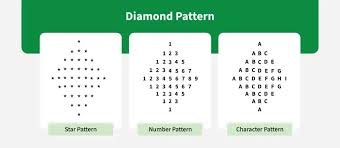
C program provides several styles such as star patterns, numbers patterns, alphabets patterns, and packed patterns. These patterns aid in the strengthening of constructs of loops, control objects, and algorithm programming.
Star Patterns
Patterns in stars are formed using asterisk (*) character to shape different patterns. These forms prove to be a great practice to learn nested loops.
Right Half Pyramid -- In this pattern, a right angle triangle is created but the hypotenuse →right. Stars in any row will add up as we move on.
Copy Code
c

#include <stdio.h>

int main() {

 int i, j, rows;

 printf("Enter the number of rows: ");

   scanf("%d", &rows);

  for (i = 1; i <= rows; ++i) {

  for (j = 1; j <= i; ++j) {

 printf("* ");

}

  printf("\n");

}

  return 0;

}
Left Half Pyramid Pattern: The stars are centered to the right and together they create a right angled triangle with the right margin. This is realised by printing space characters before the stars.
Copy Code
c

#include <stdio.h>

int main() {

  int i, j, rows;

 printf("Enter the number of rows: ");

  scanf("%d", &rows);

  for (i = 1; i <= rows; ++i) {

  for (j = i; j < rows; ++j) {

  printf("  ");

 }

  for (j = 1; j <= i; ++j) {

   printf("* ");

 }

    printf("\n");

}

   return 0;

}
Full Pyramid Pattern: This is such a design that forms a symmetrical triangle by way of centering the stars. It takes the form of both the left and the right half pyramids.
Inverted Right Half Pyramid Pattern: This pattern is simply a 180 degree flipped Right half pyramid and it also follows the pattern where the stars diminish as we proceed to the next row beginning with the number of stars in the first row.
Inverted Left Half Pyramid Pattern: This Inverted Left Half Pyramid pattern is a reverse 180 degree of the left half pyramid wherein the stars are aligned to the right margin followed by the leading spaces, and the pattern is reduced in the row-after-row of stars.
Inverted Full Pyramid Pattern: In this pattern a full pyramid is laid out 180 reversed with the most stars in the top row and symmetrically reduced ever lower.
Rhombus Pattern: This pattern has entries like those of obtaining a square but there are spacers added before each line which reduces gradually with each row in a symmetrical rhombus form.
Diamond Pattern: This pattern is composed of a combined full pyramid and an inverted full pyramid at their bases to bring about a symmetrical diamond shape.
Hourglass Pattern: The design uses an upside-down full pyramid on top with a full pyramid on the bottom and the tip of both shapes meet.
Hollow Square Pattern: This pattern prints the square on which only the boundary lines are filled with stars leaving the centre blank.
Hollow Full Pyramid Pattern: This is a pattern that involves printing of only the outer edge of a complete pyramid and the inside left unprinted.
Hollow Inverted Full Pyramid Pattern: this is a copy of the previous, in which the boundary elements of the inverted full pyramid are printed, but the elements inside it are excluded to make it hollow.
Hollow Diamond Pattern: This pattern looks just like the diamond pattern except that it lives on inside.
Hollow Hourglass Pattern: There is also the Hollow Hourglass Pattern in which only the outline of the actual hourglass pattern is seen so that it has the impression of being hollow.
Numeric Patterns:Numeric patterns are patterns that entail printing numbers in a definite design e.g. in pyramids or triangles.
Floyd Triangle: The numbers of this pattern are printed as the consecutive natural numbers with the first value being 1, then the second number is printed, the third number is printed and so on, following its sequence.
Pascal triangle: This is a triangular table filled with binomial coefficients and each binomial coefficient is equal to the sum of the two coefficients above it.
Alphabet Patterns
The alphabet patterns include placement of letters with patterns similar to the star and number patterns.
C Programming Design Patterns
Though C lacks the inherent object-oriented constructs such as classes and inheritance we can still use the basic constructs of C i.e. functions, pointers and structs to apply design patterns. Design patterns can be used as an answer to a common problem of software design that will allow one to create cleaner, more readable, and maintainable C-code. They are normally categorized into three broad classes as Creational, Structural, and Behavioral.
Creational Patterns
Creational design patterns revolve around methods of creating objects, which encourages coding adaptability and reutilization.
Factory Design Pattern: It is a pattern that turns the job of object creation into an interface by the use of the superclass. Its main concern is to package object creation such that it becomes modular, scalable and maintainable. The important concepts involve encapsulation of object construction, decoupling and flexibility.
Singleton Pattern: This is a pattern used to keep to one and only instance of an object and give a global access point to this object. It is beneficial in terms of configuration objects, connection pools, and logging. The laziness initialization makes the object be instantiated upon its necessity.
Structural Patterns
Design becomes easier when there are structural patterns because the links between items in the design are found prioritizing the way classes and objects are combined to create bigger flexible and efficient designs.
Adapter (Wrapper Pattern): Adapter pattern is used to convert incompatible interfaces into each other so that compatible interfaces can work with another interface. It is like a bridge, and it can be applied when there is a need to integrate the existing components plus new systems without alterations. The important ideas are that of Target Interface, Adapter and Adapter.
Facade Design Pattern: This pattern presents a simplified interface to some complex subsystem, this yields one class (the Facade) with simplified methods that in turn call into the complex system. It provides a uniform interface, which simplifies the use of a subsystem due to masking its complexity.
Proxy Pattern: The pattern allows controlling access to an object by giving it a place-holder/surrogate. A proxy is also able to implement other tasks apart from forwarding requests to the real object such as access control, lazy initialization, logging or caching.
Behavioral Patterns
Behavioral design patterns are concerned with the algorithms and the decomposition of responsibilities among objects, and specification of the flow of their communications and control.
Observer Pattern (Publish-Subscribe): The observer pattern specifies a one-to-many dependency between objects so that when one object changes state then all of its dependents are notified and updated automatically. It can be applicable in distributed event-handling systems.
Strategy pattern: The pattern establishes a set of algorithms, encapsulates each algorithm and allows them to be interchanged, so that the algorithms can be changed independently of their clients. It can be applied especially when changing among various algorithms or behaviors during the program run.
State Pattern: It is an object oriented design pattern that enables an object to change its behavior when its state changes thus giving an impression that the object belongs to a different class. It comes in handy when the behavior of an object is to be dynamically changed depending on its state at any particular time. Among the main notions, there are Context, State Interface, Concrete States.
Become a Better Programmer with Uncodemy
Upon the requirement of increasing knowledge of C programming patterns and C programming design principles, Uncodemy provides the best training programs. Uncodemy offers practical hands-on training by experienced professionals in the industry and the training is provided in both the offline and online mode to provide flexibility in learning.
Uncodemy C with Data structure and Algorithm training course offers a wide perspective of C programming along with various pattern programming training problems that validates the basic programming basics. In this course, significant experiences and practical examples are provided to the students which make them attain the skills to resolve the problems of programming in the real world.
Uncodemy will ensure the student meets his or her career objectives through personal guidance and assistance. They provide continuous career services which include job placement opportunities and networking events to assist students in contact with prospective employers. They have a track record of accomplishment to recommend them as they have enabled students to get jobs in good companies. Its curriculum is innovative and aimed at being current and in line with the latest trends and greens in the industry.