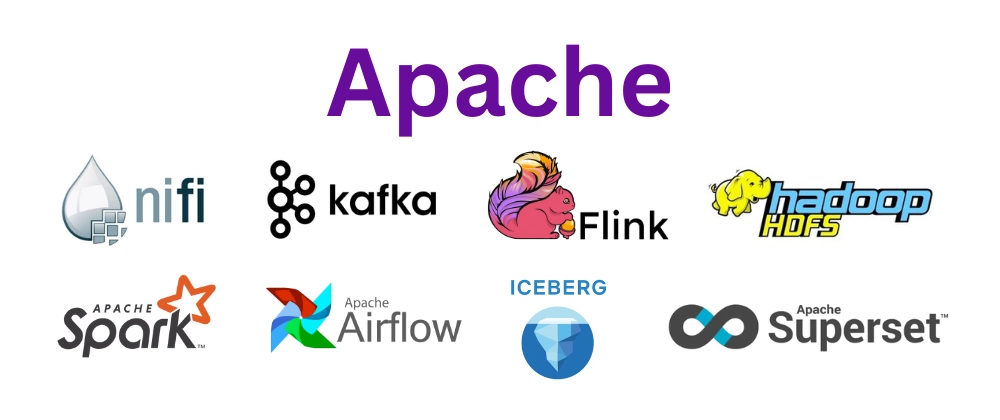
Powerful Data Processing with Apache Technologies

For anyone who is considering a data science training course in Noida or even
elsewhere, gaining expertise in Apache’s ecosystem has become increasingly mandatory. These are
open-source frameworks that form the ecosystem upon which many advanced data processing
applications are built, making them important for aspiring data scientists and analysts.
The Apache Ecosystem: Powering Modern Data Science
Known for developing several game-changing technologies that have completely
transformed how organizations handle big data is the Apache Software Foundation. Two of the most
significant contributions made by the Apache software are Apache Hadoop and Apache Spark and
they have together revolutionized data processing capabilities for businesses of all sizes.
Apache Hadoop: The Foundation of Big Data Processing
One of the first frameworks capable of handling truly massive datasets across
clusters of computers is Apache Hadoop. It consists of a distributed file system (HDFS) and
processing model (MapReduce) allowing organizations to store and analyze data at scales that
were previously not previously possible with traditional database systems.
When you decide to join a comprehensive data science training course in Noida,
you will begin your journey by understanding how Apache Hadoop works and gives you an entry into
big data. The framework has the ability to distribute data processing tasks across multiple
machines which makes it particularly valuable for organizations dealing with humongous sets of
data.
Key components of the Apache Hadoop ecosystem include:
- HDFS (Hadoop Distributed File System):This is a storage system that splits
large files across multiple machines while making sure reliability is maintained via data
replication.
- MapReduce: This is a programming model that allows for parallel processing
of diverse datasets by breaking tasks into smaller bits that can be executed simultaneously.
- YARN (Yet Another Resource Negotiator):This is a resource management layer
that assigns compute resources to applications running on a Hadoop cluster.
- Hive and Pig:These are tools that make it easier to query and manipulate
data stored in Hadoop using SQL-like language.
Many data science professionals who complete a data science training course in
Noida begin their careers by working with Apache Hadoop before moving on to newer technologies
like Apache Spark.
Apache Spark: Accelerating Data Processing
Even though Apache Hadoop transformed big data processing, it had drawbacks,
especially when it came to speed for specific kinds of operations. Apache Spark comes into play
at this point. Spark was created especially to overcome Hadoop's drawbacks and provides
noticeably faster performance for a variety of data processing jobs.
By processing data in-memory instead of writing intermediate results to disc,
Apache Spark is able to achieve these speed gains. For some tasks, especially iterative
algorithms frequently used in data science applications, this method can make Spark up to 100
times faster than Hadoop's MapReduce.
Given its increasing dominance in the big data landscape, a well-designed data
science training course in Noida will devote a significant amount of time to learning Apache
Spark. Spark is a very useful tool because of its versatility; it can handle batch processing,
real-time analytics, machine learning, and graph processing, among other tasks.
Key features of Apache Spark include:
- Resilient Distributed Datasets (RDDs):The fundamental data structure in
Spark that enables fault-tolerant, parallel operations across cluster nodes.
- Spark SQL:A module for working with structured data using SQL-like queries.
- MLlib:A library of machine learning algorithms optimized for distributed
computing.
- GraphX:A graph processing library for analyzing relationship data.
- Structured Streaming:A scalable, fault-tolerant stream processing engine.
For those pursuing a data science training course in Noida, gaining hands-on
experience with Apache Spark is often a key differentiator in the job market, particularly for
roles involving real-time analytics or machine learning applications.
Real-World Applications of Apache Technologies
Customer Analytics
Retail businesses use Apache Spark for real-time customer behaviour analysis
across various channels. They can produce tailored recommendations and focused marketing
campaigns by analysing clickstream data, purchase history, and demographic data. This use of big
data processing has changed how companies communicate with their clients.
Case studies of how retailers have used these technologies to propel business
growth through data-driven decision making are frequently included in high-quality data science
training courses in Noida.
Fraud Detection
Financial organisations use Apache Spark's real-time processing capabilities to
spot potentially fraudulent transactions as soon as they happen. These systems can immediately
identify suspicious activity and stop financial losses by examining transaction patterns and
comparing them to historical data.
To obtain hands-on experience with the same technologies that major banks and
credit card companies use, students enrolled in a data science training course in Noida may work
on projects that mimic fraud detection systems.
Healthcare Analytics
To analyse patient data, spot trends, and enhance treatment results, healthcare
providers use Apache Hadoop and Apache Spark. Processing enormous volumes of sensor data from
wearable technology, medical records, and research findings enables researchers to gain new
insights and physicians to make better decisions.
One of the most promising fields for data scientists is the use of big data
processing in healthcare, which is why many data science training programs in Noida concentrate
on this topic.
Supply Chain Optimization
Apache technologies are used by logistics and manufacturing firms to streamline
their supply chains. They can find inefficiencies, anticipate possible disruptions, and cut
expenses by examining data from suppliers, manufacturing sites, and distribution networks.
This real-world data processing example highlights how Apache Hadoop and Apache
Spark provide measurable business value, a point that is stressed in extensive data science
training programs in Noida.
The Connection Between Apache Technologies and Data Science
Data science offers the techniques and algorithms to glean valuable insights from
the data, while Apache Hadoop and Apache Spark supply the infrastructure for processing large
amounts of data. This potent combination has opened up new ways for businesses to use their data
assets.
A well-structured data science training course in Noida will teach students
how to:
- Prepare data at scale:Using Apache technologies to clean, transform, and
structure raw data for analysis.
- Build and deploy models: Leveraging distributed computing capabilities to
train machine learning models on massive datasets.
- Extract actionable insights:Using data visualization tools and reporting
methods helps data scientists present insights clearly to stakeholders.
- Implement automated systems:Create data pipelines that continuously process
information and update predictions based on new data.
Being able to perform these tasks across distributed systems is what sets modern
data science apart from its traditional statistical analysis counterpart. This makes being
proficient in Apache Hadoop and Apache Spark an essential skill for today’s data professionals.
When considering a data science training course in Noida, be sure to look for
programs that offer comprehensive coverage of both Apache Hadoop and Apache Spark, as well as
other related technologies in the Apache ecosystem. The best courses will also offer real-world
data processing challenges that give you valuable experience to highlight on your resume.
The Future of Data Processing with Apache Technologies
Apache technologies are developing to meet these challenges as big data continues
to increase in volume, velocity, and variety. The capabilities of the Apache ecosystem are being
expanded by recent innovations such as Apache Flink (for stateful computations over data
streams) and Apache Beam (for unified batch and stream processing).
In order to prepare students for the future of data processing, a
forward-thinking data science training course in Noida will expose them to these cutting-edge
technologies. A successful career in data science requires ongoing learning because the field is
always changing.
Unlock the Power of Data
Apache Hadoop, Apache Spark, and other Apache technologies together have led to
democratized big data processing that enables organizations of all sizes to derive value from
their information assets. These tools have led to a massive transformation in data science, from
a specialized academic discipline into a practical business function that drives innovation
across industries.
Many are looking to enter this exciting field, and investing in a quality data
science training course in Noida could be the first big step toward mastering these
technologies. The right education and hands-on experience can help you join the ranks of data
science professionals using Apache technologies to solve some of today’s most complex business
challenges.
Data is growing in its strategic importance, and thus proficiency and knowledge
in tools like Apache Hadoop and Apache Spark will only steadily increase. By developing these
skills now you can stay ahead of the curve and gain success in a data-driven future where the
ability to analyze and process information at scale will be the most sought-after skill.
Frequently Asked Questions (FAQs)
1. What is the difference between Apache Hadoop and Apache Spark?
Hadoop is a distributed storage and processing framework, while Spark is a faster
in-memory processing engine that can run on top of Hadoop.
2. Do I need programming knowledge before learning Apache technologies?
Basic programming skills in Python or Java are helpful but many data science
training courses in Noida include programming fundamentals.
3. Can Apache Spark process real-time data?
Yes, Spark Streaming allows for real-time data processing, making it suitable for
applications requiring immediate insights.
4. Is Apache Hadoop becoming obsolete with the rise of Spark?>
No, Hadoop remains valuable for cost-effective storage of massive datasets, with
Spark often used for processing that data.
5. How long does it take to become proficient in these technologies?
A comprehensive data science training course in Noida typically requires 3-6
months, with additional time for practice projects.
6. Are Apache technologies only for large enterprises?
No, the open-source nature of Apache tools makes them accessible to organizations
of all sizes, including startups.