Do you add first or multiply? You multiply first, right? That’s because multiplication has higher precedence than addition.
The same idea applies in C programming!
When you use multiple operators in a single expression, C decides the order of execution based on operator precedence and associativity. That’s where the precedence table in C language comes in.
Let’s break it down and make operator precedence easy to understand.
🛠️ What is Operator Precedence?
In C, operator precedence determines which operator is evaluated first in an expression that contains more than one operator.
Example:
c
CopyEdit
int result = 10 + 5 * 2;
Here, multiplication happens before addition. So:
CopyEdit
5 * 2 = 10
10 + 10 = 20
Without proper understanding, it’s easy to get confused and write code that gives unexpected results.
🔄 What is Associativity?
When two operators of the same precedence appear, associativity decides the direction in which they are evaluated:
1. Left-to-right (LTR)
2. Right-to-left (RTL)
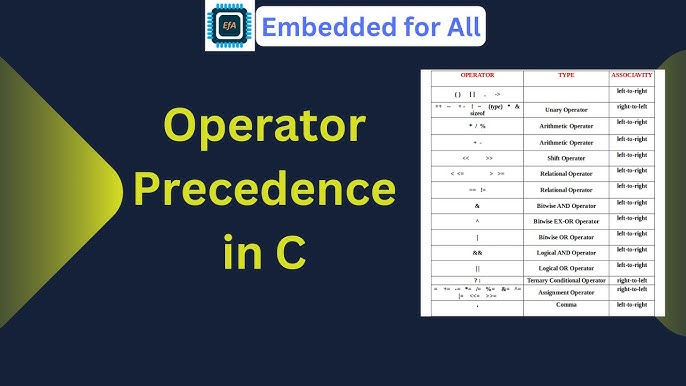
📋 Precedence Table in C Language Explained
Here’s a simplified and readable operator precedence table (from highest to lowest):
Precedence Level
Operators
Associativity
Description
1 (Highest)
() [] . ->
Left to Right
Function call, array, structure
2
++ -- + - ! ~ * &
Right to Left
Unary operators
3
* / %
Left to Right
Multiplication, Division, Modulus
4
+ -
Left to Right
Addition, Subtraction
5
<< >>
Left to Right
Bitwise shift
6
< <= > >=
Left to Right
Relational
7
== !=
Left to Right
Equality
8
&
Left to Right
Bitwise AND
9
^
Left to Right
Bitwise XOR
10
`
`
Left to Right
11
&&
Left to Right
Logical AND
12
`
`
13
?:
Right to Left
Ternary conditional
14
= += -= *= /= %= etc.
Right to Left
Assignment
15 (Lowest)
,
Left to Right
Comma separator
🧪 Examples to Make It Clear
🧮 Example 1:
c
CopyEdit
int a = 5 + 2 * 3;
Multiplication first, then addition:
CopyEdit
2 * 3 = 6
5 + 6 = 11
Result: a = 11
🧮 Example 2:
c
CopyEdit
Copy Code
int a = 5, b = 2;

int c = a > b && a != b;

> and != are relational operators


&& is a logical operator
Relational operators have higher precedence, so they are evaluated first.
int x = 5;

int y = x = 10;

Here = is right-to-left associative, so:

ini

CopyEdit

x = 10 → 10

y = 10
🛑 Common Mistakes and Misunderstandings
Mistake
Explanation
Ignoring parentheses
Can lead to wrong results
Misunderstanding associativity
Assignment operators are right-to-left
Assuming logical AND/OR runs before equality
Equality has higher precedence
Mixing pre and post increment
++x vs x++ can give different results
✅ Best Practices
1. Use parentheses to make expressions clearer and avoid confusion
2. Know that higher precedence doesn't always mean better readability
3. Stick to one operation per line when debugging complex logic
4. Practice with real-world expressions and see how outputs change
💼 Real-World Use Cases
Situation
Example
Grading system
(score >= 90) ? 'A' : 'B'
Arithmetic calculators
value = a + b * c
Conditional logic
if (age > 18 && income > 30000)
Complex updates
x = y = z = 100
🎓 Learn C Programming with Uncodemy
If you're serious about mastering C, especially tricky parts like operator precedence, pointers, and memory management, check out:
👉 Uncodemy’s C Programming Course in Noida
🧰 Course Highlights:
✅ Live interactive classes ✅ Practical coding sessions ✅ Doubt-clearing & projects ✅ Certification + placement support
Whether you’re preparing for college, internships, or job interviews—this course has what you need.
📌 Summary Table: Key Takeaways
Concept
Meaning
Precedence
Order in which operators are evaluated
Associativity
Direction (LTR or RTL) of evaluation
High precedence
Executed first in expressions
Use of ()
Overrides default precedence
Assignments
Right-to-left associativity
👋 Final Thoughts
Understanding the precedence table in C language is key to writing bug-free and logical code. It helps you predict how complex expressions will be evaluated and ensures your programs behave exactly as you intend.
So next time you're writing a formula or condition in C, don’t just rely on guesswork—use precedence and associativity wisely.
And if you’d like expert guidance, doubt support, and live projects—join Uncodemy’s C programming course and level up your skills!