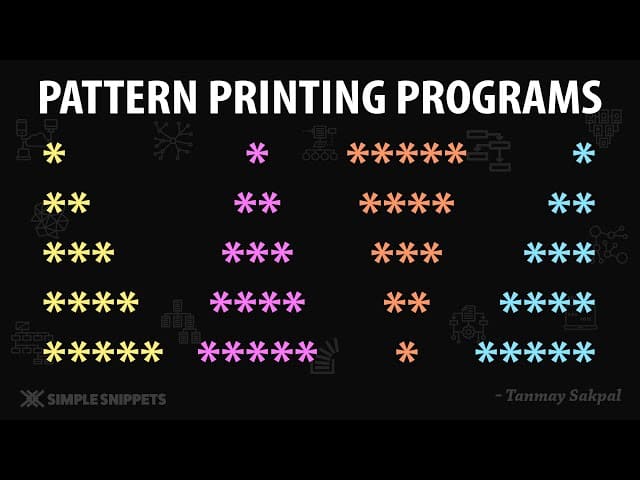
Pattern printing is a hot topic in programming interviews and exams, and it’s no wonder why! Whether you’re just starting out or looking to sharpen your logic skills, tackling pattern problems can really boost your understanding of loops, nested loops, and logical sequencing.
In this blog, we’ll dive into pattern programs using C and Python, focusing on the logic, structure, and syntax involved. No matter if you’re learning C or Python, these examples will help you get a solid grip on control structures. We’ll also show you how to tackle various types of patterns, including pyramids, triangles, inverted shapes, and more.
If you’re new to programming and seeking expert guidance, you might want to check out the Python Programming Course in Noida (uncodemy.com). Uncodemy provides real-time mentorship, structured learning, and placement support to help you get ready for the industry.
Let’s kick things off by exploring the basics of pattern programs.
What are Pattern Programs?
Mr. Bambam Kumar Yadav / 13 days
8
18 min read
Pattern programs are logic-based challenges that involve printing a structured arrangement of characters, numbers, or symbols using loops. These patterns typically follow specific sequences and are created using nested for or while loops.
Working on these programs can help you:
- Improve your logical thinking
- Enhance your ability to handle loops
- Understand the architecture of nested loops
- Strengthen your programming foundations
Core Concepts Behind Pattern Programs
Before jumping into code, let’s understand the core concepts behind pattern printing.
1. Looping Structure
To create patterns, we need to use nested loops:
- The outer loop manages the number of rows.
- The inner loop takes care of the columns or the spacing within each row.
2. Conditional Logic
Certain patterns require specific conditions within the loops (like ensuring symmetry or distinguishing between odd and even rows).
3. Alignment and Spacing
Getting the indentation and alignment just right is crucial for both the visual appeal and the accuracy of the pattern output.
Types of Pattern Programs
Here’s a quick overview of the different types of patterns you might encounter:
- Star (*) Pattern
- Number Pattern
- Alphabet Pattern
- Pyramid and Triangle Pattern
- Inverted Pattern
- Diamond Pattern
- Right/Left-Aligned Pattern
Now, let’s jump into how we can implement these patterns in both C and Python.
Star Pattern Program Examples
Pattern 1: Right-Angled Triangle
*
* *
* * *
* * * *
C program :
#include
int main() {
	int i, j;
	for(i = 1; i <= 4; i++) { for(j="1;" j <="i;" j++) printf("* "); } printf("\n"); return 0; pre>
Python Program :
for i in range(1, 5):
	for j in range(i):
        print("*", end=" ")
	print()
for i in range(1, 5):
	for j in range(1, i+1):
    	print(j, end=" ")
	print()
Alphabet Pattern Examples
Pattern 3: A to E Pyramid
A
A B
A B C
A B C D
Python Program :
for i in range(1, 5):
	for j in range(i):
        print(chr(65 + j), end=" ")
	print()
Inverted Pattern
Pattern 4: Inverted Triangle
* * * *
* * *
* *
*
Python Program :
for i in range(4, 0, -1):
	for j in range(i):
        print("*", end=" ")
	print()
Diamond Star Pattern
   *
  * *
 * * *
  * *
   *
Python Program :
n = 3
for i in range(n):
	print(" " * (n - i - 1) + "* " * (i + 1))
for i in range(n - 1):
	print(" " * (i + 1) + "* " * (n - i - 1))
Tips to Master Pattern Programs
Here are some handy tips to help you get the hang of pattern problems in C and Python:
1. Start Simple
Kick things off with right-angled triangles before diving into more complex shapes like diamonds or hollow pyramids.
2. Understand Loop Nesting
Get comfortable with nested for loops—think of the outer loop for rows and the inner loop for columns.
3. Focus on Symmetry and Spacing
Many patterns have a symmetrical nature, so paying attention to spacing is crucial for achieving the right look.
4. Dry Run Your Code
Take the time to trace each loop iteration on paper; it really helps you see how values change.
5. Modify One Pattern to Create Others
You can often create intricate patterns by tweaking simpler ones—like inverting them, adding spaces, or using different characters.
Debugging and Logical Thinking Practice
Pattern programs are more than just simple exercises in printing symbols or numbers—they're fantastic tools for honing a programmer's debugging and logical thinking skills. Because the output of these patterns is visually clear, it becomes much easier to identify where the logic might have gone awry. For example, if a triangle is misaligned or a number in a sequence is off, it quickly points to issues with loop boundaries or condition checks.
Beginners often find it challenging to formulate logic, particularly when dealing with nested loops. Engaging in pattern printing helps them grasp how adjustments in loop variables can impact the overall structure. This process allows them to backtrack errors, fix logical mistakes, and enhance their problem-solving speed. The repetitive nature of trial and error in this practice cultivates stronger debugging habits, which are essential in real-world coding situations.
Foundation for Algorithmic Thinking
Algorithmic thinking is all about outlining clear steps to tackle a problem. Pattern programs lay a solid groundwork for this skill because they require precision, structure, and a sequence of well-defined operations. Crafting a program to print a pyramid or diamond pattern often involves breaking the problem down into smaller components, like calculating spaces and characters, using nested loops effectively, and determining the order of operations.
These practices seamlessly translate to fundamental programming tasks such as recursion, sorting algorithms, searching techniques, and dynamic programming. For instance, the same nested loop principles applied in printing patterns are vital for matrix operations, solving puzzles, and executing tree traversals. Therefore, mastering pattern programs helps students gradually develop the mindset needed for writing optimized and well-structured algorithms.
Real-World Benefits of Learning Pattern Programs
While printing patterns might seem a bit academic, it really sharpens your algorithmic thinking. It enhances your skills in:
- Problem-solving
- Debugging loop-based logic
- Writing clean and structured code
- Preparing for technical interviews
Whether you’re gearing up for college exams, coding rounds in interviews, or competitive programming, these logic exercises provide a solid foundation.
Why Learn Pattern Programs from Uncodemy?
If you’re on the lookout for a structured way to master programming, consider joining the Python Programming Course in Noida (uncodemy.com). Uncodemy offers:
- Real-time expert trainers
- Live project-based learning
- 100% placement assistance
- Personalized doubt resolution
This course dives deep into Python fundamentals, DSA, pattern printing, and interview prep.
Additional Theoretical Concepts
Here are two important theoretical concepts associated with pattern programs:
Difference Between Loop Types
A for loop is perfect when you know exactly how many times you need to iterate (think fixed structure patterns). On the other hand, a while loop or do-while loop comes in handy when you're dealing with dynamic or user-defined limits for your patterns.
Time Complexity in Pattern Programs
While pattern printing is often just a practice exercise, taking a closer look at their time complexity can really sharpen your analytical skills. Most pattern programs tend to operate in O(n²) time because of those nested loops. Grasping how loop nesting ramps up complexity is essential for crafting optimized code in your future projects.
Conclusion
Pattern programs are an excellent way to really grasp programming logic and loops. Whether you're printing stars, numbers, or letters, each example helps you get a better handle on iteration and structure. No matter if you're coding in C or Python, remember that practice is key. These skills will not only help you ace coding interviews but also sharpen your problem-solving abilities.
If you're truly committed to mastering programming, don’t hesitate—enroll in the Python Programming Course in Noida (uncodemy.com) by Uncodemy today and start paving your way to becoming a skilled developer!
FAQs: Print Pattern Programs in C and Python
Q1. Why are pattern programs important for beginners?
Pattern programs are a fantastic way to sharpen your loop control, boost your logical thinking, and get comfortable with syntax—skills that are essential for any programming task.
Q2. Which language is better for pattern printing—C or Python?
Both languages have their strengths! C gives you a solid low-level understanding, while Python is all about simplicity. Practicing in both can really enhance your skill set.
Q3. Can pattern programs be asked in job interviews?
Absolutely! Many tech interviews, especially for fresh graduates, often include at least one pattern printing question to assess your loop handling abilities.
Q4. What is the best way to learn pattern programs?
Begin with simple patterns and gradually tackle more complex ones. Regular practice is key, and make sure to grasp the logic behind each line of code.
Q5. Where can I learn more about such concepts?
You can sign up for the Python Programming Course in Noida (uncodemy.com) to dive deeper into pattern programs, data structures and algorithms, and more, all with real-world guidance.