ProGAN Models: Progressive Growing for Better AI Images
The realm of Artificial Intelligence (AI) and Deep Learning has seen some incredible changes over the past ten years. One of the most intriguing advancements is the emergence of Generative Adversarial Networks (GANs), which allow machines to create images, videos, and even voices that closely resemble real-world data. While traditional GANs set the groundwork, more sophisticated models like ProGAN (Progressive Growing of GANs) have elevated image generation to a whole new level.
In this blog, we’re going to dive into ProGAN Models: Progressive Growing for Better AI Images. We’ll break down what ProGAN is, how it operates, its architecture, the benefits and challenges it presents, its applications, and how it’s influencing the future of AI image generation. If you’re eager to learn about generative models, programs like the Deep Learning Course in Noida are fantastic options for gaining comprehensive knowledge and practical experience.
What are GANs?
Before we delve into ProGAN, it’s essential to revisit the concept of GANs. Generative Adversarial Networks (GANs) consist of two models that work against each other:
- -Generator (G): This model creates fake data that mimics real-world samples.
- -Discriminator (D): This model assesses the data to figure out if it’s real or fake.
As they train together, the generator improves at producing realistic data, while the discriminator sharpens its ability to spot fakes. This back-and-forth competition results in impressively realistic outputs.
What is ProGAN?
Progressive Growing of GANs (ProGAN) is a cutting-edge GAN model introduced by Tero Karras and his team at NVIDIA in 2017. Unlike traditional GANs that attempt to generate images all at once, ProGANs gradually develop both the generator and discriminator during training.
To put it simply, the model begins by creating low-resolution images (like 4x4) and slowly increases the resolution step by step until it can generate high-resolution, detailed, and lifelike images (like 1024x1024).
This method tackles many of the issues that standard GANs face, such as training instability and poor image quality.
How Does ProGAN Work?
The main concept behind ProGAN is progressive growing. Let’s break it down step by step:
- Start Small: The generator kicks things off by creating very low-resolution images (4x4 pixels).
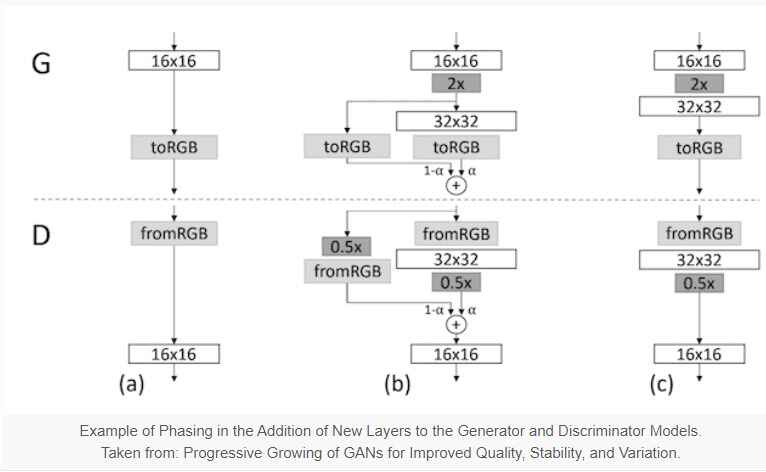
- Gradual Growth: As the training continues, new layers are added to both the generator and the discriminator. For instance, it evolves from 4x4 → 8x8 → 16x16 → 32x32, and so forth.
- Smooth Transition: Each time new layers are introduced, the transition is smooth (fade-in). This helps prevent any sudden instability during training.
- High-Resolution Output: Ultimately, the model is capable of producing breathtaking high-resolution images (up to 1024x1024).
This progressive training approach guarantees both stability and quality in image generation.
Architecture of ProGAN
The ProGAN architecture tweaks traditional GAN structures to support progressive growth.
1. Generator
- Begins with a low-resolution image.
- Layers are added progressively to enhance resolution.
- Utilizes convolutional layers with upsampling.
- Incorporates activation functions like ReLU and Tanh.
2. Discriminator
- Mirrors the generator by starting with low-resolution input.
- Layers are added progressively to manage higher resolutions.
- Uses downsampling convolutional layers.
- Employs Leaky ReLU activations.
3. Key Innovations in ProGAN
- Fade-in Layers: Gradually blending in new layers instead of making abrupt changes.
- Pixel Normalization: Stabilizes training by normalizing pixel-level features.
- Equalized Learning Rate: Ensures a consistent learning speed across layers.
- Mini-batch Standard Deviation: Promotes diversity in the generated images.
Advantages of ProGAN Models
- Stable Training: The progressive growth method helps avoid the instability often seen in GAN training.
- High-Resolution Images: ProGANs can create images as large as 1024x1024 pixels.
- Better Feature Learning: The progressive layers assist in capturing finer details step by step.
- Reduced Mode Collapse: Techniques like fade-in and normalization help minimize repetitive outputs.
- Scalability: It’s easy to extend ProGANs to generate even higher resolutions.
Applications of ProGAN
ProGANs have found their way into various industries, and here are some of the standout applications:
1. Human Face Generation
ProGANs can create incredibly realistic human faces that don’t actually exist.
2. Art and Design
Artists are leveraging ProGANs to craft one-of-a-kind digital artwork and textures.
3. Gaming and Virtual Reality
They’re used to produce lifelike avatars, immersive environments, and detailed textures for a more engaging experience.
4. Healthcare
ProGANs help generate synthetic medical images, allowing for the training of diagnostic models while keeping patient privacy intact.
5. Fashion Industry
In the fashion world, ProGANs are used to come up with fresh design ideas and forecast style trends.
6. Data Augmentation
They create synthetic yet realistic data to enhance datasets for machine learning training.
Challenges of ProGANs
Despite their power, ProGANs do encounter some hurdles:
- High Computational Demand: They need a lot of GPU resources for effective training.
- Training Time: The progressive growing process takes longer than traditional GANs.
- Ethical Concerns: There’s a risk of misuse, such as creating deepfakes and fake identities.
- Limited Diversity: Although improved, mode collapse can still happen.
ProGAN vs DCGAN
Feature
DCGAN
ProGAN
Resolution
Limited
Very High (up to 1024x1024)
Training Stability
Moderate
High
Image Realism
Good
Excellent
Architecture Growth
Fixed
Progressive
Applications
Basic Images
Realistic Faces, VR, Art
Why Learn ProGANs?
Foundation for Advanced Models: ProGAN laid the groundwork for concepts that are now used in StyleGAN and other models.
- Industry Relevance: They’re widely utilized in sectors focused on AI-driven image generation.
- Career Growth: Skills in GANs and ProGANs are highly sought after by AI engineers, researchers, and data scientists.
- Hands-On Projects: Learners can dive into unique projects in fields like computer vision, gaming, and healthcare.
For a structured learning experience, enrolling in the Deep Learning Course in Noida can provide students and professionals with practical exposure to GANs, ProGANs, and other cutting-edge AI concepts.
Exploring Career Opportunities After Mastering ProGAN
- AI Engineer – Create innovative generative AI solutions.
- Computer Vision Engineer – Utilize ProGANs for visual tasks like generating objects.
- Deep Learning Specialist – Design cutting-edge GAN and ProGAN models.
- Data Scientist – Leverage ProGANs for data augmentation and modeling.
- Research Scientist – Push the boundaries in generative modeling and AI ethics.
The Future of ProGANs
Even though newer models like StyleGAN and Diffusion Models are making waves, ProGAN still stands as a pivotal achievement in AI research. Its progressive growing technique has set the stage for the evolution of modern generative AI.
ProGANs will keep fueling research focused on image quality, training stability, and scalable AI models. For those learning the ropes, mastering ProGAN is a crucial step toward understanding the advanced generative models that will shape the AI-driven future.
Wrapping Up
ProGAN Models: Progressive Growing for Enhanced AI Images mark a significant leap in generative modeling. By gradually ramping up resolution during training, ProGANs produce incredibly realistic, high-resolution images while ensuring stability.
From generating human faces to applications in art, healthcare, and gaming, ProGANs have unlocked a world of possibilities. Although challenges like high computational demands and ethical issues persist, the benefits far outweigh these hurdles, making ProGANs an essential asset for AI practitioners.
For students, researchers, and professionals eager to explore generative AI, ProGANs are more than just an advanced concept—they're a gateway to the future of machine creativity. Enrolling in specialized programs like the Deep Learning Course in Noida guarantees hands-on experience with ProGANs and career growth in this thrilling field.
FAQs on ProGAN Models: Progressive Growing for Better AI Images
Q1. What sets ProGAN apart from traditional GANs?
ProGANs take a unique approach by gradually increasing the resolution of images, which enhances both stability and realism compared to standard GANs.
Q2. What are the primary uses of ProGANs?
They excel at creating lifelike human faces, improving healthcare imaging, designing fashion, crafting gaming environments, and augmenting data.
Q3. What advantages do ProGANs have over DCGANs?
ProGANs deliver higher resolution images, smoother training processes, and more realistic results when stacked against DCGANs.
Q4. Are there any downsides to using ProGANs?
Absolutely. They demand significant computational power, longer training durations, and can raise ethical concerns if not handled properly.
Q5. How can I begin my journey with ProGANs?
Start by grasping the fundamentals of GANs, then move on to DCGANs and ProGANs. Engaging in hands-on training through structured programs, like the Deep Learning Course in Noida, can really help you develop your skills effectively.