Imagine you are guarding a priceless family heirloom. You don’t leave it on the porch for anyone to see or touch; you lock it safely inside a vault, and only trusted people know how to access it. This concept, applied to programming, is called encapsulation.
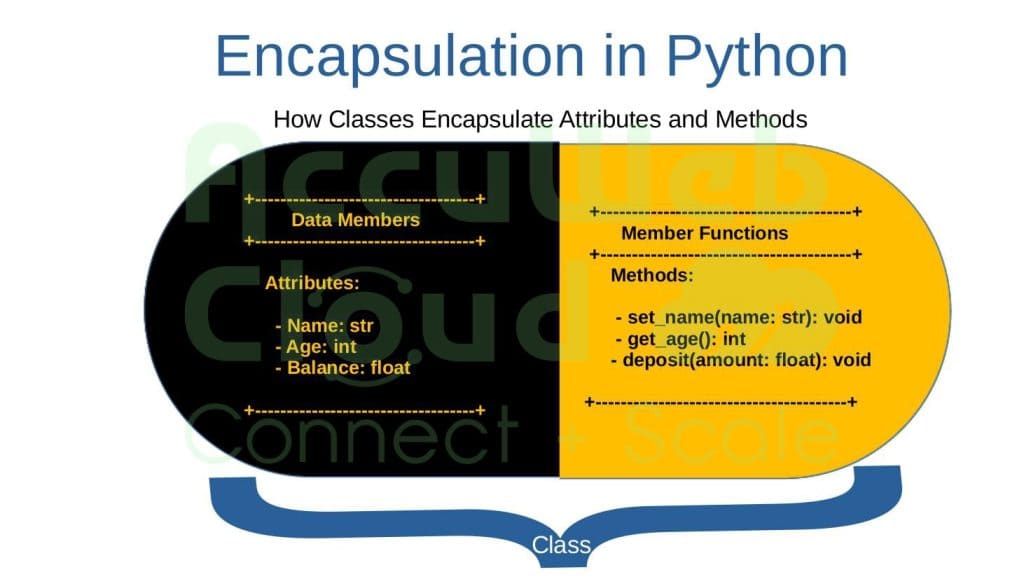
If you are taking a Python Programming Course in Noida, you’ll hear this term often because it’s one of the most crucial pillars of object-oriented programming (OOP). Encapsulation means bundling data (variables) and the methods (functions) that operate on that data into a single unit—usually a class—and restricting access to some of the object's components to protect them from unauthorized modifications.
Encapsulation in Python involves restricting direct access to some of an object’s components. It prevents data from being modified accidentally and promotes better modularity and maintainability.
In Python, this is typically done using access specifiers:
Public members: Accessible from anywhere.
Protected members: Prefixed with a single underscore (_), meant to be accessed only within the class and its subclasses.
Private members:Prefixed with double underscores (__), inaccessible directly outside the class.
Let’s see a simple example before we dive deeper.
                            class BankAccount:
                            def __init__(self, owner, balance):
                                self.owner = owner
                                self.__balance = balance

                            def deposit(self, amount):
                                if amount > 0:
                                    self.__balance += amount
                                    print(f"Deposited ₹{amount}. New balance: ₹{self.__balance}")
                                else:
                                    print("Deposit amount must be positive!")

                            def withdraw(self, amount):
                                if 0 < amount <= self.__balance: self.__balance -="amount" print(f"withdrew ₹{amount}. remaining balance: ₹{self.__balance}") else: print("insufficient balance or invalid amount.") def get_balance(self): return account='BankAccount("Riya",' 5000) account.deposit(1500) account.withdraw(2000) print(account.get_balance()) < pre>
In this example, __balance is a private variable. You can’t access it directly outside the class, keeping the balance secure from unintended modifications.
Why is Encapsulation Important?
Encapsulation provides a protective barrier around your data, much like a safe vault. Without it, anyone could manipulate sensitive data however they wish, potentially breaking your program’s logic and integrity.
When you take a Python Programming Course in Noida,you’ll learn that real-world applications—like banking software, hospital management systems, and e-commerce platforms—depend heavily on encapsulation to keep data secure and consistent.
Fun Analogy: The Ice Cream Shop
Imagine a famous ice cream shop in Noida that’s always crowded. Everyone loves it, not just for the flavors but for the perfect creamy texture. The recipe? Top secret! Customers can choose flavors and toppings, but they have no idea about the secret process in the kitchen. The public-facing part of the shop is like the public interface of a class, and the guarded recipe is like private data—encapsulated away from the public eye.
This separation ensures no customer accidentally (or intentionally) tampers with the recipe, just as encapsulation ensures no outside code interferes with private data. If a mischievous customer could sneak in and change the ratio of milk to sugar, the entire ice cream shop’s reputation could collapse overnight!
Classroom to Corporate: The Evolution of Understanding
When you first learn encapsulation during your Python Programming Course in Noida,it might seem like a boring rule. You might think, "Why can’t I just access everything directly?" But in a corporate environment, you’ll appreciate its importance.
Imagine working on a team of 50 developers. If everyone had access to modify each other's data structures freely, it would be pure chaos. Bugs would multiply, features would break, and deadlines would vanish into thin air. Encapsulation is what keeps your code organized and prevents your software from turning into an unmanageable mess. It’s like assigning cubicles in an office—everyone has their own space to work securely.
Historical Fun: From Early Computers to Encapsulation
Back in the 1950s and 60s, programming was a linear affair. Code was written in a single block, with data and logic all jumbled together. As programs grew, this style quickly became unsustainable. The introduction of OOP was a monumental leap forward, and encapsulation was its heart.
Visionaries like Ole-Johan Dahl and Kristen Nygaard introduced the concept while working on Simula, the first OOP language. Python inherited these ideas but added its own flavor of simplicity and readability. Python’s approach to encapsulation is more about convention than enforcement—using underscores and double underscores to indicate intent rather than rigidly blocking access.
Deep Dive: Protected vs Private
In Python, protected members are indicated by a single underscore (_). This tells other developers, “I’m not meant to be accessed directly, but if you know what you’re doing, proceed carefully.”
Private members use double underscores (__). This leads to name mangling, where the interpreter changes the name of the variable in a way that makes it harder to access from outside.
Example:
                            class Car:
                                def __init__(self):
                                    self._speed = 120  # protected
                                    self.__engine_number = "EN12345"  # private

                                def show_engine_number(self):
                                    return self.__engine_number

                            car = Car()
                            print(car._speed)  # You can access, but you shouldn't!
                            print(car.show_engine_number())  # Correct way
Real-World Case Study: Hospital Management System
Let’s say you are building a hospital management system. You create a Patient class that stores sensitive data like medical history and billing details. You don’t want every developer or every module to modify this data directly.
                        class Patient:
                            def __init__(self, name, history):
                                self.name = name
                                self.__medical_history = history

                            def get_medical_history(self):
                                return self.__medical_history

                            def update_medical_history(self, new_history):
                                self.__medical_history = new_history

                        patient = Patient("Arjun", "Diabetes")
                        print(patient.get_medical_history())
                        patient.update_medical_history("Diabetes, Hypertension")
                        print(patient.get_medical_history())
This keeps the medical records safe and only modifiable through well-defined methods.
Advanced Use Cases: APIs and Frameworks
When you build APIs, encapsulation prevents external users from breaking your logic. You expose only what is necessary and keep the rest hidden. Frameworks like Django and Flask use encapsulation principles extensively.
Emotional Journey: A Developer’s Growth
When you start learning, you want to experiment and access everything. Over time, you start valuing stability and predictability. Encapsulation embodies that maturity. It’s a sign you’ve transitioned from a coder to a true software developer who understands that protecting data is protecting your software's integrity—and your reputation.
Final Lesson: Encapsulation as a Philosophy
Encapsulation isn’t just about access modifiers; it’s about writing considerate, future-proof code. It’s a philosophy that respects fellow developers and future maintainers.
Just like a master chef carefully curates recipes for future generations, a good programmer protects and shapes their codebase for those who will maintain and build on it in the future.
Whether you're working on large enterprise apps, small personal projects, or your assignments in a Python Programming Course in Noida, mastering encapsulation in python will make you a more professional, dependable, and confident developer.
Conclusion
Encapsulation helps you keep your code clean, robust, and secure. It empowers you to think about how your work affects others and makes your projects easier to maintain and scale.
If you're serious about becoming a Python expert, dive deeper into object-oriented principles in your Python Programming Course in Noida. Embrace encapsulation wholeheartedly; it’s one of the most rewarding practices you'll carry throughout your programming career.