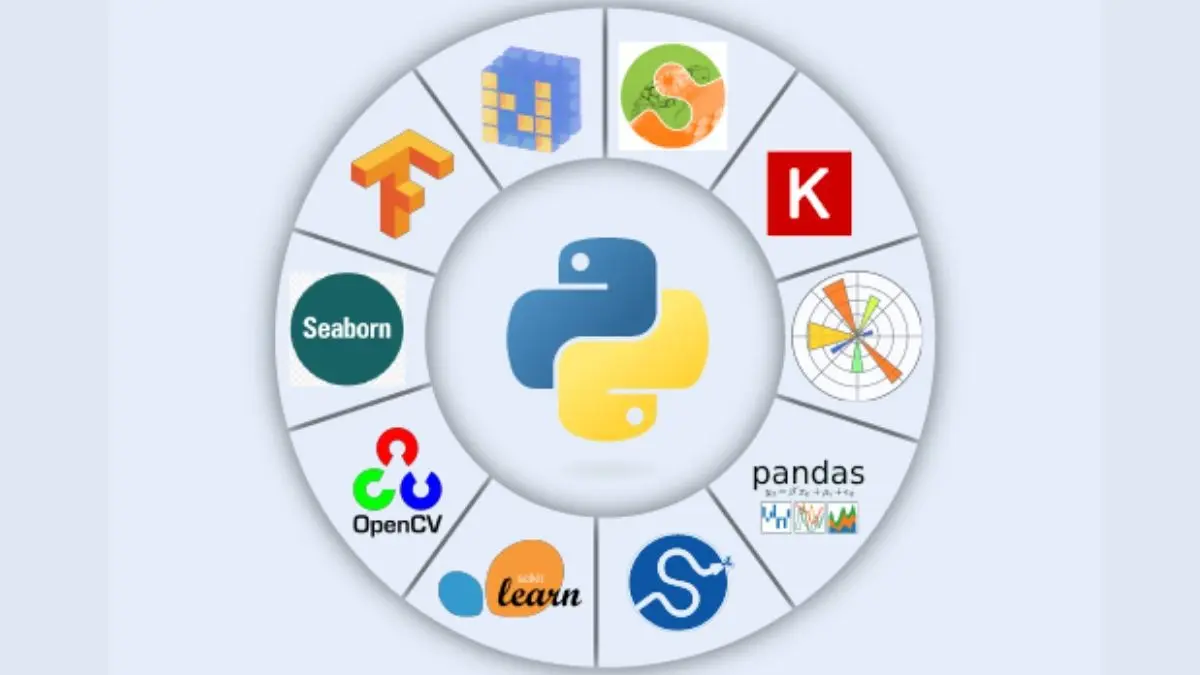
Whether you are a beginner or an experienced developer, knowing the right Python libraries can make you far more productive. Here’s a curated list of libraries every developer should have in their toolkit.
1. NumPy
- Category: Data Analysis, Scientific Computing
-
- Why Learn It: NumPy is the backbone of numerical computing in Python. It offers high-performance multidimensional arrays and tools for mathematical operations.
- Use Cases:
- Matrix and vector operations
- Linear algebra
- Fourier transforms
- Scientific simulations
- Example:
python
CopyEdit
Copy Code
import numpy as np

arr = np.array([1, 2, 3])

print(arr + 5)  # Output: [6 7 8]
2. Pandas
- Category: Data Analysis
- Why Learn It: Pandas makes working with structured data (tables, spreadsheets, databases) incredibly easy.
- Use Cases:
- Data cleaning
- Data manipulation
- Reading/writing CSV, Excel, SQL
- Example:
python
CopyEdit
Copy Code
import pandas as pd

data = pd.read_csv("data.csv")

print(data.head())
3. Matplotlib
- Category: Data Visualization
- Why Learn It: The go-to library for creating plots, charts, and graphs in Python.
- Use Cases:
- Line, bar, scatter, pie charts
- Custom visualizations
- Example:
python
CopyEdit
Copy Code
import matplotlib.pyplot as plt

plt.plot([1, 2, 3], [4, 5, 6])

plt.show()
4. Seaborn
- Category: Data Visualization
- Why Learn It: Built on top of Matplotlib, Seaborn provides beautiful and easy-to-create statistical visualizations.
- Use Cases:
- Heatmaps
- Box plots
- Regression plots
- Example:
python
CopyEdit
Copy Code
import seaborn as sns

import pandas as pd

df = pd.DataFrame({"x": [1,2,3], "y": [4,5,6]})

sns.lineplot(x="x", y="y", data=df)
5. Requests
- Category: HTTP Requests
- Why Learn It: This library makes it easy to send HTTP requests without worrying about complexities.
- Use Cases:
- Calling APIs
- Web scraping
- Sending data to servers
- Example:
python
CopyEdit
Copy Code
import requests

response = requests.get("https://api.github.com")

print(response.json())
6. Flask
- Category: Web Development
- Why Learn It: Flask is a micro web framework for building lightweight web apps quickly.
- Use Cases:
- REST APIs
- Prototypes
- Web dashboards
- Example:
python
CopyEdit
Copy Code
from flask import Flask

app = Flask(__name__)

@app.route('/')

def home():

    return “Hello, World!”

app.run()
7. Django
- Category: Web Development
- Why Learn It: A full-stack framework for building robust, secure, and scalable applications.
- Use Cases:
- E-commerce platforms
- Social media sites
- Large web apps
8. TensorFlow
- Category: Machine Learning
- Why Learn It: One of the most popular libraries for deep learning and neural networks.
- Use Cases:
- Image recognition
- NLP tasks
- AI models
9. Scikit-Learn
- Category: Machine Learning
- Why Learn It: A beginner-friendly ML library for classical algorithms.
- Use Cases:
- Regression
- Classification
- Clustering
- Example:
python
CopyEdit
from sklearn.linear_model import LinearRegression
model = LinearRegression()
10. PyTorch
- Category: Machine Learning
- Why Learn It: A flexible deep learning framework preferred for research.
- Use Cases:
- AI research
- Neural network experiments
-
11. BeautifulSoup
- Category: Web Scraping
- Why Learn It: Makes extracting data from HTML and XML simple.
- Use Cases:
- Scraping news websites
- Extracting structured data
- Example:
python
CopyEdit
Copy Code
from bs4 import BeautifulSoup

import requests

html = requests.get("https://example.com").text

soup = BeautifulSoup(html, "html.parser")

print(soup.title.text)
12. SQLAlchemy
- Category: Database Management
- Why Learn It: A powerful ORM for working with relational databases.
- Use Cases:
- Database queries
- Migrations
- API backends
13. OpenCV
- Category: Computer Vision
- Why Learn It: Industry-standard for image and video processing.
- Use Cases:
- Face detection
- Object tracking
- Image filtering
14. Pygame
- Category: Game Development
- Why Learn It: Great for building 2D games and learning graphics programming.
- Use Cases:
- Game development
- Interactive simulations
15. FastAPI
- Category: API Development
- Why Learn It: Modern, fast, and asynchronous API framework.
- Use Cases:
- High-performance REST APIs
- Microservices
Final Thoughts
Python’s power lies in its community and the vast library ecosystem. As a developer, you don’t need to master all libraries at once — start with the essentials like NumPy, Pandas, Matplotlib, and Requests, then explore more specialized ones based on your project needs.