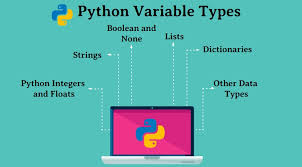
Python variables explanation
Variables are named spaces in Python that obtain a value and are used to access and operate data all through the execution of a program. A variable is declared when a value is added to the variable using equals symbol (=). e.g. country = "United States" uses a string value to put the value United States in the variable country, and year_founded = 1776 uses the integer value 1776 to put the value 1776 in the variable year_founded.
Python Variable Naming conventions and rules
Python follows well-established naming conventions and rules essential to write clean and functional codes. The names of the variables must not begin by a digit and should not include spaces, quotation marks, or other punctuations. But underscores are allowable and the most common use of underscores is to divide longer variable names, commonly referred to as "snake_case". Python is case sensitive and therefore year_founded and Year_Founded would be regarded as different variables. The names of variables have to start with a letter or underscore and they should only contain letters, numbers and underscores. They ought to be descriptive and not too short or too long. Python will raise a NameError in case a variable reference occurs prior to its being defined or in case the name is misspelled.
The Dynamic Typing in Python
Python is dynamically typed, implying that the type of a variable is set during the run based on the value placed in it rather than being declared explicitly. It means that a variable can contain various types of information during the running of a program. You can use a built-in type() function to check the type of a variable.As an example, type(answer) could produce <class 'int'> when the type of message could produce <class 'str'>. A very helpful type checking method is likewise listopod system lists highly unsafe-- Whereas type() just returns the precise type of a-object, isinstance() is by far a more prudent option since it looks at the inheritance hierarchy, thus is more versatile in terms of checking whether an object behaves in a similar way as a specified type or not.
Commutative Python Data Types
Python provides a broad collection of the built-in data types, all of which possess certain properties and applications. These types are very essential in manipulating and designing programs.
Numeric Types
Numeric types work with numeric data, such as integers, floating-point and complex.
Integer (int): It is the integer figures (whole numbers) with or without negative numbers. There is no limit to the length of integer value in Python.
Floats (float): This is the real number with the decimal point, also called the floating point numbers. Also, they may be written in e or E scientific format.
Complex numbers (complex): complex numbers are numbers expressed as (real part) + (imaginary part) j; they are also used when one wants to perform a mathematical operation that involves imaginary numbers.
Sequence Types
Data can be grouped in an ordered collection called sequence types that may hold a variety of values.
Strings (str): A series of Unicode characters is a sequence of strings, which usually represent words or sentences. A single character in Python is a one character length string. Single,double,and triple quotes strings can be created. The characters of a string may be accessed on an individual basis using its index that is set to begin with 0. One can extract several characters via slices. It is possible to know the length of a string with the help of the len () function.
Lists (list): Lists are ranked, changeable lists of values, identical to arrays in other programs. They are of high flexibility and may include objects of different data types. Access to list items is specified by indexes where negative ones indicate an element at the tail of the list (e.g. -1 is the last element).
Tuples These objects (tuple) are immutable, ordered values. Tuples cannot be changed with lists in contrast. They are formed by inserting values delimited using commas, but, optionally, parentheses.
Mapping Type
Dictionaries (dict): Dictionaries are a map, as they hold data using key-value pairs. Keys have to be distinct and unchangeable, whereas the value may be of any data type and may be cloned. To access dictionary contents it is possible to use square brackets with a key name or the get() method.
Set Types
Sets (set): sets Sets are iterable, mutable and non-duplicate collections of data. These are generated with the in-built set() method or with elements in between curly braces. Index can not access set items.
Frozenset (frozenset): Just like sets, except that they are immutable.
Boolean Type
Boolean (bool): This is a type of truth value, and it contains True or False. True and False are literal values in the Python language.
Calculations with Python Variables
Variables are applicable in a number of operations such as mathematical operations, string operations, and comparisons. Rudimentary arithmetic such as addition, subtraction, multiplication and division are permitted in Python. + operator can be used to concatenate strings. Equality operators are also applicable to compare values like, <, >, ==, and !=. We should also take care that the types of variables are compatible when we apply operations; e.g. we cannot directly add a string and an integer but we will get an error unless we convert one into a type through which operations can be carried out.
Python Learning Uncodemy Courses
Uncodemy is an educational organization in Delhi and Noida teaching Python programming, data science and machine learning. Their Python courses are very flexible and they are available offline and online and thus the students learn at their own pace. Uncodemy Python Training Course in Delhi has offline classes with placement assistance and offers a comprehensive curriculum at a low fee. These courses are able to offer an adequate basis to those interested in becoming Python developers.