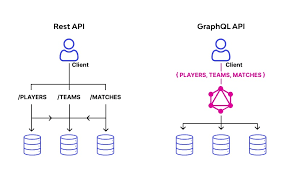
What is REST API?
Based on hypermedia, REST or REpresentational State Transfer is a style of architecting distributed systems that was proposed by Roy Fielding in 2000. It has turned out to be one of the most utilized methods to develop web-based APIs. REST is neither protocol nor a standard but only an architectural style that can be applied by developers in different manners.
Principles of REST
The principles under which REST is based enable simplicity, scalability and statelessness. An API based on REST architectural style is regarded as REST API or RESTful API.
Six principles of RESTful architecture are:
Create Uniform Interface: This principle makes the entire system architecture simpler and enhances the interaction visibility by using generality across the component interactions interface. This comes in forms of constraints such as the unique identification of its resources, representation-based manipulation of resources, self-descriptive messages and hypermedia as the engine of application state. As an example, REST APIs employ the normal HTTP requests like GET, POST, PUT, DELETE and URIs to locate the resources.
Client-Server Architecture: Such design patterns promote the separation of concerns making client and server components evolve with independence. The division of user interface issues (client) and data storage issues (server) can be done to allow a more portable user interface (to multiple platforms) and easily scaling.
Statelessness: Every individual request issued by a client should possess sufficient information in order to make sense out of it and finish it which would imply that the server cannot avail of the existence of some earlier stored context data. The session state has to be maintained by the client application only.
Cacheable: The server side or the responses must explicitly attach themselves to be cached or otherwise. When a response is cacheable, the client app may reuse the information to answer comparable requests over a help period.
Layered System: The style enables an architecture that is built in layers and that each component of the architecture can only communicate with the next layer. This assists in scalability and security.
Code on demand (Optional): REST supports client extension through downloaded and executed code, example: applets or scripts. This may streamline the clients since less pre-implementation is required.
The Working Process of REST APIs
The system normally works by means of the server and the client exchanging queries and responses, in JSON format at enormous odds. They apply HTTP operations such as GET, POST, PUT, PATCH, and DELETE to specify the actions taken on resources which are congruent with CRUD (Create, Read, Update, Delete) operations. An example is that GET gives a resource, POST makes a new one, PUT updates or makes a resource, PATCH partly updates a resource, DELETE gets rid of a resource.
Rest APIs limitations
REST APIs have been found to lack flexibility in the way they handle the fast-evolving client requirements even though they are widely applied.
One problem with REST is excessive and inadequate fetching since the end surgeons download the data by calling endpoints that respond with data structures of a determined size.
Overfetching: Information is downloaded by a client more than it is necessary by the application. Taking an example, retrieving a list of users would also give their birthday or addresses when all that is required is the list of names.
Underfetching and N+1 Requests Problem: A certain endpoint can fail to supply the needed information regarding a particular endpoint, and the client will be forced to have extra requests. This can be compounded to a scenario where the client will first have to download a list of the elements and after that, one request is accepted per each individual element so that they receive all the required data. E.g., when rending the last three followers of each user we would need to issue an initial request to /users, then for each user a distinct request to /users/<user-id>/followers.
UI Adjustments Backend: One of the typical REST patterns is to design the endpoints using views of the application, and this may be handy. Nonetheless, this involves a rather cumbersome process with frontend development making the frontend iterations challenging and with the changes in UI necessitating changes in the backend to address new information requirements, leading to a slow pace in productivity and feedback integration.
Understanding GraphQL
Facebook created GraphQL in 2012 as a solution to the problem of development of more useful and efficient APIs. It addresses most of the challenges that the developers face in dealing with REST APIs. GraphQL is an API and your query language, a server-side execution environment, and a tooling environment. As opposed to the REST, which is an architectural style, GraphQL is a specification and a query language.
Fundamentals of GraphQL
The primary innovation represented by GraphQL is that it enables the clients to define what they require in the particular query to be served at a particular endpoint. The server will then give back a JSON object which exactly meets these requirements, as an echo of the nesting structure of the query. This frontend-based practice allows frontend developers to get all that they require at once.
How GraphQL holds benefits
GraphQL has various benefits compared to the REST API, especially relating to flexibility and efficiency.
Removal of Over- and Underfetching: Clients have the possibility to specify precisely what data they want, and thus they do not encounter the over- fetching (receiving more data than they needed) and under- fetching (requiring a series of requests to receive all data) issues when using REST.
Flexibility of the Frontend Teams: GraphQL enables flexibility to implement changes on the client-side without the server needing additional tasks. Because clients request specific data requirements, backend engineers do not have to adjust when the frontend design and data requirements change, which enhances productivity. This allows one to create interactive tools or dashboards where entities or shapes of data may vary depending on how they are interacted with, which is especially useful.
Fine-Grained Insights and Performance Tracking: GraphQL offers fine-grained insights to the data that was requested on the backend, so that developers know how available data is utilized. This could assist in developing an API over time and making fields that are no longer asked to be deprecated. Besides, GraphQL can be used to monitor low-level performance metrics of requests processed under the server side, and instrument and measure resolver functions, giving important information of the bottlenecks in the system.
Strong Type System: GraphQL is a strong type system, which defines API capabilities. All the fields revealed in an API are calculated in a schema with the GraphQL Schema Definition Language (SDL), a contract between the client and server on how data can be available. Such schema allows frontend and backend teams to work independently and do not need to communicate with each other every time as both of them know the final data structure. Applications are also easy to test through mocking of the required data structures by fronted teams.
Graph Databases: GraphQL naturally reflects graph data structure, one of the best options when it comes to highly connected data. The query structure of its language supports multi-hop nesting and traversal of its relationships, rendering it very similar to the visualization and thinking of graph data. This structural similarity enables the developers to use a single query to access information that has a deep nesting and relationship structure.
GraphQL limitations
Although GraphQL has huge benefits it also has some drawbacks.
Complexity and Learning Curve: GraphQL is more versatile but entails an initial learning of GraphQL queries which makes it more complex than REST to use when it comes to simple cases.
Support to write to the server; GraphQL also supports writing to the server, often called mutations, but this implementation is rudimentary in comparison to that provided by web/REST-based systems.
Which One to study?
Answering the question of whether to learn REST API or GraphQL is personal based on what you want to achieve and your career goals.
Study REST API in the event of:
Simplicity Rule: In the cases of simpler data structures and uncomplicated resource accessibility REST APIs tend to be more straightforward and to deploy.
Std-HTTP Methods: In case you want to use standard HTTP operations (GET, POST, PUT, DELETE) to specify operations on resources, REST will fit directly.
Comprehensive Usability: REST has been used to design web APIs for more than a decade and is still commonly used, hence it is a handy skill in most of the current systems.
If you do GraphQL learn.
Complex Data Relationships: When you expect your data to be closely interconnected or graph in nature and relationships are as valuable as objects, being able to represent your graph data structure with GraphQL and follow relationships with a single query can be very useful.
Flexible Data Fetching: In applications which need clients to be able to write precise data specifications to prevent unnecessary overand underfetching, GraphQL provides greater control and efficiencies.
Quick Frontend Development: When you want your project to go through multiple rapid iterations on the frontend without the need to frequently update the backend to reflect the data needs of the project, then the flexibility of GraphQL will surely be of great use.
Dynamic and Evolving Ecosystems: GraphQL is also viewed as a dynamic or efficient extension of the REST ecosystem, especially those in an environment of quick change clients and use in big scale apps (such as Facebook and GitHub).
Uncodemy Courses
Uncodemy has a training curriculum with a course on introduction to both REST and GraphQL APIs and this is available in the frontend development certification course. These classes will offer IT training to both the entry-level and the professionals. These courses may be useful to the full-stack developers eager to get a skill in fetching data with the help of such technologies as Axios or Fetch API. Also, other useful guides that compare REST API, GraphQL, and gRPC overlaying their basics, more complex mechanics, and limits and advantages of each of them are available at platforms such as Udemy.