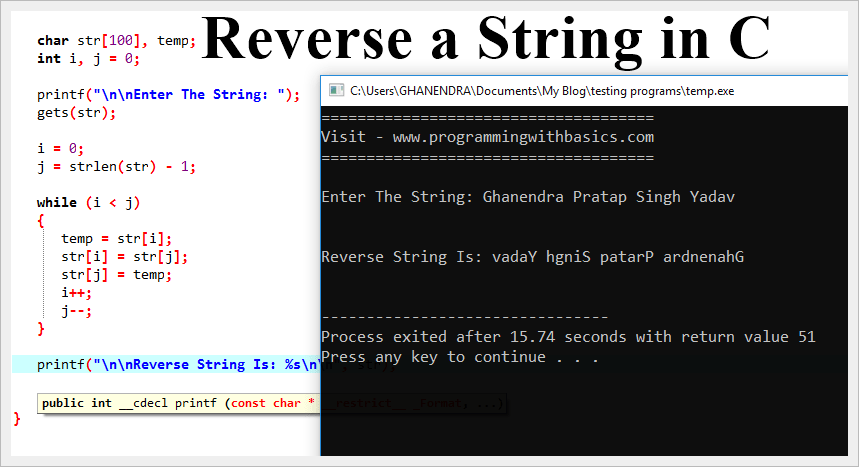
Reversing a string is one of those classic exercises in programming that every beginner encounters. It’s a great way to get a grip on essential concepts like looping, string manipulation, array indexing, and even recursion. This isn’t just an academic exercise; it lays the groundwork for tackling real-world challenges such as checking for palindromes, encoding and decoding data, and parsing strings.
In this article, we’ll explore various methods to write the Reverse String program in both C and Python. We’ll break down each approach step by step and give you a peek into how the concept operates behind the scenes. Whether you’re just starting out or looking to refresh your skills, this blog will serve as a handy guide.
What is String Reversal?
String reversal is all about rearranging the characters in a string so that they appear in the opposite order. For instance, if you reverse "hello," you’ll get “olleh.”
This operation often serves as a gateway to more complex string-related problems, including:
- Palindrome checking
- Data transformation
- Output formatting
Why Learn Reverse String?
- Mastering string reversal can help you:
- Grasp string indexing
- Dive into string traversal techniques (both forward and backward)
- Hone your skills in iteration and conditionals
- Build your logic and problem-solving abilities
If you’re new to programming and seeking expert guidance, consider enrolling in the C Programming Course in Noida orthe Python Programming Course in Noida offered byUncodemy. These courses focus on hands-on, project-based learning to help you get the most out of your experience.
Reverse String in C
Let’s first look at how string reversal works in C language.
Method 1: Using Loop and Temporary Variable
Copy Code
#include <stdio.h>

#include <string.h>

int main() {

char str[100], temp;

int i, len;

    printf("Enter a string: ");

    gets(str);  // For simplicity, using gets()

len = strlen(str);

for (i = 0; i < len / 2; i++) {

     temp = str[i];

     str[i] = str[len - i - 1];

     str[len - i - 1] = temp;

}

    printf("Reversed string: %s", str);

return 0;

}
Output:
Enter a string: hello
Reversed string: olleh
Explanation:
- The function strlen() is all about figuring out how long a string is.
- We loop from the beginning to the halfway point of the string.
- To reverse the string, we swap characters from the front and back, using a temporary variable to help us out.
- The join() method is what we use to stitch those characters together into a fresh new string.
Real-Life Applications of String Reversal
Reversing a string isn’t just a theoretical exercise; it has practical uses in various fields, such as:
- Palindrome Check: You can easily determine if a string reads the same forwards and backwards by comparing it to its reverse.
- Encoding/Decoding Algorithms: Certain ciphers rely on reversing strings as part of their process.
- Data Structures: When working with stacks, you often simulate string reversal operations.
- User Input Validation: Reversing strings can be a handy technique for custom data parsing.
Common Mistakes to Avoid
- Forgetting about the null character \0 in C.
- Using gets(), which is considered unsafe in modern C; it’s better to use fgets() instead.
- Assuming that strings in Python can be changed (spoiler: they can’t).
- Overlooking leading or trailing spaces when comparing reversed strings.
Reverse String Algorithm (Step-by-Step)
Here’s a straightforward algorithm to reverse a string:
1. Start with the input string.
2. Determine the length of the string.
3. Set up two pointers:
- One at the start (i = 0)
- One at the end (j = length - 1)
4. As long as i is less than j, swap the characters at positions i and j.
5. Move i forward and j backward.
6. Display the modified string.
Reverse String Using Recursion (C & Python)
Ø C Code
Copy Code
#include <stdio.h>

#include <string.h>

void reverse(char *str, int start, int end) {

    if (start >= end) return;

    char temp = str[start];

    str[start] = str[end];

    str[end] = temp;

    reverse(str, start + 1, end - 1);

}

int main() {

    char str[100];

    printf("Enter a string: ");

    gets(str);

    reverse(str, 0, strlen(str) - 1);

    printf("Reversed string: %s", str);

    return 0;

}
Ø Python Code
Copy Code
def reverse_recursive(string):

    if len(string) == 0:

     return string

    return string[-1] + reverse_recursive(string[:-1])

s = input("Enter a string: ")

print("Reversed string:", reverse_recursive(s))
Performance Comparison
Language
Method
Time Complexity
Space Complexity
C
Loop
O(n)
O(1)
C
Recursion
O(n)
O(n)
Python
Slicing
O(n)
O(n)
Python
Loop
O(n)
O(n)
Best Practices
- Always check your input to steer clear of runtime errors.
- When performance isn’t a big deal, lean on Python’s built-in methods.
- In C, stick to pointer logic for better efficiency.
- Steer clear of gets() in C — it’s outdated and unsafe.
- For handling large strings in C, avoid recursion to prevent stack overflow.
Learn With Projects
While grasping string reversal is important, diving into real projects will elevate your skills even further. With Uncodemy’s carefully crafted curriculum, you can become proficient in C or Python and work on exciting live projects like:
- Chat applications
- Compiler simulators
- Web scraping bots
- Custom encryption tools
Sign up for the C Programming Course in Noida or the Python Programming Course in Noida and jumpstart your career.
Conclusion
The reverse string program is a timeless example that boosts your confidence in managing strings, loops, and memory in both C and Python. Whether you’re using built-in functions or crafting the logic from scratch, it’s a hands-on way to see how different languages handle strings.
By practicing these variations and getting to know how they work, you’ll build a strong foundation in programming. Once you’ve got string reversal down, you’ll feel much more at ease tackling more complex string challenges and algorithms.
So, the next time you find yourself typing "olleh" instead of "hello," remember—it’s not just letters flipped around. It’s a step closer to mastering the art of coding!
Frequently Asked Questions (FAQs)
Q1. What’s the time complexity of reversing a string?
Ans. The time complexity is O(n), where n represents the number of characters in the string, since each character is processed once.
Q2. Can I reverse a string using recursion in C?
Ans. Absolutely! You can use recursion. Just keep in mind that for larger strings, recursion might cause a stack overflow in C. It’s usually safer to go with iterative methods in those situations.
Q3. Are strings mutable in Python?
Ans. Nope, strings in Python are immutable. Any operation that tries to change the string will create a new object in memory instead.
Q4. Why should we steer clear of gets() in C?
Ans. The gets() function is risky because it doesn’t check for bounds, which can lead to buffer overflow. It’s better to use fgets() instead.
Q5. What’s the difference between [::-1] and reversed() in Python?
Ans. The [::-1] slice gives you a new copy of the string, while reversed() provides an iterator. To turn that iterator back into a string, you can use ''.join(reversed(string)).