Seq2Seq Models in AI: Learning With Translation Tasks
Language is one of the most complex and fascinating aspects of human intelligence and teaching machines to understand it has always been a challenge. That’s where Sequence-to-Sequence (Seq2Seq) models come in.
Seq2Seq models form the foundation of many AI applications, including language translation, chatbots, and summarization. They are designed to process one sequence (like text in one language) and produce another (like text in a different language).
In this blog, we’ll break down what Seq2Seq models are, how they work, and how they revolutionized machine translation — all in a human, beginner-friendly way.
What is a Seq2Seq Model?
A Sequence-to-Sequence (Seq2Seq) model is a neural network architecture that converts a sequence from one domain to another.
For example:
Input: “How are you?”
Output: “Comment ça va ?”
This simple example demonstrates how a model can translate text from English to French. But behind this simplicity lies a deep and powerful architecture that changed the field of Natural Language Processing (NLP) forever.
Seq2Seq models are especially effective when:
The input and output lengths are different.
The task involves context understanding, like summarizing or paraphrasing.
Core Components of a Seq2Seq Model
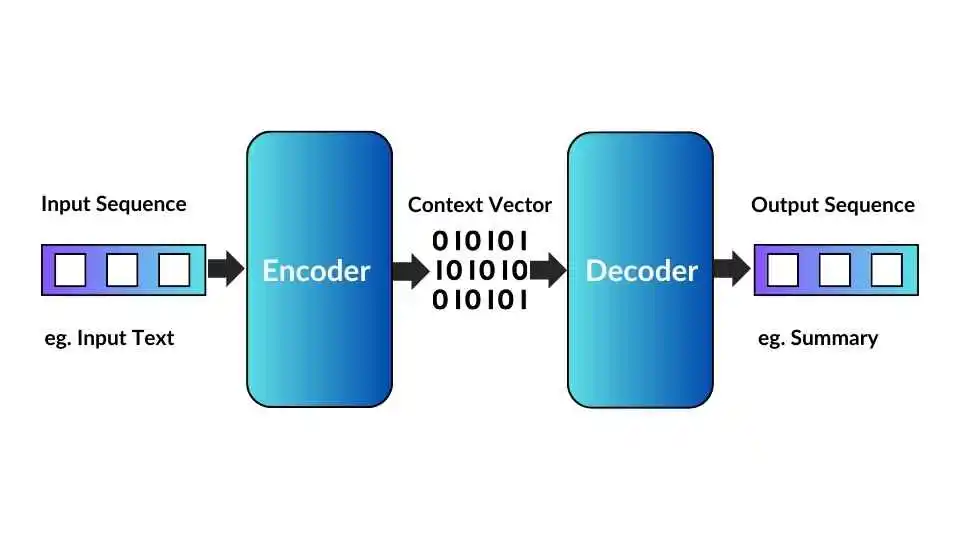
Seq2Seq models are built around two main neural networks — the Encoder and the Decoder.
1. Encoder
The encoder processes the input sequence (e.g., an English sentence) and converts it into a fixed-size vector representation called a context vector. This vector captures the meaning and features of the entire input sentence.
Think of it as compressing the sentence “I love learning AI” into a meaningful digital summary the machine can understand.
2. Decoder
The decoder takes this context vector and generates the output sequence word by word (e.g., a French translation).
It predicts the next word based on:
The context from the encoder.
The words it has already generated.
This step-by-step generation continues until the model produces the entire translated sentence.
How Does a Seq2Seq Model Work?
Here’s a simplified explanation of the process:
1. Input Encoding: Each word in the input sentence is converted into an embedding (a numeric vector).
2. Context Generation: The encoder processes these embeddings and produces a context vector summarizing the input.
3. Decoding and Output Generation: The decoder uses this vector to generate the translated sentence, one word at a time.
4. Training with Teacher Forcing: During training, the model compares its generated outputs with the correct ones and adjusts weights to improve future predictions.
This architecture is most often implemented using Recurrent Neural Networks (RNNs) or Long Short-Term Memory (LSTM) units — both designed to handle sequential data.
The Evolution of Seq2Seq Models
When Google introduced the Seq2Seq architecture in 2014, it changed everything for NLP. It made machine translation systems like Google Translate far more accurate and context-aware.
However, early Seq2Seq models had limitations:
They struggled with long sentences, as the context vector couldn’t retain all information.
They sometimes lost meaning when translating complex sentences.
This led to the introduction of the Attention Mechanism, which allows the decoder to “focus” on relevant parts of the input sequence during translation — solving the long-dependency problem.
Key Features of Seq2Seq Models
Contextual Understanding: Can handle varying input and output lengths.
Language Flexibility: Works across multiple languages and domains.
Scalable: Easily adapted for tasks like summarization or dialogue generation.
Foundation for Transformers: Seq2Seq paved the way for advanced models like BERT, GPT, and T5.
Applications of Seq2Seq Models in AI
1. Machine Translation
The most famous use case of Seq2Seq models is in language translation.
Example: Translating English to French, Hindi to English, or Chinese to Spanish.
Companies like Google, DeepL, and Microsoft built large-scale translation systems based on Seq2Seq architectures.
Impact: Global communication became seamless and faster across cultures and industries.
2. Text Summarization
Seq2Seq models can generate short summaries of long documents by understanding and condensing context.
Example: Summarizing research papers or news articles automatically.
Impact: Saves time for researchers, journalists, and analysts.
3. Chatbots and Virtual Assistants
Chatbots use Seq2Seq models to generate human-like responses in real-time.
Example: Customer support bots and virtual assistants like Siri or Alexa.
Impact: Automates conversation, improves response quality, and enhances user engagement.
4. Question Answering
Seq2Seq models are trained to read passages and generate answers in natural language.
Example: Educational AI tools that answer student questions.
Impact: Makes learning interactive and self-paced.
5. Speech Recognition
Seq2Seq models can convert audio sequences to text sequences in speech-to-text systems.
Example: Transcribing meetings or voice notes.
Impact: Boosts accessibility and productivity in workplaces.
6. Code Generation
Advanced Seq2Seq frameworks can now translate natural language to code.
Example: “Write a function to calculate factorial” → Python code output.
Impact: Simplifies programming for non-developers.
Advantages of Seq2Seq Models
Handles variable-length input and output.
Works well with sequential and time-series data.
Provides a foundation for advanced NLP architectures.
Can be fine-tuned for domain-specific applications.
Supports multilingual and multimodal AI systems.
Limitations
Struggles with very long sequences (without attention).
High training cost due to recurrent computations.
May lose contextual nuances in complex paragraphs.
Sensitive to noisy or incomplete data.
The Role of Attention Mechanism in Seq2Seq
The Attention Mechanism was introduced to overcome the limitations of basic Seq2Seq models.
Instead of compressing all information into one vector, attention allows the model to look at different parts of the input sentence while generating each output word.
For example, when translating:
“I love learning Artificial Intelligence.”
The decoder focuses more on “love” when generating “aimer” and on “Artificial Intelligence” when generating “intelligence artificielle”.
This dynamic attention improved both accuracy and fluency in translations.
Seq2Seq vs Transformer Models
Feature
Seq2Seq
Transformer
Architecture
RNN/LSTM-based
Attention-only (no recurrence)
Training Speed
Slower
Much faster (parallelized)
Long Dependencies
Limited
Strong handling
Use Cases
Translation, summarization
All modern NLP and multimodal tasks
While Transformers have largely replaced traditional Seq2Seq models, the Seq2Seq concept remains the foundation of modern AI architectures. Models like BERT, GPT, and T5 are all built upon the sequence-to-sequence learning principle.
Real-World Example: Google Translate
Google Translate is one of the earliest large-scale implementations of the Seq2Seq model.
Before the introduction of Transformers, Google used RNN-based Seq2Seq models for translation. These models analyzed the structure and context of sentences, producing much smoother translations than rule-based systems.
Today, even though Google has shifted to Transformer-based architectures, Seq2Seq models remain an essential part of its evolution story.
Learn Seq2Seq and NLP with Uncodemy
If you’re fascinated by how machines translate, summarize, or converse, then learning Seq2Seq modeling is your first step into NLP and Deep Learning.
At Uncodemy, you can explore advanced AI concepts through:
Each course includes hands-on projects, industry-level mentorship, and certification, making you job-ready for careers in AI, Data Science, or NLP Engineering.
Conclusion
The Seq2Seq model revolutionized how AI understands and generates language. From real-time translation to chatbots and summarization tools, it paved the way for everything that defines modern AI communication.
While newer models like Transformers have taken center stage, Seq2Seq remains the core concept that started it all — proving that sometimes, the simplest ideas can lead to the biggest revolutions.