What is Simple Linear Regression in Machine Learning?
Mr. Irshad Khan / 1 day ago - 0
- 8 min read
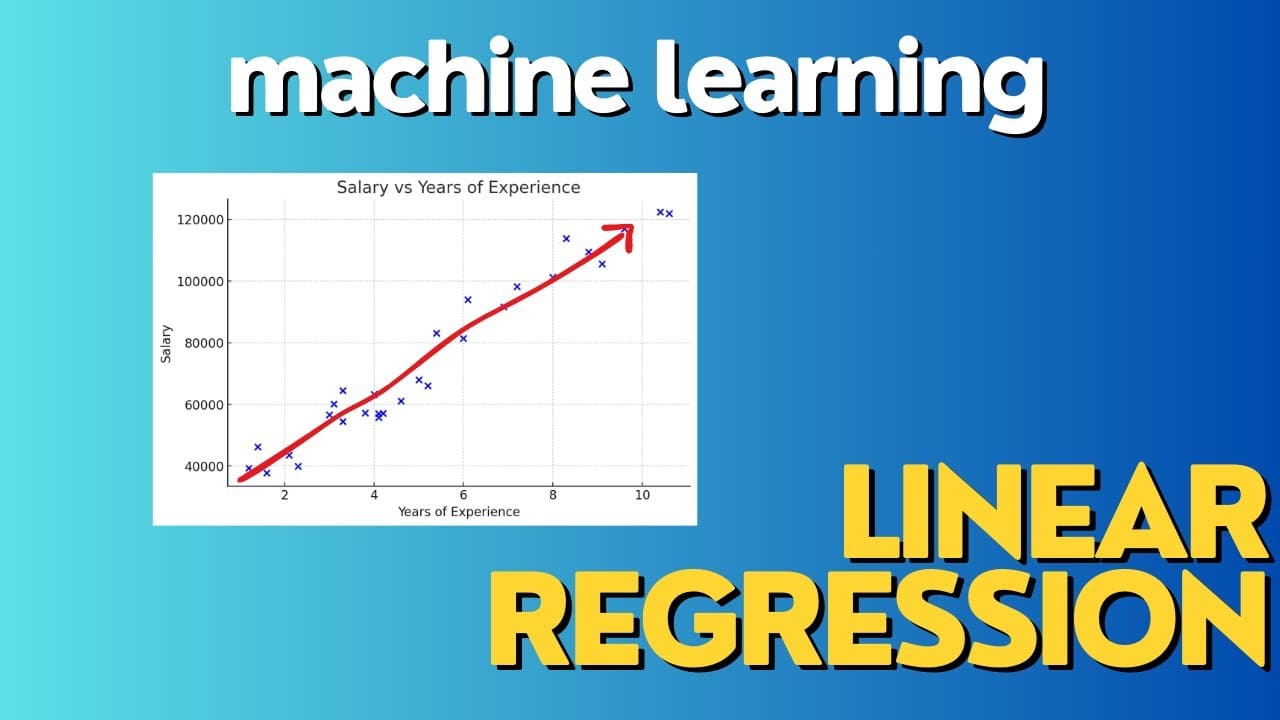
Simple linear regression in machine learning is a technique that is similar to plotting the most suitable straight line through a group of dots on a plot. Let's say you want to predict how much you will spend on groceries, based on how many people are in your family. You gather data from multiple families of different sizes and create a visualization chart. Simple linear regression defines the straight line that best fits the relationship between family size (X-axis) and grocery spending (Y-axis).
In more technical terms, simple linear regression is a statistical technique for understanding and predicting some outcome based on two variables, one of which we want to predict (grocery spending) and one we are predicting from(family size).
Simple relates to the modeling of only two variables, and linear relates to the straight line used to represent the prediction. This is one of the first subjects covered in every comprehensive machine learning course in Noida because it is the foundation for more advanced algorithms.
Why is Simple Linear Regression Important?
To comprehend simple linear regression in machine learning, it's important for three reasons. First, it is simple and intuitive – most people grok the basic idea of drawing a line through points of data. It can be a great place to start for beginners who might be intimidated by more complicated machine learning ideas.
Second, there are a ton of real-world examples that use simple linear regression. Businesses want to predict sales, economists want to forecast trends, and scientists want to understand relationships amongst lots of different factors. When you take a machine learning course in Noida, you'll see how wide-ranging this simple technique really is.
Third, simple linear regression serves as a stepping stone to more complex techniques. Once learners understand simple linear regression, it is a lot easier to learn to understand things like multiple linear regression, polynomial regression, and lots of other machine learning algorithms.
The Mathematical Formula Behind Simple Linear Regression
The beauty of simple linear regression in machine learning lies in its straightforward mathematical formula. Don't worry – you don't need to be a math genius to understand this!
The basic equation is: y = mx + b
This might look familiar from your school math classes! In machine learning terms:
- y is what we want to predict (the dependent variable)
- x is what we use to make predictions (the independent variable)
- m is the slope of the line (how much y changes when x increases by one unit)
- b is the y-intercept (the value of y when x equals zero)
In machine learning courses, you might also see this written as: y = β₀ + β₁x
Here, β₀ represents the intercept and β₁ represents the slope. Both formulas mean exactly the same thing – they're just different ways of writing the relationship.
How Does Simple Linear Regression Work?
When a simple linear regression is taught in machine learning, students learn that the algorithm determines the best possible straight line through the data points. So, how does the algorithm determine "best?"
The algorithm uses a method called "least squares." Take an example of drawing different lines through a sample of data points. Some lines may be far away from the points, and some lines may be closer. The least squares method provides a straight line, which minimizes the distance from the line to all of the data points collectively.
Another way to consider this is if you had an arbitrary group of friends all standing together in a field, and you wanted to draw a straight path as close as possible to all of your friends. Your best option would probably involve selecting the path that has the least amount of total distance you would have to walk in order to reach everyone. A simple linear regression does this to the data points.
Step-by-Step Process of Simple Linear Regression
Knowing the process can help you learn this topic in a machine learning course in Noida. The steps are laid out like this:
Step 1: Collect Data
In the beginning, you want to collect data for both variables that you're interested in studying. For example, you want to collect data for both the houses' sizes and the price of the houses.
Step 2: Graph the Data
In the second step, you will put together a scatterplot, with one variable being plotted on the x-axis and the other variable being plotted on the y-axis. This will give you a visual feel as to whether or not there appears to be some sort of relationship between the variables.
Step 3: Figure Out the Best Line
In order for the algorithm to figure out the best line, it will calculate the slope and intercept that results in the line with the least total error. Each software will do this in its own way, so you don't need to worry about any mathematical work yourself right now.
Step 4: Model Evaluation
Once you have the line, you must see how well your line fits your data. This, in itself, means looking at a number of different metrics that will tell you how good your predicted values can be trusted.
Step 5: Predictions
Finally, you will predict new values using the line. If someone provided you with the area of a house, you could use your model to predict the price of the house.
Advantages of Simple Linear Regression
As you learn about simple linear regression in a machine learning course in Noida, you will notice there are several benefits to this method:
Simplicity: You do not need advanced mathematical training to grasp simple linear regression concepts. For example, a straight line fit to data is not an overly complex idea.
Speed: Our favorite recommendation is that simple linear regression models can train rapidly, whether your data is large or otherwise. If you need quick results or computational limitations, this will be your best option.
Good Introduction: If you are brand new to machine learning (or not), simple linear regression provides a good launching point for new ideas. You will be introduced to training models, making predictions, and assessing accuracy.
Interpretability: There is not too much to explain about a simple linear regression model. The relationship between variables is easy to express and explain. You can convey your results to non-technical individuals quite easily.
No Over-Fitting With Small Datasets: More complex models have the potential to "memorize" patterns (and not really learn) from small datasets. Since the simple linear regression method is less complex, this phenomenon is not likely to occur.
Limitations and Challenges
While simple linear regression in machine learning is powerful, it has some limitations that any good machine learning course in Noida will cover:
Linear Relationship Assumption: Simple linear regression assumes that the relationship between variables is linear. If the real relationship is curved or more complex, this method won't capture it accurately.
Sensitive to Outliers: Extreme values in your data can significantly affect the line's position, potentially leading to poor predictions for normal cases.
Limited to Two Variables: By definition, simple linear regression only works with one input variable. Real-world problems often involve multiple factors.
Assumes Normal Distribution: The method works best when your data follows certain statistical assumptions, which might not always be true in practice.
Unlock Your Data Science Potential Today
Although simple linear regression may seem trivial in machine learning, it represents the basis for more complicated analysis. Should you choose to take a course in machine learning in Noida or learn by yourself, fundamental concepts, such as simple linear regression, will secure your future in data science and machine learning. Progression from simple linear relationships to complex predictive models starts here - and it is simpler than you think.
Frequently Asked Questions (FAQs)
Q: Do I need advanced math skills to understand simple linear regression?
A: No, basic algebra is sufficient. The concept is intuitive, and most software handles the complex calculations automatically.
Q: How accurate is simple linear regression for predictions?
A: Accuracy depends on how well your data fits a linear relationship. For truly linear relationships, it can be very accurate.
Q: Can I use simple linear regression for categorical data?
A: Simple linear regression works best with numerical data. For categorical data, you'd need different techniques or data preprocessing.
Q: What's the difference between correlation and simple linear regression?
A: Correlation measures the strength of the relationship between variables, while regression creates a model to make predictions.
Q: How do I know if simple linear regression is the right choice for my problem?
A: Start by plotting your data. If the relationship appears roughly linear, simple linear regression is a good starting point.