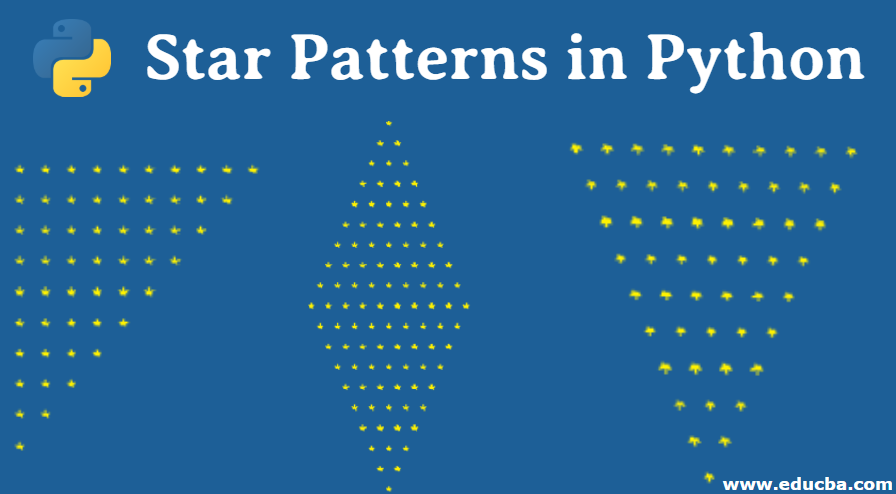
What Are Star Patterns in Python?
Mr. Rajesh Kumar Mandal / 15 day ago - 11
- 10 min read
Simply put, a star pattern in Python is a visual representation made up of asterisks (*) in certain shapes or forms. You can think of it as if you are drawing using text. Using stars, you can make triangles, diamonds, pyramids, or other shapes in the computer terminal. Star pattern designs are done using loops, which are one of the fundamental building blocks of programming.
You may wonder why star pattern programs are popular in computer programming courses when you first see them. The answer is simple: star patterns present an opportunity for you to mix creativity and logical thinking. You are not producing boring code that no one sees, but rather developing some visual and pleasing result that appears on your screen.
Why Star Patterns Matter for Beginners?
If you've signed up for a Python programming course in Noida or are going to be learning online, there's a high chance you'll be coming across star patterns in the beginning stages of your learning. And there is a good reason for that. The star patterns give you a chance to learn a number of important concepts without the complexities of syntax and terminology.
First, you will be able to understand loops, which are instructions that repeat a certain number of times. In general, loops are used in almost every program you will ever write. A star pattern, in Python, is requesting the computer to print stars in a specific pattern by repeating the instructions.
Second, you will be introduced to nested loops — a loop within other loops. Once again, this sounds very complicated, but it isn't very hard to understand when you can see how it works. When you paint a wall, you tend to paint it in rows (top to bottom). Now for each row, you would paint dot by dot to fill in the row. In concepts, nested loops work the same way when it comes to star patterns.
The Beauty of Simple Patterns
Let us begin with the most basic star pattern - a simple triangle. Although this appears simple, working with this pattern teaches you the fundamentals of programming logic, primarily how many stars to print on each row and how to enter them properly.
The nice thing about working on the simpler patterns is that you can achieve success quickly. After a few minutes of learning the concept, you can create something on your screen that looks impressive to you. This sense of success and immediate gratification is likely to keep you motivated as an emerging programmer and will lead you into the next step of the journey.
Many students who take Python programming courses become disheartened when they do not understand and struggle with abstract concepts taught in the class. With star patterns, you have a concrete way to see your code in action - the perfect way to visualize your learning process and process and helps make what you're doing more real and not as intimidating.
Building Complexity Step by Step
Once you have a handle on elementary triangles, the world of star patterns opens up immensely. You can create inverted triangles, where the stars are decreasing from top to bottom instead of increasing. You can begin thinking about diamonds by combining upward and downward triangles. You can even start making more complex shapes, such as hearts, Christmas trees, and geometric shapes.
Once you start making new shapes, they build on the simplified shapes that you have typically come from. Building on what you have done previously is Star Patterns is such a great program for beginners. You are not going from simple addition to calculus. You are simply making small, manageable shifts in logic while building confidence.
The development from simple to fabricating star patterns should seem similar to the overall progress of learning a language such as Python. The overall journey of learning coding starts small and grows as you begin to piece together both simple coding modules to create distinct programs. The natural progression that happens to make the star pattern a very natural entry-level programming logic learning tool.
Real-World Applications
You may ask: unless you plan to be learning all your life, what value do star patterns have? While star triangles aren't something you're ever going to put into professional software, the skills you develop as you work on star patterns are incredibly valuable.
The logic involved in creating star patterns has a direct correlation to solving actual programming problems. When you start to figure out how to create a diamond pattern, you are building your problem-solving skillset that will support your work on website development, data analysis, or mobile app development.
I know many well-known programmers who have fond memories of their initial star pattern programs. Simple tasks like these can ignite coding passions that remain for a lifetime.
Common Challenges and How to Overcome Them
All beginners are faced with similar hurdles when they begin to learn star patterns in Python. One of the first hurdles will be the spacing. If you want to create patterns that appear symmetrical and neat, you must pay careful attention to the amount of space required for the patterns to align correctly.
A second hurdle will be understanding how the numbers of the row (or levels) relate to the stars. In the case of the triangle pattern, the first row will only have one star, the second will have two stars, and so on. It is important to note, when creating star patterns, the relationship between the number of stars per row and the row number will help you halve the time creating more complex patterns.
Do not be discouraged if your first few attempts do not look good. Believe it or not, experienced programmers debugged their star patterns when they were learning. You just need to keep trying, make mistakes, and develop your understanding of how to create star patterns.
The Role of Practice
Like learning to play a musical instrument, you need to practice to get the shape of a star pattern right. Start with a simple pattern, move on to a more complex one, and you will learn something to improve your understanding of loops, conditions, and program flow with every pattern you construct.
Courses on Python programming in Noida, and in many other cities, aptly dedicate courses on star patterns for the educational value they represent, and the ability to help students to assimilate programming concepts better than just theory.
You should practice different star patterns regularly. You can either try to build new patterns yourself or make variations to existing patterns. This will solidify your understanding of programming features. Active experimentation is where you will learn.
Tips for Success
When creating star patterns, you might want to begin by visually working out the pattern on paper beforehand. This allows you to see the "logic" before you code! Count the number of stars in each row, and notice any patterns or relationships occurring.
You may want to also break down big patterns into manageable parts. For example, if you wanted to create a diamond, you would first create the top half (a triangle) and the bottom half (an inverted triangle)!
Don't get too impatient or excited with the learning process! Take the time to understand why everything in your code is the way it is. The deeper you understand this, the better off you will be in the future, especially as you dive into more complicated programming tasks.
Moving Beyond Basic Patterns
When you feel confident with basic star patterns, you can always try and make some more advanced variations. You might even want to try and generate patterns with symbols other than "*", add color to your output, or create animated patterns that change over time.
Advanced star patterns can start to involve more mathematical concepts such as Fibonacci sequences, prime numbers, or geometric progressions. It is enjoyable to create these challenges as they push your programming skills while maintaining the fun and visual satisfaction of the pattern creation itself.
Conclusion: Your Gateway to Programming Mastery
Star patterns in Python are much more than simple exercises - they're your gateway to understanding the beautiful logic of programming. These visual, satisfying programs make learning enjoyable while building the foundation skills you need for advanced programming concepts.
Whether you're just starting your coding journey or looking to strengthen your fundamentals, star patterns offer the perfect blend of creativity and logic. They prove that programming isn't just about writing complex code - it's about thinking systematically, solving problems step by step, and creating something meaningful.
So grab your computer, open Python, and start creating your first star pattern. You'll be amazed at how quickly these simple exercises transform your understanding of programming and set you on the path to becoming a confident coder.
Frequently Asked Questions (FAQs)
Q: How long does it take to learn basic star patterns in Python?
A: Most beginners can create simple star patterns within a few hours of learning basic Python syntax. With regular practice, you can master various patterns in a week or two.
Q: Do I need to memorize star pattern codes?
A: No, memorizing isn't necessary. Focus on understanding the logic behind each pattern. Once you grasp the concept, you can recreate any pattern by thinking through the steps.
Q: Are star patterns used in real programming jobs?
A: While you won't print star patterns in professional software, the problem-solving skills and loop logic you learn are essential for real-world programming tasks.
Q: What should I do if my star pattern doesn't look right?
A: Check your spacing and counting carefully. Draw the pattern on paper first to visualize the logic, then trace through your code step by step to find the issue.
Q: Can star patterns help me learn other programming languages?
A: Absolutely! The logical thinking and loop concepts you learn with star patterns in Python apply to most other programming languages as well.