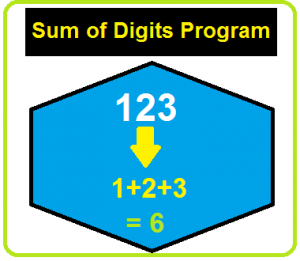
In this article, we will walk through the sum of digits program, its algorithm, and actual code in different programming languages. Whether you are just starting your coding journey or brushing up on logic building, this topic offers a great way to sharpen your skills.
Also, if you are a beginner looking to master Python, Java, or C, we highly recommend checking out Uncodemy’s Programming Courses. Their beginner friendly approach makes programming easy to understand and apply.
Let us dive into the concept first.
What is the Sum of Digits?
The sum of digits refers to the addition of individual digits of a number. For example:
- For the number 987, the sum would be 9 plus 8 plus 7 which equals 24.
- For the number 1001, the result is 1 plus 0 plus 0 plus 1 which equals 2.
This problem can be approached using loops, recursion, and even inbuilt functions depending on the language.
This concept is often used in:
- Digital root problems
- Number validation systems
- Puzzles and games
- Data compression logic
Understanding the Algorithm
To calculate the sum of digits of a number, follow these steps:
- Take an integer input from the user
- Extract each digit from the number
- Add the digit to a running sum
- Repeat the process until the number becomes zero
- Print the result
Let us understand this through a simple breakdown of logic.
Suppose the number is 563:
- Start with sum as 0
- Extract 3 using number modulo 10 → 563 modulo 10 equals 3
- Add 3 to sum → sum becomes 3
- Divide number by 10 to remove the last digit → 563 divided by 10 becomes 56
- Extract 6 using 56 modulo 10
- Add 6 to sum → sum becomes 9
- Continue until the number becomes zero
This logic can be implemented using a while loop or recursion.
Pseudocode for Sum of Digits
Let us look at a pseudocode version of this program:
Copy Code
bash

CopyEdit

function sumOfDigits(number):

    sum = 0

    while number is not equal to 0:

        digit = number modulo 10

        sum = sum plus digit

        number = number divided by 10 (integer division)

    return sum
This logic remains the same across most programming languages. You just need to adjust the syntax accordingly.
Sum of Digits in Python
Python is one of the most beginner friendly languages and perfect for implementing such logical programs.
Code Example:
Copy Code
python

CopyEdit

def sum_of_digits(number):

    total = 0

    while number != 0:

        digit = number % 10

        total += digit

        number //= 10

    return total

num = int(input("Enter a number: "))

result = sum_of_digits(num)

print("Sum of digits is:", result)

Output:

yaml

CopyEdit

Enter a number: 458

Sum of digits is: 17
Explanation:
We use the modulo operator to extract each digit and add it to a running total. Then we reduce the number using integer division.
Sum of Digits Using Recursion in Python
Recursion is a technique where a function calls itself. Here’s how you can solve this problem recursively.
Copy Code
python

CopyEdit

def sum_of_digits_recursive(number):

    if number == 0:

        return 0

    return number % 10 + sum_of_digits_recursive(number // 10)

num = int(input("Enter a number: "))

result = sum_of_digits_recursive(num)

print("Sum of digits is:", result)
This method is clean and elegant but might not be efficient for very large numbers due to recursion depth limits.
Sum of Digits in C
If you are working with C, here’s how you can write the program:
Copy Code
c

CopyEdit

#include <stdio.h>

int main() {

    int number, digit, sum = 0;

    printf("Enter a number: ");

    scanf("%d", &number);

    while (number != 0) {

        digit = number % 10;

        sum += digit;

        number = number / 10;

    }

    printf("Sum of digits is: %d", sum);

    return 0;

}
C uses basic arithmetic and loops to accomplish the same task. Notice how the approach remains the same.
Sum of Digits in Java
For Java learners, here’s a version using standard input and a loop.
Copy Code
java

CopyEdit

import java.util.Scanner;

public class SumOfDigits {

    public static void main(String[] args) {

        Scanner sc = new Scanner(System.in);

        int number, sum = 0;

        System.out.print("Enter a number: ");

        number = sc.nextInt();

        while (number != 0) {

            sum += number % 10;

            number = number / 10;

        }

        System.out.println("Sum of digits is: " + sum);

    }

}
This program works well for both beginners and intermediate learners trying to understand number manipulation in Java.
Applications of Sum of Digits
The concept of summing digits is not just academic. It is used in:
- Checksum algorithms like the Luhn algorithm used in credit card validation
- Digital root calculations for numerology and computer algorithms
- Barcode validations and ISBN verifications
- Cryptography for basic encryption logic
- Game development where logic is based on numerical inputs
Common Variations and Challenges
Once you understand the basic idea, try experimenting with variations:
- Sum of digits for negative numbers (handle the sign)
- Sum of digits of a floating point number (ignore the decimal)
- Sum of digits of a number represented as a string
- Sum of digits without using a loop (only recursion)
- Find sum of digits until a single digit remains (digital root)
Here’s how to compute the digital root using recursion:
Copy Code
python

CopyEdit

def digital_root(number):

    if number < 10:

        return number

    return digital_root(sum_of_digits(number))

def sum_of_digits(number):

    total = 0

    while number != 0:

        total += number % 10

        number //= 10

    return total

num = int(input("Enter a number: "))

print("Digital root is:", digital_root(num))
Optimizing the Code
If performance is a concern and you are dealing with very large numbers, it is often a good idea to:
- Convert the number to a string and iterate over characters
- Use list comprehensions for compact code in Python
- Avoid recursion in languages that have a recursion depth limit
Here’s a Python one-liner using list comprehension:
Copy Code
python

CopyEdit

num = input("Enter a number: ")

print("Sum of digits is:", sum([int(d) for d in num if d.isdigit()]))
This is a concise method and particularly useful when working with input that might contain non numeric characters.
Learning Recommendation
If you are enjoying solving problems like the sum of digits, you are already on the right track to becoming a strong programmer. Understanding such logic strengthens your grasp on number theory, control flow, and algorithmic thinking.
To take your programming skills to the next level, consider joining the Programming with Python and Java Course by Uncodemy. Their hands on approach and real world projects make learning engaging and effective. Whether you are preparing for interviews or academic assessments, this course can be your stepping stone.
Final Thoughts
The sum of digits problem is simple yet powerful. It introduces you to core programming concepts like loops, recursion, arithmetic operations, and logic building. Once you are confident with this, you can challenge yourself with more complex problems involving strings, arrays, or even algorithms like sorting and searching.
Here is a quick checklist of what you have learned:
- What the sum of digits means
- Algorithms to implement it
- Programs in Python, C, and Java
- Variations and optimizations
- Real world applications
- A learning path forward
Never underestimate the value of practicing small problems. They lay the groundwork for solving complex algorithms in the future.
So go ahead, write your own version of the sum of digits program, tweak it, challenge it, and most importantly, have fun with it.
Happy coding!