This method is not just a futuristic concept. It’s already being applied in robotics, logistics, environmental monitoring, security, and even financial systems. By mimicking the self-organizing behavior found in nature, Swarm AI promises scalability, resilience, and adaptability that centralized systems often struggle to deliver.
Understanding Swarm AI
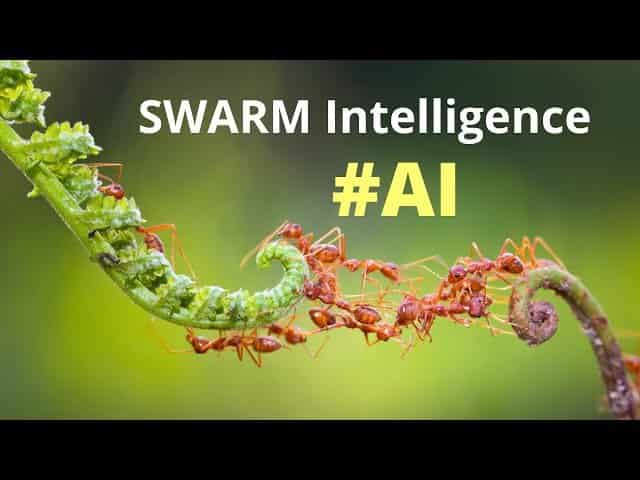
At its core, Swarm AI is inspired by swarm intelligence, a field of study that examines how large groups of simple agents (like ants, bees, or birds) coordinate their actions through simple rules to produce complex, intelligent behavior.
For example, ants leave pheromone trails to communicate with each other, enabling them to find the shortest path to food sources collectively. Similarly, flocks of birds can change direction almost simultaneously without a leader, thanks to local interaction rules.
In Swarm AI, each agent operates independently, but follows a shared set of rules or protocols. These agents interact locally–sharing information, responding to changes, and adjusting their behavior. The collective result is a coordinated, intelligent system that emerges without requiring a central controller.
Why Decentralization Matters
Traditional AI systems often rely on a centralized model, where one large neural network or control unit processes all data and makes decisions for the entire system. While this can work for certain applications, it introduces some major limitations:
Single point of failure: If the central system goes down, the entire operation halts.
Scalability issues: As the system grows, the central model becomes more complex and expensive to maintain.
Slow adaptability: Centralized models may struggle to respond to rapidly changing environments because every update needs to go through the main control.
Swarm AI solves these problems by removing the need for a single control center. Instead, intelligence is distributed across many agents. If one agent fails, others can continue functioning. New agents can be added or removed without disrupting the entire system. This decentralized nature makes Swarm AI highly scalable, fault-tolerant, and dynamic.
Key Components of Swarm AI Systems
To build a functioning Swarm AI system, developers need to consider several core components:
1. Autonomous Agents:
Each agent has basic capabilities–such as sensing its environment, making simple decisions, and communicating with nearby agents. These agents could be physical (like robots) or virtual (software bots).
2. Local Communication:
Instead of broadcasting messages globally, agents share information locally with neighbors. This keeps communication efficient and reduces system complexity.
3. Simple Behavioral Rules:
Swarm behavior doesn’t emerge from complex programming but from a few simple rules. For example, “move toward nearby agents,” “avoid collisions,” or “follow the strongest signal.” These rules, when applied collectively, lead to surprisingly complex results.
4. Emergent Intelligence:
The system doesn’t need a central brain because intelligence emerges from interactions. The more agents cooperate, the more sophisticated the overall behavior becomes.
Popular Swarm AI Algorithms
Several algorithms and models have been developed to simulate and implement swarm behavior. A few widely used ones include:
Particle Swarm Optimization (PSO):
Inspired by the movement of bird flocks, PSO is used in optimization problems where multiple agents (particles) search for the best solution by adjusting their positions based on their own experience and their neighbors’.
Ant Colony Optimization (ACO):
Based on how ants find the shortest paths to food, ACO is particularly effective for problems like route optimization, network design, and logistics.
Boids Algorithm:
This model simulates flocking behavior with three rules: separation, alignment, and cohesion. It’s often used in animations, simulations, and drone swarm control.
Bee Colony Algorithms:
These algorithms mimic how bees explore and exploit food sources, making them useful for tasks that require exploration and decision-making under uncertainty.
These algorithms provide a foundation for building Swarm AI applications, allowing developers to adapt biological principles into practical solutions.
Real-World Applications of Swarm AI
Swarm AI is not just a research topic–it’s already making an impact across industries:
1. Robotics and Drones
Imagine a swarm of drones scanning disaster zones for survivors, delivering medical supplies, or mapping difficult terrain. Swarm algorithms enable drones to coordinate without needing centralized control, making operations more flexible and resilient.
2. Traffic and Logistics
Delivery fleets, autonomous vehicles, and warehouse robots can coordinate using Swarm AI to optimize routes, avoid congestion, and ensure smooth flow without depending on a central server.
3. Environmental Monitoring
Swarms of underwater robots or sensor-equipped drones can track pollution levels, detect forest fires early, or monitor wildlife populations efficiently.
4. Financial Systems
In trading and risk analysis, swarm-based algorithms can analyze data in parallel, make local decisions, and adapt strategies collectively to changing market conditions.
5. Defense and Security
Military and security organizations are exploring Swarm AI for reconnaissance missions, surveillance, and even coordinated defense maneuvers, leveraging its decentralized nature for resilience.
Benefits of Swarm AI
The appeal of Swarm AI lies in its unique set of advantages:
Scalability: Adding more agents doesn’t require reprogramming the entire system.
Fault Tolerance: The system continues to function even if some agents fail.
Adaptability: Agents can respond to local changes in real time.
Efficiency: Communication and computation are distributed, making the system faster in dynamic environments.
Cost-Effectiveness: Swarm systems often use many simple, low-cost agents instead of one expensive super-intelligent system.
Challenges of Implementing Swarm AI
Of course, Swarm AI also comes with its own set of challenges:
Designing Effective Rules: Striking the balance between simplicity and desired behavior can be tricky.
Communication Overhead: Even local communication can become complex in large swarms if not optimized.
Debugging and Monitoring: Since behavior emerges collectively, identifying where things go wrong can be difficult.
Ethical and Security Concerns: Deploying autonomous swarms in real-world environments requires strict safety and privacy considerations.
Developers need to design carefully, simulate extensively, and implement monitoring tools to ensure swarms behave as intended.
Tools and Frameworks for Swarm AI Development
For developers looking to experiment with Swarm AI, several tools and frameworks are available:
Python Libraries: Frameworks like PySwarm and DEAP offer easy ways to experiment with swarm optimization algorithms.
ROS (Robot Operating System): Widely used in robotics, ROS supports building decentralized multi-robot systems.
Simulation Platforms: Tools like NetLogo, MATLAB, and Unity can be used to prototype and visualize swarm behavior before deploying it in the real world.
Custom Agent Frameworks: Developers can use general multi-agent platforms like LangGraph, CrewAI, or custom SDKs to build agent-based swarm architectures.
These tools lower the barrier to entry, allowing both beginners and advanced developers to bring Swarm AI concepts to life.
The Future of Swarm AI
The future of Swarm AI looks incredibly promising. As hardware becomes cheaper and more powerful, deploying large numbers of autonomous agents will become more practical. Advances in AI communication protocols, reinforcement learning, and edge computing will make swarm systems even more intelligent and autonomous.
We can expect Swarm AI to play a major role in smart cities, space exploration, medical applications, and decentralized autonomous organizations (DAOs) where swarms of agents handle complex decision-making without centralized oversight.
Final Thoughts
Swarm AI represents a major shift in how we approach artificial intelligence. Instead of relying on a single, centralized model to solve every problem, Swarm AI distributes intelligence across many smaller agents that work together. This mirrors the way complex systems function in nature–like how ants build colonies or bees coordinate in hives. Each agent has a specific role, but collectively, they achieve far more than any individual unit could manage alone.
For developers and businesses, this decentralized approach is exciting because it breaks away from the limitations of traditional AI frameworks—topics that are increasingly covered in an Artificial Intelligence course. Organizations no longer have to depend on one massive model that’s expensive to train, maintain, and scale. Instead, they can deploy a network of lightweight, specialized agents that can adapt, communicate, and solve problems collaboratively. This kind of flexibility opens the door to a wide range of use cases–from dynamic supply chain optimization and financial modeling to real-time cybersecurity defense systems.
Another big advantage is resilience. In centralized systems, if the main model goes down, everything stops. In Swarm AI, if one agent fails, others can continue working, ensuring the system remains stable. This makes it ideal for high-stakes environments where uptime and reliability are critical. At the same time, it allows companies to scale their AI infrastructure more naturally–adding or removing agents as needed without overhauling the entire system.
For learners and professionals, Swarm AI is worth exploring because it brings together several essential skills: agent design, communication protocols, distributed problem-solving, and system orchestration. As more industries adopt multi-agent systems, those who understand how to design and manage swarms will be in high demand.
Ultimately, Swarm AI isn’t just a futuristic concept–it’s a practical and powerful way to build intelligent systems that are flexible, collaborative, and robust. As tools and frameworks continue to mature, this decentralized approach could redefine how AI solutions are built and deployed across industries. Whether you’re a developer, researcher, or enterprise leader, keeping an eye on Swarm AI now could give you a strong advantage in the evolving AI landscape.