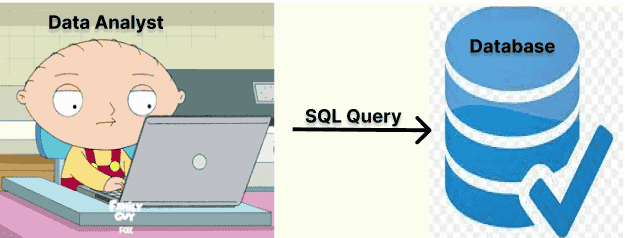
Basic SQL Statements to use by data analysts.
SELECT
SELECT is a basic SQL query that data analysts will use to retrieve information on a database. It is a widely used SQL query used in interview questions to test the data professionals.
WHERE
The WHERE clause plays a very significant role in the narrowing down of records according to the given conditions. It enables analysts to access data that fits certain specifications only which makes it invaluable where specific data retrieval is required.
GROUP BY
GROUP BY is called together with aggregate functions to bring together rows, which share identical values in given columns, into a summary row. This command can be used in doing aggregations such as counting, summing or averaging the data within each group.
ORDER BY
To arrange the result set of a query in either ascending or descending order, the ORDER BY clause is typed, and this term takes as its parameters one or more columns. It is critical to the presentation of data in an organized and clear form that brings trends and patterns into the fore.
INSERT INTO
A new row of data is inserted into a table using INSERT INTO command. Although this is mostly related to the modification of data, analysts can use it to insert small groups of new data to test or to do a targeted analysis.
UPDATE
The update command is the command to make changes in the existing data in a table. This helps data analysts to fix errors, or update records during data cleaning and preparation.
DELETE
The DELETE command is applied to delete the records present in a table. Just as in the case of UPDATE, analysts can use DELETE to clean data but with caution as it is a permanent command.
Complex SQL Data Analysis.
Joins
Joins are important in the integration of rows in two or more tables depending on a corresponding column between the two tables. It is important to know the various joins: INNER JOIN, LEFT JOIN, RIGHT JOIN and FULL OUTER JOIN to join two or more different datasets and do an exhaustive analysis.
INNER JOIN: Displays rows where there is a match of both tables.
LEFT JOIN (or LEFT Outer Join): Displays all the rows of the left table, and matching rows on the right table also. When there is no match, the right side will be having NULLs.
RIGHT JOIN (or RIGHT OUTER JOIN): Selects all the rows in the right table, and the corresponding rows in the left table. In case of no match, the left side will be having NULLs.
FULL OUTER JOIN: Provides all of the rows in case one of the tables matches.
Subqueries
Subqueries or inner query or nested query is a query that is contained in another SQL query. They are strong in their ability to execute complicated tasks like filtering data according to the results of another query, or to retrieve the data, on which the outer query will utilize. As an example, a subquery may be placed in a WHERE clause to narrow the results according to a condition based on a value of an aggregate in another table.
Window Functions
The computation carried out by window functions is done on a grouping of table rows that are somehow related to the current row. Whereas a given aggregation function summarizes the rows in an input table into one output row, window functions do not do the same but provide a value per row in a given window of rows. These operations come in handy especially when counting moving averages, ranking, or cumulative sums to give more insight on the trend of data without taking away the number of rows in the result set.
Common Table Expressions (CTE)
Common Table Expressions (CTEs) help to create a temporary named result set that you can then refer to in a SELECT, INSERT, UPDATE or a DELETE statement. CTEs make complex queries easier to read and understand by dividing them into reasonable steps. They are particularly useful in recursive queries or where you have to repeat the same sub query in a larger query.
Temporary Tables
Temporary storage structures are temporary tables which store part of the data temporarily. They can be used to decompose complex queries, store intermediate results and enhance query performance by minimizing the data processed at each successive step. Such tables are present only during the present session or transaction and are dropped automatically later.
UNION and UNION ALL
UNION and UNION ALL are to combine the result sets of two or more statements of the SELECT. UNION eliminates rows that are duplicated across the SELECT statements whereas UNION All includes all rows including duplicates. These operators are also needed when an analyst requires combining data of a few similar tables or combining various query results into one output.
Data Manipulation SQL Functions.
SQL has a range of functions to operate on data which are essential in preparing data to be analyzed.
String Functions: String functions like SUBSTRING, LENGTH, TRIM, UPPER and LOWER are distinguished to manipulate text information. As an example, leading or trailing spaces can be abolished in text with the help of TRIM which guarantees the integrity of data.
Numeric Functions: Functions such as ROUND, CEILING, FLOOR and ABS are applied in numerical operations, which are useful in data cleansing and transformation.
Date Functions: Date functions like DATE_PART, DATEDIFF, NOW, and EXTRACT are essential when dealing with date and time data and provide an opportunity to perform time-series analysis and compute time at a time period.
Aggregate Functions: Aggregate functions such as COUNT, SUM, AVG, MIN, and MAX are functions that perform some calculations on the group of rows and give a single value in aggregate. They are often combined with GROUP BY clauses so as to summarize the data.
SQL Skills Improvement with Uncodemy (Online Courses).
Although the given documents do not directly refer to Uncodemy, there are various online sources that provide extensive SQL training to data analysts course , which are similar to the ones that Uncodemy may be providing. The courses will assist those who want to become data analysts to acquire skills in SQL.
Udacity SQL for Data Analysis: Udacity provides a free course SQL for Data Analysis, which instructs its students to extract and analyze data in databases using SQL. The course is very good in developing the basic knowledge.
DataCamp Data analyst in SQL: DataCamp offers a course known as the Associate Data Analyst in SQL, which is designed to help one master the essential skills to query databases, work with the results, and become a good SQL data analyst; the course does not require one to have any prior experience in programming.
Data Analysis Uncodemy Courses: Udemy has a number of courses suitable for data analysis. The course named Zero to Hero SQL is pointed out as a comprehensive one since it addresses both fundamental and advanced SQL skills required to analyze data in business. A second course offered by Udemy on free learning of SQL to analyze data is also available, which is hands-on SQL to data analysts.
The courses are essential in case any person wants to know how to use SQL to analyze the data (starting with simple commands and ending with more complicated ways that may be used in real life).