Transpose of a Matrix in C with Code and Explanation
Whether you’re starting your programming journey or brushing up on essential skills, understanding how to work with matrices in C is crucial. One fundamental matrix operation is the transpose, which flips the matrix rows and columns. This operation is widely used in computer science, engineering, data science, and many other fields.
If you want to learn C programming comprehensively and with real-world applications, joining a C Programming Course in Noida is an excellent choice. These courses offer hands-on practice, help you master concepts like matrix transpose, and build your confidence.
Transpose of a Matrix in C with Code and Explanation
Mr. Bambam Yadav / 1 days
0
4 min read
In this article, we’ll cover everything about the transpose of a matrix in C — from the basics to coding examples, optimizations, and practical tips.
What is a Matrix Transpose?
Let’s start with the fundamentals.
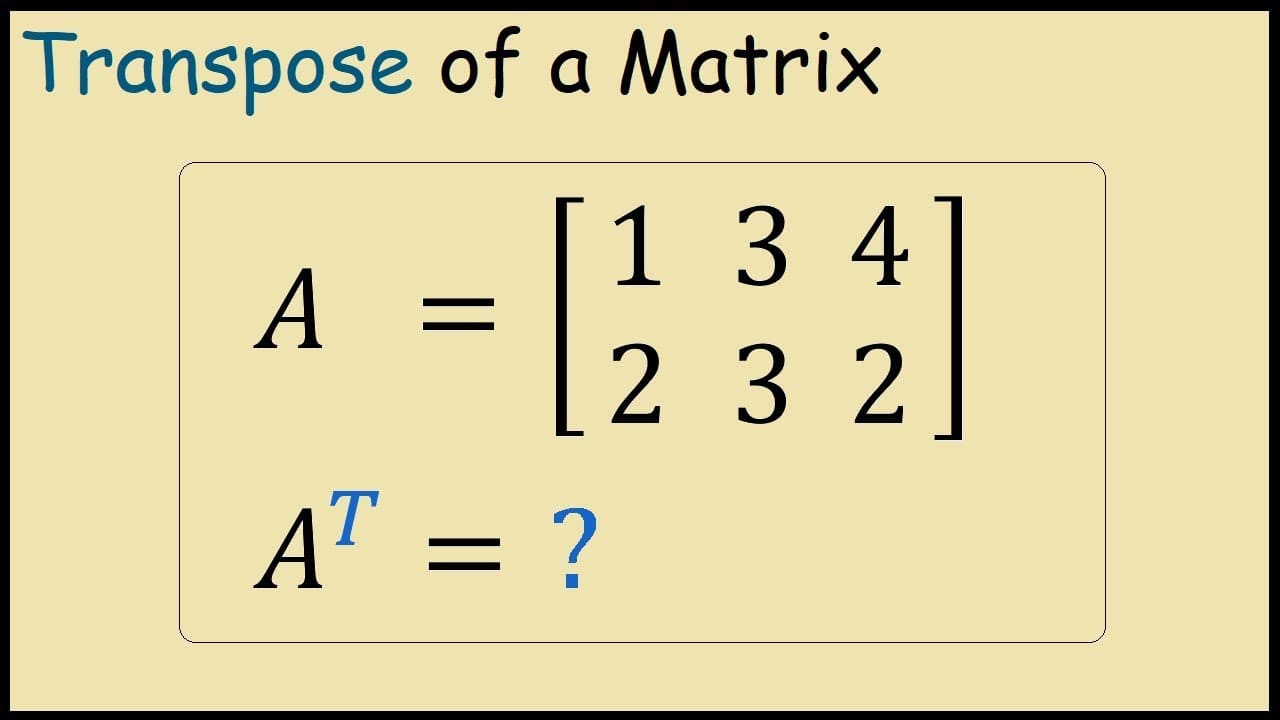
A matrix is essentially a two-dimensional array of numbers arranged in rows and columns. For example, consider a matrix A of size 3×2 (3 rows and 2 columns):
                            A = | 1  2 |
                                | 3  4 |
                                | 5  6 |
The transpose of matrix A, denoted by Aᵀ, is formed by swapping rows with columns:
                            Aᵀ = | 1  3  5 |
                              	 | 2  4  6 |
The dimensions of Aᵀbecome 2×3 instead of 3×2.
Why Does Transpose Matter?
Matrix transpose is not just a theoretical concept; it’s a critical operation in multiple domains:
Mathematics and Linear Algebra: Used in matrix multiplication, eigenvalue calculations, and solving systems of linear equations.
Computer Graphics: For changing coordinate spaces and transformations.
Data Science: Rearranging datasets for better analysis or visualization.
Algorithms: Many problems on platforms like LeetCode or HackerRank require matrix transposition logic.
Transpose in Programming: How Does It Work?
To transpose a matrix in programming, you essentially swap the element at position (i, j) with the element at (j, i).
Let’s say you have a matrix matrix[M][N]. Its transpose will be stored in transpose[N][M] such that:
transpose[j][i] = matrix[i][j];
The challenge lies in correctly indexing and managing memory, especially in C, where arrays have fixed sizes and no built-in matrix types.
Writing a Simple Transpose Program in C
Let’s walk through a straightforward C program that transposes a matrix of any dimension.
Step 1: Declare the Matrix and Read Input
The program should ask for the number of rows and columns, then accept matrix elements from the user.
Step 2: Create a Transpose Matrix
Declare another matrix with switched dimensions, i.e., transpose[N][M].
Step 3: Fill the Transpose Matrix
Using nested loops, assign transpose[j][i] = matrix[i][j].
Step 4: Print the Transposed Matrix
Output the transposed matrix row by row.
Complete C Code Example
                            #include

                            int main() {
                                int M, N;

                                // Input matrix dimensions
                                printf("Enter number of rows (M): ");
                                scanf("%d", &M);
                                printf("Enter number of columns (N): ");
                                scanf("%d", &N);

                                int matrix[M][N];
                                int transpose[N][M];

                                // Input matrix elements
                                printf("Enter elements of the %dx%d matrix:\n", M, N);
                                for (int i = 0; i < M; i++) {
                                    for (int j = 0; j < N; j++) {
                                        scanf("%d", &matrix[i][j]);
                                    }
                                }

                                // Compute transpose
                                for (int i = 0; i < M; i++) {
                                    for (int j = 0; j < N; j++) {
                                        transpose[j][i] = matrix[i][j];
                                    }
                                }

                                // Display the transpose
                                printf("Transpose of the matrix:\n");
                                for (int i = 0; i < N; i++) {
                                    for (int j = 0; j < M; j++) {
                                        printf("%d ", transpose[i][j]);
                                    }
                                    printf("\n");
                                }

                                return 0;
                            }
Explanation of the Code
We first take matrix dimensions from the user.
Declare two 2D arrays: one for the original matrix and one for the transpose.
Read values into the original matrix.
The nested loops iterate through every element, assigning the transposed value.
Finally, the transpose is printed.
This simple program is a classic exercise in any C Programming Course in Noida, teaching students about arrays, loops, and data manipulation.
Handling Square Matrices with In-Place Transpose
If the matrix is square (i.e., M == N), we can optimize memory use by performing the transpose in-place. Instead of creating another array, we swap elements across the diagonal.
Here’s how:
                            for (int i = 0; i < N; i++) {
                            for (int j = i + 1; j < N; j++) {
                                int temp = matrix[i][j];
                                matrix[i][j] = matrix[j][i];
                                matrix[j][i] = temp;
                            }
                        }
Dynamic Memory Allocation for Larger Matrices
When matrix sizes are unknown or too large for static arrays, dynamic memory allocation is recommended.
Using pointers and malloc, we can create 2D arrays dynamically:
                            int **matrix = malloc(M * sizeof(int *));
                            for (int i = 0; i < M; i++) {
                                matrix[i] = malloc(N * sizeof(int));
                            }
This technique is valuable for real-world programs and is covered in depth in advanced C Programming Courses in Noida.
Real-World Use Cases of Matrix Transpose
Understanding matrix transpose is essential beyond academic exercises:
Image Processing: Transpose operations help rotate or flip images.
Signal Processing: Matrices represent signals, and transpose affects data alignment.
Scientific Computation: Linear algebra libraries use transpose operations heavily.
Data Analysis: Transpose helps reshape datasets for visualization or machine learning.
Optimizing Matrix Transpose Operations
For very large matrices, naive transposition can be inefficient due to poor cache locality.
Blocked Transpose
This technique breaks the matrix into smaller sub-blocks that fit into the cache, reducing cache misses.
Tips to Remember for Beginners
Always validate matrix sizes before accessing elements.
Test your program with small and edge case matrices.
Understand the difference between row-major and column-major storage.
Use debugging prints to verify intermediate results.
Frequently Asked Questions (FAQs)
Q1: Can transpose be done in-place for non-square matrices?
A: No, in-place transpose requires a square matrix because only then rows and columns are equal. For non-square matrices, you need a separate matrix.
Q2: How to handle very large matrices?
A: Use dynamic memory and optimized algorithms like blocked transpose or external libraries.
Q3: Is transpose operation reversible?
A: Yes, transposing twice returns the original matrix.
Q4: Can transpose be used with matrices of types other than int?
A: Absolutely! The logic applies to float, double, or any data type.
Why Join a C Programming Course in Noida?
If you want to master concepts like matrix transpose and other foundational C programming topics, enrolling in a C Programming Course in Noida will help you:
Learn from experienced instructors
Get hands-on practice and assignments
Understand practical applications beyond theory
Prepare for interviews or projects confidently
Conclusion
The transpose of a matrix in Cis a fundamental operation that opens doors to understanding multidimensional arrays, pointers, memory management, and algorithm optimization.
Whether you’re a student, job seeker, or hobbyist programmer, mastering matrix transpose gives you a solid foundation. Don’t hesitate to take a C Programming Course in Noidato deepen your knowledge with professional guidance and real-world projects.
Mastering this will not only help you in academics but also in diverse fields like graphics, data science, and system programming.