If you’ve ever wondered how delivery apps plan the shortest route to drop off your order or how navigation systems calculate the best travel itinerary with multiple stops, you’re already thinking in the realm of algorithms. More specifically, you're engaging with a classic problem in computer science called the Travelling Salesman Problem (TSP). This problem has fascinated computer scientists, mathematicians, and engineers for decades because it captures a very real challenge: how to find the most efficient path that visits each destination exactly once and returns to the starting point.
For learners pursuing a Python Programming Course in Noida, understanding the travelling salesman algorithmis more than just a curriculum requirement. It’s a gateway to understanding optimization problems, algorithms used in artificial intelligence, and the foundational logic behind route planning applications. In this article, we’ll walk through the concept of the travelling salesman algorithm, explore its real-world applications, and see how it’s implemented in Python using simple code.
What is the Travelling Salesman Problem (TSP)?
At its heart, the Travelling Salesman Problem asks a seemingly simple question: given a list of cities and the distances between them, what is the shortest possible route that visits each city once and returns to the starting city?
Here’s a real-world analogy: Imagine a delivery person who needs to drop packages in five different cities. They must figure out the most time- and cost-efficient route to visit all five cities once and come back to the starting point. Sounds easy when it's just a few cities—but as the number of cities increases, the complexity grows exponentially.
Why Is It Important?
Despite sounding like a riddle, TSP is a critical problem in logistics, transportation, manufacturing, and computer networking. Optimizing routes saves time, reduces fuel consumption, and improves efficiency. Airlines, ride-sharing companies, and courier services use similar logic to determine routes.
For students taking a Python Programming Course in Noida, the travelling salesman algorithm provides a perfect context to apply Python skills in data structures, loops, recursion, and libraries.
Concept Behind the Algorithm
The brute-force way to solve the TSP is to generate all possible permutations of cities, calculate the total distance for each route, and then choose the one with the least distance. But here's the catch: if you have n cities, there are (n-1)! possible routes. For 10 cities, that’s 362,880 possibilities!
So, while brute force guarantees the optimal solution, it's not scalable. That’s why various approximate and optimized approaches are used in real-world applications.
Some of the common methods include:
Brute Force: Try every possible route.
Dynamic Programming (Held-Karp Algorithm):Uses overlapping subproblems to reduce complexity to O(n^2 * 2^n).
Greedy Algorithms:Selects the next nearest unvisited city.
Genetic Algorithms:Inspired by natural selection to evolve optimal solutions.
Simulated Annealing:Introduces randomness to escape local minima and find a global optimum.
For the sake of this discussion, we’ll begin with simpler and more understandable approaches using Python.
Python Implementation Using Brute Force (Basic Level)
Let’s look at how you could use basic Python knowledge to implement a brute-force solution. This example is perfect for students who are new to algorithms but have a solid understanding of Python basics.
Explanation: This code calculates the total distance of every possible route between four cities and selects the one with the minimum distance. It's a classic brute-force solution, useful for small datasets.
Greedy Algorithm: A Faster Approximation
Brute-force becomes inefficient as the number of cities grows. A greedy approach provides an approximate solution more efficiently. It simply picks the nearest unvisited city at each step.
                            def greedy_tsp(dist_matrix):
                                n = len(dist_matrix)
                                visited = [False] * n
                                path = [0]
                                visited[0] = True

                                for _ in range(n - 1):
                                    last = path[-1]
                                    next_city = None
                                    min_dist = float('inf')
                                    for j in range(n):
                                        if not visited[j] and dist_matrix[last][j] < min_dist:
                                            min_dist = dist_matrix[last][j]
                                            next_city = j
                                    path.append(next_city)
                                    visited[next_city] = True

                                return path

                            # Example usage
                            dist_matrix = [
                                [0, 10, 15, 20],
                                [10, 0, 35, 25],
                                [15, 35, 0, 30],
                                [20, 25, 30, 0]
                            ]

                            route = greedy_tsp(dist_matrix)
                            print("Greedy Route:", route)
Explanation:Though this method doesn’t guarantee the shortest route, it works much faster for larger numbers of cities and often comes quite close to the optimal path.
Real-World Application Scenarios
Students may wonder—where exactly is this used? Here are some familiar examples:
Courier and Delivery Routing: Delivery services like FedEx and Amazon use variants of TSP to deliver packages efficiently.
Ride-sharing:Apps like Uber solve route optimization problems in real time.
Printed Circuit Board (PCB) Design: Minimizing the path to connect nodes on a circuit.
Tour Planning:Travel apps use this to recommend efficient sightseeing routes.
Robotics: Robots that perform inspections or cleaning use pathfinding algorithms based on TSP.
Understanding the logic behind these implementations helps Python learners connect theory with practical use cases.
Why Python for the TSP?
Python has become the go-to language for algorithmic and scientific computing. For learners enrolled in a Python Programming Course in Noida, TSP is a brilliant opportunity to apply their Python knowledge in a more analytical setting. Libraries such as itertools, numpy, and networkx offer significant help in solving graph and optimization problems.
Python's clean syntax and large library ecosystem make it ideal for exploring algorithms like TSP without getting bogged down in complex code structures. Plus, Python is widely used in research and industry, making this skill directly relevant to future career prospects.
A Glimpse into Optimization Techniques
Let’s take a moment to understand how professional systems handle TSP in more complex scenarios. Advanced techniques include:
Dynamic Programming:Stores already computed paths to avoid redundant calculations. This can be significantly more efficient than brute-force.
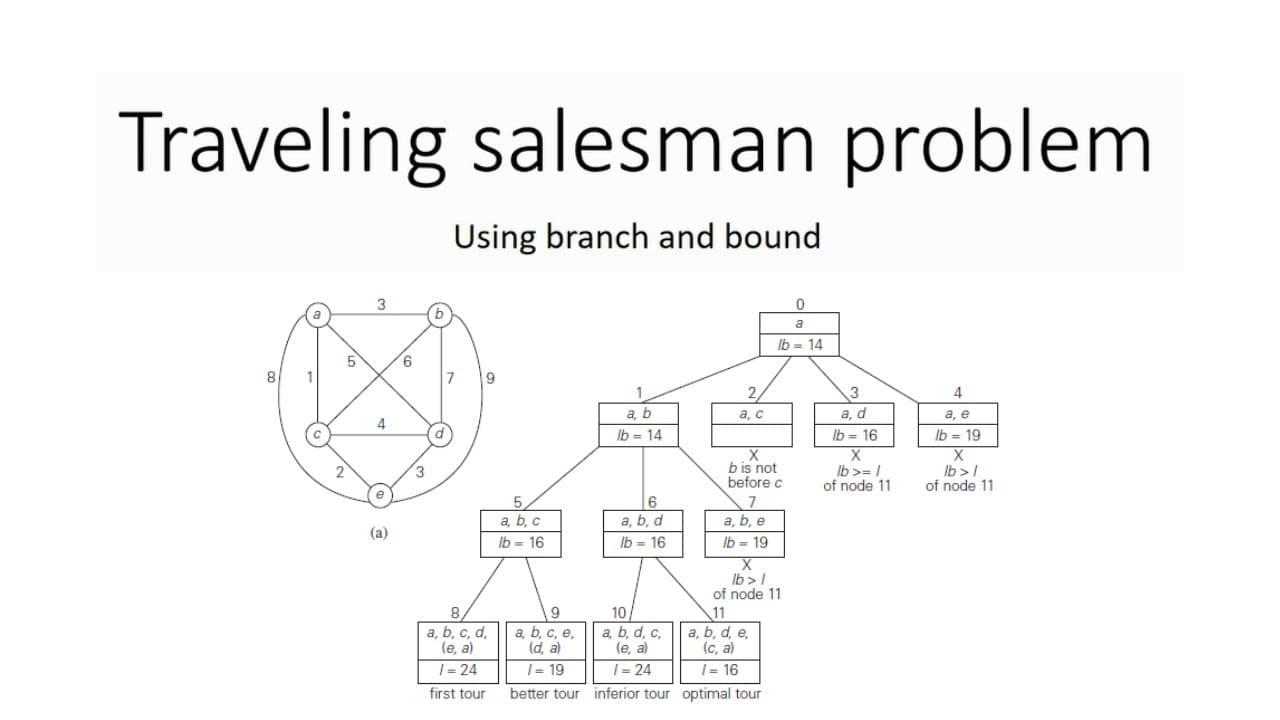
Branch and Bound: Systematically eliminates subpaths that exceed the current best distance.
Genetic Algorithms: Inspired by evolution, where "fittest" paths survive and combine to form new paths.
Although these methods require a deeper understanding of algorithms, students get introduced to them in advanced modules of a Python Programming Course in Noida.
Learning Outcome for Beginners
By writing code for the TSP, students accomplish multiple objectives:
Apply Python loops, conditionals, and functions.
Handle arrays and matrices effectively.
Understand permutation and combination concepts.
See firsthand how performance scales with input size.
Learn the art of balancing accuracy with efficiency.
TSP is not just about coding—it’s about learning to approach problems systematically. Once students understand brute-force and greedy approaches, they can gradually progress to recursion, backtracking, and eventually to advanced topics like heuristics and probabilistic methods.
Common Mistakes to Avoid
Assuming symmetry: Not all real-world distances are symmetrical. Be careful with one-way routes.
Missing return path: A complete TSP route must return to the start.
Overlooking edge cases:Try with two or three cities to see if your logic still works.
Confusing cities with paths: Use proper indices and keep your matrix well-structured.
Final Thoughts
The Travelling Salesman Problem is more than a problem—it’s a journey into the world of algorithmic thinking. It invites students to engage with a blend of math, logic, and computer science, helping them sharpen both their coding and analytical skills. For learners in aPython Programming Course in Noida, TSP serves as a meaningful milestone that ties together all the fundamental skills learned so far.
Starting with simple brute-force methods and advancing to optimized greedy solutions, the journey through TSP offers valuable lessons in thinking ahead, analyzing efficiency, and writing clean, logical code. And with Python as a companion, tackling even the most complicated routes becomes a little more accessible—and definitely more enjoyable.
So the next time you see a delivery guy speeding through the city or your map app magically laying out a perfect route, remember—it might just be the travelling salesman algorithm at work behind the scenes.