Ever have you at any point of time wondered how a normal delivery person just figures out the shortest route to often drop off all your various categories of Amazon packages? Or even know how to use Google Maps, which just decides one of the best orders to visit multiple places? Behind the scenes, there often lies a classic problem in all time computer science and also a mathematical model called the Travelling Salesman Problem (TSP).
In this blog, we will then break down all the TSP in the simplest way possible, with real-world practical examples, quite easy-to-understand logic, and also a great tour through one of the most common algorithms that are used to tackle it. Whether you’re just a student, a unique designer or developer, or even just have a curious mind, then get ready to crack that particular code behind all these interesting, fascinating puzzles
What Is the Travelling Salesman Problem?
Let’s start with the most engaging type of story.
Imagine that you're one of the salesmen who often needs to visit various cities to sell a particular product. You must then :
1. Visit each city by going once and only once.
2. Start as well as end at your home city.
3. Take one of the shortest possible routes to save both time and fuel.
Simple, isn't it right? Well, not at all, quite.
If you have alternatives of only 4 cities to visit, at that time you can manually find and list out all possible routes. But what if there are more cities, like 10, 20, or 100 cities? The number of all possible routes explodes into somewhat millions or even trillions!
This is the prime essence of the whole Travelling Salesman Problem (TSP) that often helps in finding some of the shortest possible paths that one can visit each city exactly once and later return to the starting point from which they were initially.
Why Is TSP So Famous?
The TSP is famous and renowned everywhere because:
It’s quite simple to state them, but on the other hand, incredibly hard to solve various complex problems for large numbers.
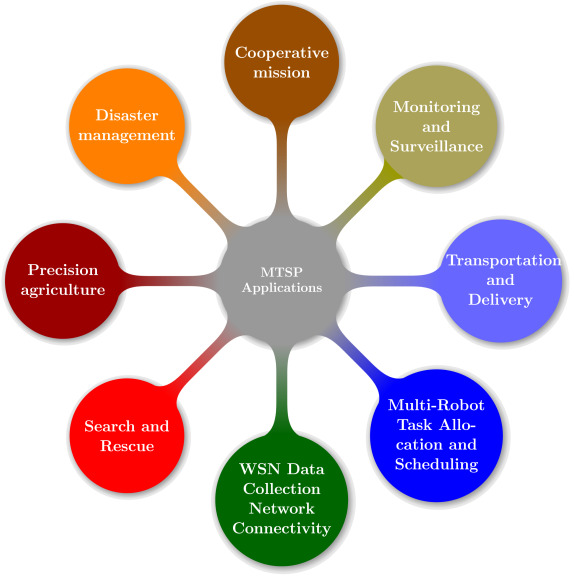
It has practical, real-life applications in areas like logistics, transportation, computer chip design, and even in the new area of DNA sequencing.
It belongs to one of the groups of problems whichthatjust known as NP-hard, meaning that there's no known type of algorithm that can solve it quickly for large types of inputs.
So, solving this kind of TSP efficiently is simply not just a geeky brain-teaser, but it has some set of real-world impact.
Real-Life Examples and Use Cases of TSP
Here are some of the interesting situations where TSP plays a crucial and high-priority role:
Courier services firms like FedEx or DHL are just planning for the optimal type of delivery routes.
Ride-sharing apps like Uber the known Uber determining one of the best pick-up and drop-off sequences that cannot be seen elsewhere.
Warehouse robots help in optimizing the best item collection paths.
Drone delivery systems that are just navigating through multiple types and varieties of drop zones.
Travel planning type of tools that often help tourists to visit multiple attractions in the shortest possible route.
Brute Force Approach: Why It Often Fails
The brute force type of approach to TSP is simply used to:
1. List all types of possible routes (called permutations).
2. Calculate later the distance of each one of them.
3. Choose the shortest possible route for your journey.
Let’s suppose you have n cities. Then the number of possible routes is:
(n-1)! / 2 (since we just consider circular paths and remove all the extra duplicates)
For just 10 cities, using this formula, 181,440 possible routes!
While this brute force often guarantees the correct answer, it also quickly becomes quite impractical due to both time and computational power requirements.
Smart Ways to Solve the Problem of TSP
Since this brute force doesn’t have a huge scale, scientists as well as engineers have now developed some smarter algorithms to solve the TSP more efficiently. Here are some of the most popular ones:
1. Dynamic type of Programming: Held-Karp Algorithm
The Held-Karp type of algorithm is one of the smart approaches often implemented using dynamic programming.
How It Works throughout:
Instead of recalculating all the same subpaths multiple times, you must implement a cycle that stores results and reuses them, ultimately saving time.
It uses a recursive category of formulas and also a table to track all the minimum distances for subsets of cities for sure.
Time Complexity features:
O(n^2 * 2^n)
That’s a huge and wide improvement in over factorial time, but still, they cannot fast enough for very large n.
Example:
If you have about 20 cities, then it’s still manageable on a modern type of computer using algorithm of Held-Karp algorithm.
2. Greedy Algorithm
This is one of the fastest yet approximate solution-driven algorithms.
How It Just Works:
Start from a particular city.
Later, at each step, you have to go to the nearest unvisited city.
Repeat all this until all cities are visited, and return to the starting point for ease.
Pros of this algorithm:
Super fast.l When you start using
Easy to implement also
Cons of this algorithm:
Doesn’t guarantee the shortest path.
Can even get “stuck” with a suboptimal route.
Use Cases:
Great when you just require a quick, decent solution and can’t even afford to wait for the perfect one to arrive
3. Genetic Algorithms (GA)
Inspired by the evolutionary and natural selection-driven, genetic algorithms are a powerful way to solve all complex problems.
How It Works:
Start with a sample population of random routes.
Evaluate them and see each route (based on the distance parameter).
Use some crossover and also mutation to create new generations.
Keeping the best routes and then repeating.
Pros:
Handles some of the large datasets well.
Find out about near-optimal solutions over time that will help you out.
Cons:
Slower than other greedy, but it is much better in terms of quality.
Doesn’t guarantee the perfect route.
Use Cases:
Used in the best AI-powered logistics and also in routing tools.
4. Ant Colony Optimization algorithm (ACO)
Inspired by some of the great real ants that are finding one of the shortest paths to food, ACO is a quite smart and also nature-inspired algorithm.
How It Just Works:
Simulated ants often explore different paths.
They leave behind a set of virtual pheromone trails.
Paths with more kinds of pheromones are more likely to be chosen.
Over time, this best path emerges a lot.
Pros:
Works quite and very well for complex types of graphs.
Continuously improves over time.
Cons:
Needs a set of tuning parameters.
Computationally, it's quite heavier than greedy.
Use Cases:
Used in some best supply chain optimization, robot path planning, and also in network routing.
5. Branch and Bound
The smartest way to prune all the unnecessary paths.
How It Works:
Builds a type of tree for all possible paths.
“Bounds” are often set based on some current shortest paths.
If a path just can't beat the best one so far, it’s always the cutoff that is followed.
Pros:
Helps in finding the exact solution.
Smarter than some of the brute force.
Cons:
Still quite slow for a large set of n.
Memory-intensive features .
Visualizing the algorithm of TSP
Imagine about 10 dots on a map, where each one represents a city. A path that connects all the dots without even lifting your pen, returning to the starting dot later, and covering the least distance.
A good TSP draws the path like a master artist, which is smooth, efficient, and beautiful in logic.
TSP in Python programming language: Simple Code Example
Let’s see a Greedy TSP implementation in Python:
                 import math

                def distance(p1, p2):
                    return math.sqrt((p1[0] - p2[0])**2 + (p1[1] - p2[1])**2)

                def greedy_tsp(points):
                    n = len(points)
                    visited = [False] * n
                    path = [0]
                    visited[0] = True
                    total_distance = 0

                    for _ in range(n - 1):
                        last = path[-1]
                        nearest = None
                        min_dist = float('inf')
                        for i in range(n):
                            if not visited[i]:
                                dist = distance(points[last], points[i])
                                if dist < min_dist:
                                    min_dist = dist
                                    nearest = i
                        path.append(nearest)
                        visited[nearest] = True
                        total_distance += min_dist

                    total_distance += distance(points[path[-1]], points[0])  # Return to start
                    path.append(0)

                    return path, total_distance
                    # Sample points
                    cities = [(0,0), (1,5), (5,2), (6,6), (8,3)]
                    route, dist = greedy_tsp(cities)
                    print("Route:", route)
                    print("Distance:", round(dist, 2)
Conclusion
The Travelling Salesman Problem isn’t just often a mathematical curiosity, and it’s also a quite powerful model that will impact how the modern world moves, delivers, and also how other types operate. While there's no kind of approach that one-size-fits-all solution, understanding all different approaches will help us appreciate the right balance between speed and accuracy.