Types of Graph in Data Structures: Directed, Undirected, Weighted &
More
-
Pradyumn Singh / 3 days ago
- 13
- 14 min read
This article breaks down the major types of graphs used in data structures, their
definitions, key features, and real-world applications.
What is a Graph in Data Structures?
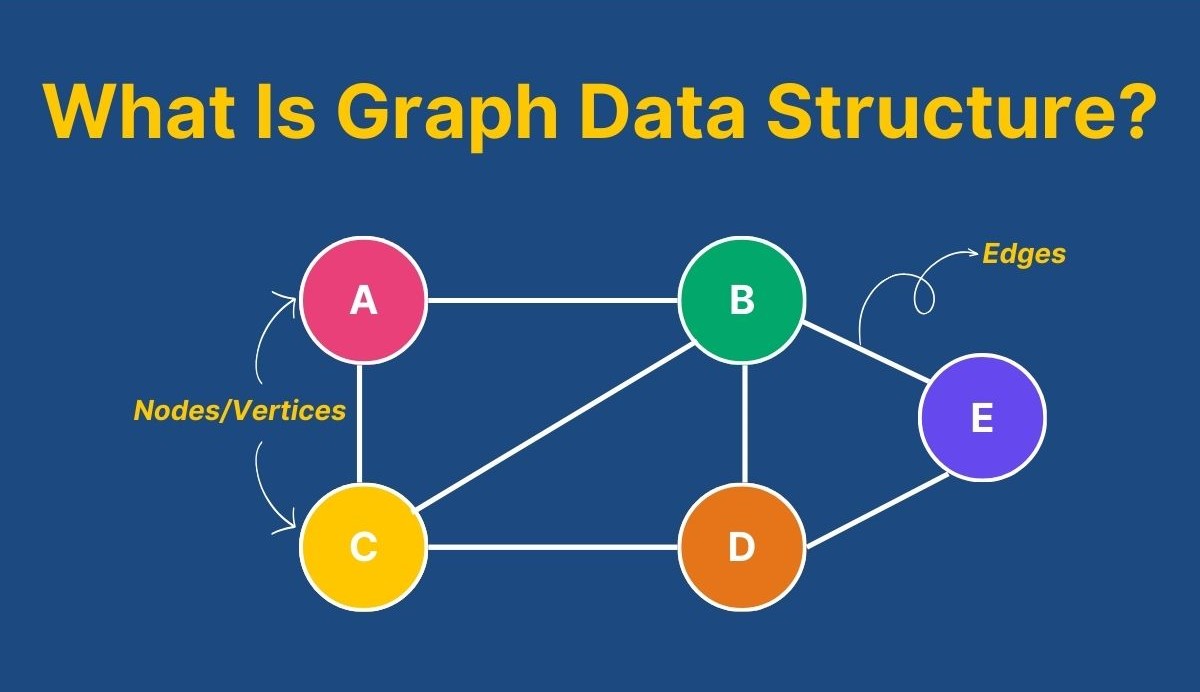
A graph is a non-linear data structure that consists of two main components:
- Vertices (or Nodes): The entities or points.
- Edges (or Links): The connections between the nodes.
In technical terms, a graph G is defined as G = (V, E), where:
- V is a set of vertices
- E is a set of edges connecting the vertices
Importance of Graphs in a Data Science Course
Graphs are vital for tasks such as:
- Finding shortest paths (e.g., GPS navigation)
- Modeling social networks
- Detecting fraud in transactions
- Recommending systems (like on Netflix or Amazon)
- Analyzing connections in Big Data
That’s why a good Data Science Course will always cover graphs in detail,
especially when diving into algorithms and network analysis.
Types of Graph in Data Structure
Let’s explore the major types one by one.
1. Directed Graph (Digraph)
A directed graph is one where edges have a direction, from one node to another.
- Example: In a social network, a “follower” relationship
on Twitter is directional: if A follows B, it doesn’t mean B follows A.
- Each edge has a direction.
- Represented as ordered pairs (u, v), meaning an edge from u to v.
Applications:
- Web page linking
- Workflow systems
- Representing state transitions in automation
2. Undirected Graph
In an undirected graph, the edges have no direction, the connection is mutual.
- Example: On Facebook, if two people are friends, the
connection is bidirectional.
- Represented as unordered pairs (u, v)
- If there is an edge between A and B, it implies A is connected to B and
vice versa.
Applications:
- Modeling undirected relationships like friendships or road maps
- Computer networks
- Biology (protein interaction networks)
3. Weighted Graph
A weighted graph assigns a weight (or cost) to each edge. These weights can
represent distance, time, or cost.
- Example: In Google Maps, roads between cities have
weights depending on distance or traffic.
- Edges have numerical values.
- Can be directed or undirected.
Applications:
- Shortest path algorithms (Dijkstra’s, Bellman-Ford)
- Network optimization
- Logistics and delivery routing
4. Unweighted Graph
As the name suggests, unweighted graphs do not have any weights on their edges.
- Example: A friendship graph where you only care about
who is friends with whom, not the "strength" of the friendship.
- All edges are considered equal.
- Simpler and easier to process.
Applications:
- Social media graphs
- Basic topological modeling
- Hierarchical relationships
5. Cyclic Graph
A cyclic graph contains at least one cycle, a path where the first and last node
are the same.
- Example: A city loop route in public transport.
- Cycles may cause infinite loops in some algorithms.
- Useful in understanding feedback systems.
Applications:
- Operating systems (deadlock detection)
- Electrical circuits
- Scheduling and dependency graphs
6. Acyclic Graph
An acyclic graph does not contain any cycles. When directed, it's known as a
Directed Acyclic Graph (DAG).
- Example: A task scheduling system where some tasks must
be completed before others.
- No cycles
- Topological sorting is possible
Applications:
- Compiler design
- Task scheduling
- Git version control
7. Connected Graph
In a connected graph, there is a path between every pair of vertices. You can
reach any node from any other node.
- Applicable only to undirected graphs.
- Single component
Applications:
- Mapping networks
- Infrastructure design
8. Disconnected Graph
A disconnected graph has at least one pair of vertices that do not have a path
between them.
Applications:
- Clustering data
- Community detection in social networks
9. Complete Graph
A complete graph is one in which every vertex is connected to every other vertex.
- Example: A network where every computer is directly
connected to every other.
Applications:
- Network simulations
- Theoretical computer science
10. Sparse and Dense Graphs
A sparse graph has relatively few edges. A dense graph has many edges, close to
the maximum possible.
Applications:
- Sparse: Road maps, social networks
- Dense: Telecommunication networks, simulations
Graph Representations in Data Structures
There are two main ways to represent graphs in computer programs:
- Adjacency Matrix: A 2D array where the element at (i, j) is 1 (or the
weight) if there's an edge from i to j.
- Adjacency List: Each node has a list of connected nodes.
In a Data Science Course, you’ll learn which representation to use depending on
whether the graph is sparse or dense.
Graph Algorithms You’ll Learn in a Data Science Course
Graphs are not just about structure but also about computation. Some important
algorithms include:
- DFS (Depth First Search): For traversing or searching tree/graph
structures.
- BFS (Breadth First Search): For shortest path in unweighted graphs.
- Dijkstra’s Algorithm: For finding the shortest path in weighted graphs.
- Bellman-Ford Algorithm: Works with graphs with negative weights.
- Kruskal’s & Prim’s Algorithm: For minimum spanning tree.
- Topological Sorting: For DAGs.
Real-World Applications of Graphs
Here's how graphs are used in actual industries, reinforcing the importance of
understanding them in a Data Science Course:
- Social Media: Friend suggestions, influencer ranking
- E-commerce: Product recommendation engine
- Transportation: Route planning, traffic forecasting
- Healthcare: Disease transmission network
- Cybersecurity: Threat detection and risk analysis
- Banking: Fraud detection in transaction networks
Importance of Choosing the Right Graph Type
The success of many data science tasks depends on choosing the right type of
graph structure. For example, using a directed graph in a recommendation system allows us to
represent influence or following relationships (like user-to-product or user-to-user
interactions), while weighted graphs are crucial for cost-sensitive problems such as finding the
most efficient delivery route.
When building models or running analytics, graph selection isn’t just
theoretical, it affects performance, scalability, and even model accuracy. For instance, a
sparse graph with millions of nodes and only a few edges can still reveal key community
structures in social networks, while a dense graph might be needed for detailed simulations in
high-speed networks or biological systems.
Graph Databases and Data Science
In modern data science applications, especially in handling Big Data, traditional
relational databases often fall short when dealing with highly interconnected data. This is
where graph databases like Neo4j, Amazon Neptune, or TigerGraph come into play. These databases
are optimized to store graph structures and run graph algorithms efficiently.
Graph databases allow for:
- Real-time relationship queries
- Deep link analytics (e.g., multi-hop recommendations)
- Fraud pattern recognition
- Knowledge graph construction for NLP models
Advanced Concepts: Hypergraphs and Multigraphs
Beyond basic graph types, advanced structures are also used in specialized
applications:
- Multigraph: A graph that allows multiple edges between the same pair of
vertices. Useful in transport networks where multiple routes can connect two cities.
- Hypergraph: A generalization where an edge can connect more than two
vertices. This is useful in modeling group interactions, such as in group chats or
co-authorship in academic papers.
Integration with Machine Learning
Graphs are playing an increasingly important role in modern machine learning:
- Graph Neural Networks (GNNs): These are neural networks that operate
directly on graph structures. They're used in chemistry (for predicting molecule
properties), social networks (for influence detection), and recommendation engines.
- Graph-based Clustering: Algorithms like Spectral Clustering rely on graph
Laplacians to group similar items commonly used in unsupervised learning.
- Feature Engineering: Graph metrics like PageRank, centrality, and
clustering coefficients are used to enrich datasets for supervised learning tasks.
FAQs: Types of Graphs in Data Structures
- Q1. What is a graph in data structures? A graph is a
collection of nodes (vertices) connected by edges. It models relationships between objects.
- Q2. What is a directed graph? Edges have a direction,
showing a one-way relationship from one node to another.
- Q3. What is an undirected graph? Edges have no
direction, meaning connections between nodes are two-way or mutual.
- Q4. What is a weighted graph? Edges carry weights or
values, representing costs, distances, or capacities between nodes.
- Q5. What is an unweighted graph? Edges have no weights;
all connections are equal.
- Q6. What is a cyclic graph? A graph containing at least
one cycle, meaning you can start at a node and return to it.
Conclusion
Graphs are an essential part of the data science toolbox. Knowing the different
types of graphs in data structure like directed, undirected, weighted, and others, allows data
scientists to model and solve real-world problems more effectively. A well-structured Data
Science Course not only teaches these graph types but also applies them in algorithms and
practical scenarios. As data grows more interconnected, mastering graph data structures will be
increasingly valuable for anyone pursuing a future in technology, analytics, or research.