Okay, so inheritance is super important in object-oriented programming (OOP). It's like
one of the main ideas, along with those other concepts like encapsulation and polymorphism. Basically,
in Java, it lets you create new classes that automatically get all the good stuff (fields and methods)
from classes that already exist. This makes your code way easier to reuse, keeps things organized, and
makes your whole project easier to manage.
If you're learning Java, getting ready for job interviews, or building big apps,
you just gotta understand how inheritance works.
The Java training course at Uncodemy really focuses on getting inheritance down. They'll
explain the ideas and also get you coding to understand how it actually works. This guide will
show you what inheritance is, why it's important, the different kinds of inheritance in Java
(with examples), when to use it, how to use it right, where it falls short, some more
complicated stuff, and even some common interview questions.
What Is Inheritance in Java?
Okay, so inheritance is basically when you create a new class (think of it as a
child class) that automatically gets all the good stuff – properties and actions – from another
class (its parent). The child class gets all the public and protected things from its parent,
but it can also add its own unique stuff or change how the inherited things work.
Here’s an example: A “Car” class can extend a more general “Vehicle” class,
inheriting fuel and speed fields, while adding features like air conditioning or specific engine
types.
Benefits:
Promotes code reuse
Simplifies maintenance and debugging
Enables polymorphic programming
Reflects real-world hierarchical relationships
Encourages extension rather than modification
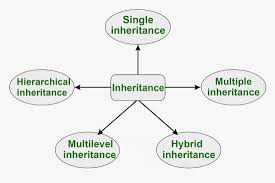
Types of Inheritance in Java
Java supports several major types of inheritance:
Single Inheritance
Multilevel Inheritance
Hierarchical Inheritance
Hybrid Inheritance (through interfaces)
Multiple Inheritance (only via interfaces; not with classes)
Let’s explore each in detail.
1. Single Inheritance
What It Is:
A subclass inherits directly from a single superclass.
Diagram:
                            text
                             Animal
                                |
                               Dog
Example: If you define a “Dog” class as a subclass of “Animal,” all public and
protected members of “Animal” become available to “Dog,” except constructors.
Key Point: This is the simplest and most common form of inheritance in Java,
mirroring straightforward “is-a” relationships.
2. Multilevel Inheritance
What It Is:
A subclass inherits from another subclass, creating a “chain” of inheritance.
Diagram:
                    text
                    Vehicle
                        |
                        Car
                        |
                    ElectricCar
Example:
“Car” inherits from “Vehicle”
“ElectricCar” inherits from “Car”
Thus, “ElectricCar” inherits both its own methods and all those from
“Car” and “Vehicle”
Key Point: Multilevel inheritance enables progressive generalization—adding
features and specializations layer by layer.
3. Hierarchical Inheritance
What It Is:
Multiple subclasses inherit from the same superclass (siblings).
Diagram:
                    text
                        Animal
                        /   |   \
                    Dog  Cat  Cow
Example:
Both “Dog,” “Cat,” and “Cow” inherit from “Animal.”
They share “Animal”’s fields/method,s but can have their own unique
behaviors
Key Point: Useful for modeling “family trees” where all subclasses share a common
set of features but each adds its own.
4. Multiple Inheritance (Supported via Interfaces)
What It Is:
A subclass inherits behaviors from more than one class or interface.
Key Note:
Java does not support multiple inheritance of state/implementation from multiple
classes (to avoid ambiguity, known as the “diamond problem”).
However, Java supports multiple inheritance of methods/behavior via interfaces.
Diagram (via Interfaces):
                            text
                    Flyable    Swimmable
                        \       /
                            Bat
Example (Conceptual):
“Bat” can “implement” both “Flyable” and “Swimmable” interfaces,
inheriting all their abstract method signatures.
Bat must provide its own code (“implementation”) for both.
Key Point: Multiple interfaces can be implemented by any class, combining diverse
behaviors safely.
5. Hybrid Inheritance (Combination, via Interfaces)
What It Is:
Any combination of two or more types of inheritance, made possible with
interfaces.
Diagram:
                    text
                Person         CanDrive
                    |          /
                Driver------/
Example (Conceptual):
“Driver” inherits characteristics from “Person” (hierarchical), but also
implements “CanDrive” (multiple inheritance of behavior).
This pattern solves complex design needs found in large systems.
Code Sample Summaries for Each Type
To illustrate further, let’s outline conceptual code snippets for each type.
(This is only descriptive to avoid code overload.)
Single Inheritance Example
“Student” class extends “Person” class.
Person defines name and age.
Student inherits these fields and adds roll number, study method, etc.
Multilevel Inheritance Example
“SportsCar” extends “Car”, which extends “Vehicle”.
Vehicle: fields for speed, fuel
Car: adds model, manufacturer
SportsCar: adds turbo mode, racing features
Hierarchical Inheritance Example
“Manager”, “Engineer”, and “Intern” all extend “Employee”.
All share base salary, employee ID, etc.
Each adds its own departmental or role-specific fields/methods.
Multiple Inheritance via Interface Example
“Printer” implements both “Printable” and “Scannable” interfaces.
Interfaces define contract: what methods must exist, but not how they
work.
“Printer” must provide a body for both print and scan methods.
Limitations and Important Rules in Java Inheritance
Okay, here's a more human-sounding take on those points:
No Multi-Class Inheritance: This stops the diamond problem, which means cleaner
code with fewer bugs. Use interfaces if you want several behaviors.
Constructors: If you're building a subclass you *have* to call the constructor of
superclass specifically.
Private Stuff Stays Private: Only public and protected stuff gets passed down.
Private bits are only for the class they're made in.
Static Belongs to the Class Itself: Static properties and methods link to the
entire class not its parts, therefore aren't passed to anything else normally.
Real-World Use Cases
Think about it:
Company Software: You've got your HR systems, right? Different employee types all
come from the main Employee thing.
Bank Stuff: Different accounts like savings, checking, investment – they all come
from a basic account thing.
Online Stores: Products, downloads, services – they're all based on a main
Product thing.
Games: All the characters use a GameObject and are split into players, enemies,
and items.
Our Java course at Uncodemy uses exercises like these to make sure you get how
inheritance works through real examples. You won't just learn the theory.
Best Practices with Inheritance in Java
Favor composition over inheritance for code flexibility (design
principle: "has-a" instead of always "is-a").
Use inheritance to model true “is-a” relationships—never extend just for
code sharing.
Keep hierarchies shallow—deep chains become hard to maintain.
Override methods with @Override annotation for clarity and safety.
Use interfaces for common behaviors across unrelated classes.
Restrict inheritance with the final keyword if a class should not be
subclassed.
Types of Inheritance in Java
Type
Supported in Java?
How Achieved
Real-World Example
Single
Yes
Subclass extends one superclass
Dog extends Animal
Multilevel
Yes
Multi-level extend
ElectricCar extends Car extends Vehicle
Hierarchical
Yes
One superclass, multiple subclasses
Manager, Engineer, Intern extend Employee
Multiple
No (with classes), Yes (with interfaces)
Implements multiple interfaces
Printer implements Printable, Scannable
Hybrid
Yes (with interfaces)
A combination of the above
Driver extends Person, implements CanDrive
Common Pitfalls and Their Solutions
Pitfall
How to Avoid/Remedy
Deep/complicated hierarchies
Design for clarity and flatten when possible
Using inheritance solely for code reuse
Prefer composition; use inheritance for logical “is-a” relationships
Not using super() properly
Always call the superclass constructor as needed
Forgetting to override
Use @Override to avoid typos and bugs
Inheriting private members by accident
Remember: private members stay within the parent class
Conclusion
In Java, inheritance is more than just code; it's a way of thinking to build
strong, scalable, and well-organized software. Understand the types: single, multilevel,
hierarchical, multiple (using interfaces), and hybrid. With real examples and projects (like in
Uncodemy’s Java course), you can create code that makes sense, just like the real world.
Use inheritance to cut down on repeated code, make things clear, and use flexible
composition when it fits. Always design for what you need now and what you might need later.
With these skills, you’ll be able to build and keep up Java applications that last.
Frequently Asked Questions (FAQs)
Q1: Why does Java allow multiple inheritance through interfaces, not
classes?
To avoid ambiguity—the “diamond problem”—which arises if two superclasses define
the same method or field. Interfaces solve this by only providing method signatures, not state
or method bodies (except default methods since Java 8, but these are also well-resolved with
hierarchy rules).
Q2: How does method overriding differ from method overloading?
Overriding: Subclass provides its own implementation of a superclass method (same
signature).
Overloading: Same method name in the same class, but different parameter lists.
Q3: Can a subclass inherit constructors?
No. Constructors are not inherited, but you can call a superclass constructor
using super().
Q4: What is the “diamond problem”?
Ambiguity when multiple parent classes (if allowed) define a method or state with
the same name—Java eliminates this by not supporting multiple class-based inheritance.
Q5: How does Uncodemy’s Java programming course teach
inheritance?
Students learn through hands-on projects, scenario-based challenges, and live
coding sessions, practicing all inheritance types using real business cases and design
patterns—preparing for both technical interviews and scalable software development.